
Context:
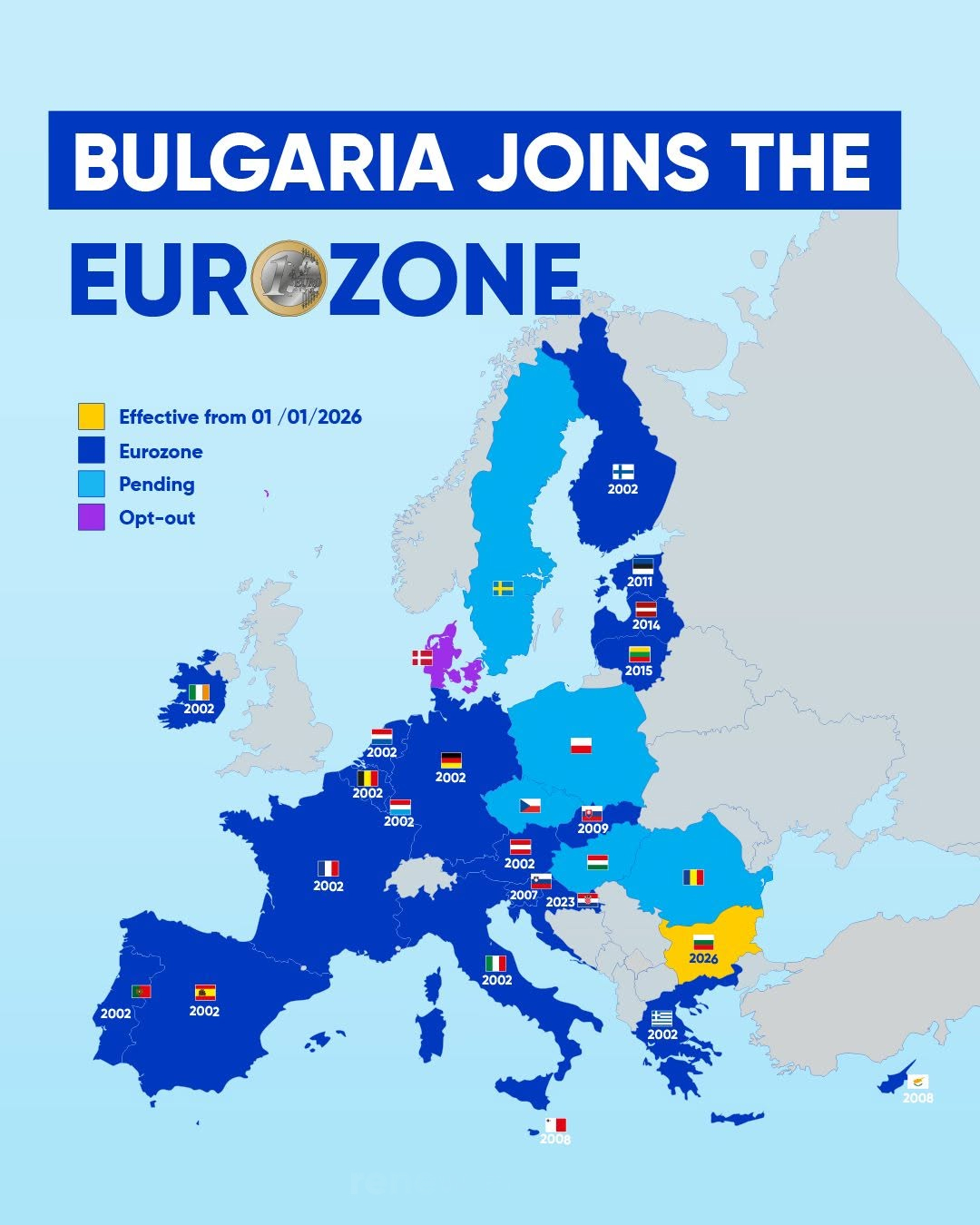
Recently, on January 1, 2026, Bulgaria officially joined the Eurozone, becoming the 21st member of the European Union (EU) to adopt the euro.
About the Eurozone:
-
-
- The Maastricht Treaty of 1992 established the European Union and laid the foundation for:
- The Maastricht Treaty of 1992 established the European Union and laid the foundation for:
-
1. The European Economic and Monetary Union (EMU)
2. Adoption of a common currency, the euro
3. Creation of a unified central banking system, the European Central Bank (ECB)
4. Formation of a common economic region
-
-
- The eurozone refers to EU member states that have fully adopted the euro as their official currency.
- Out of 27 EU members, 21 now use the euro, while the remaining six retain their national currencies.
- The eurozone refers to EU member states that have fully adopted the euro as their official currency.
-
Other territories using the euro:
-
-
- Microstates such as Andorra, Monaco, Vatican City, and San Marino (through formal agreements).
- Kosovo and Montenegro, which use the euro unilaterally despite not being EU members.
- Microstates such as Andorra, Monaco, Vatican City, and San Marino (through formal agreements).
-
Why Do Countries Join Eurozone?
Economic Benefits:
1. Price transparency: Enables consumers to compare prices across member states, enhancing competition.
2. Ease of transactions: Simplifies cross-border trade and investment.
3. Price stability: The ECB targets inflation close to 2%, helping stabilise domestic markets.
4. Lower interest rates: A common monetary policy can reduce borrowing costs.
5. Elimination of currency exchange costs: Facilitates trade, travel, and tourism.
6. Insulation from external shocks: Membership in a large currency bloc provides economic resilience.
Strategic and Socio-Economic Benefits:
· Access to a single market with free movement of labour, goods, services, and capital.
· Tourism boost: Adoption of the euro simplifies travel and spending.
· Symbolic value: As the world’s second-largest reserve currency, the euro reinforces European identity and integration.
Eligibility for Eurozone Membership:
-
-
- All EU members are required to adopt the euro, except Denmark, which has a formal opt-out.
- Countries must meet the convergence criteria, including:
- All EU members are required to adopt the euro, except Denmark, which has a formal opt-out.
-
1. Economic alignment with eurozone members (inflation, public debt, fiscal deficit, and interest rates).
2. Legal and institutional alignment, particularly central bank independence.
3. Social, political, and economic readiness to ensure smooth integration.
-
-
- Bulgaria implemented legal and policy reforms to meet these requirements.
- Bulgaria implemented legal and policy reforms to meet these requirements.
-
Transition plan:
-
-
- From January 1, 2026, transactions are permitted in both the Bulgarian lev and the euro.
- From February 1, 2026, the euro becomes the sole legal tender.
- From January 1, 2026, transactions are permitted in both the Bulgarian lev and the euro.
-
Implications for Bulgaria and the EU:
Economic
· Improved access to eurozone markets, capital, and investment.
· Greater economic stability and lower transaction costs.
· Boost to tourism and cross-border commerce.
Political and Strategic
· Strengthens Bulgaria’s integration into the European Union.
· Reduces potential economic leverage historically exercised by Russia through currency and trade links.
Risks
· Domestic political opposition and cultural ties with Russia may generate internal friction.
· Possible short-term inflationary pressures during the transition from the lev to the euro.
Conclusion:
Bulgaria’s adoption of the euro represents a major milestone in EU integration. While it promises economic stability, price transparency, and enhanced regional influence, it also tests domestic political consensus and geopolitical sensitivities. Bulgaria’s experience reflects the broader challenges of euro adoption in politically complex and economically diverse countries.



