
Context:
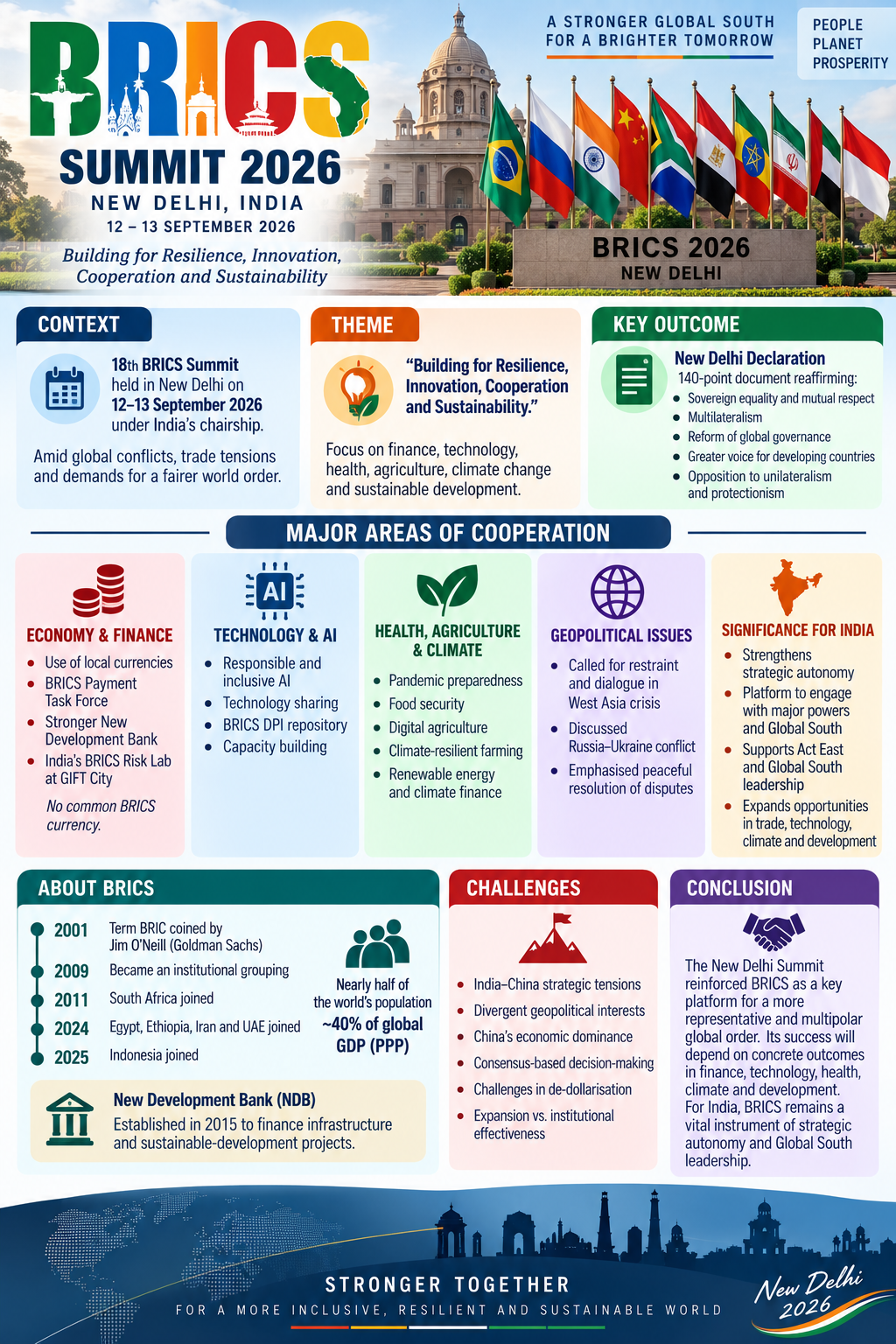
The 18th BRICS Summit was held in New Delhi on 12–13 September 2026 under India’s chairship. The summit was significant amid geopolitical conflicts, trade tensions, economic fragmentation and growing demands for reform of global governance. India’s presidency focused on making BRICS more practical, inclusive and development-oriented.
Theme:
India chaired BRICS under the theme “Building for Resilience, Innovation, Cooperation and Sustainability.” The agenda focused on strengthening cooperation in finance, technology, health, agriculture, climate change and sustainable development.
New Delhi Declaration:
The summit adopted the New Delhi Declaration, a comprehensive 140-point document. It reaffirmed commitment to:
-
-
-
- Sovereign equality and mutual respect
- Multilateralism and peaceful dispute resolution
- Reform of global governance institutions
- Greater representation of developing countries
- Opposition to unilateralism and protectionism
- Sovereign equality and mutual respect
-
-
Geopolitical Issues:
-
-
-
- The West Asia crisis was a major challenge for BRICS diplomacy. Members called for restraint, dialogue and diplomacy. The grouping also discussed the Russia–Ukraine conflict, global security and the need for peaceful resolution of disputes.
- The summit demonstrated BRICS' importance as a platform for dialogue among countries with different geopolitical interests.
- The West Asia crisis was a major challenge for BRICS diplomacy. Members called for restraint, dialogue and diplomacy. The grouping also discussed the Russia–Ukraine conflict, global security and the need for peaceful resolution of disputes.
-
-
Economic and Financial Cooperation:
BRICS continued efforts to reduce excessive dependence on the US dollar through:
-
-
-
- Greater use of local currencies
- Cross-border payment cooperation
- Strengthening the BRICS Payment Task Force
- Expanding the role of the New Development Bank
- Greater use of local currencies
-
-
India also promoted a BRICS Risk Lab at GIFT City and discussions on a New Investment Platform.
Importantly, the summit did not create a common BRICS currency.
Technology and AI:
-
-
-
- Technology emerged as a major area of cooperation. BRICS supported responsible and inclusive Artificial Intelligence, technology sharing and capacity building.
- India promoted cooperation in Digital Public Infrastructure (DPI), including a BRICS DPI repository. Cooperation in AI can help reduce the technological divide between developed and developing countries.
- Technology emerged as a major area of cooperation. BRICS supported responsible and inclusive Artificial Intelligence, technology sharing and capacity building.
-
-
Health, Agriculture and Climate:
The summit promoted cooperation in:
-
-
-
- Pandemic preparedness
- Infectious-disease surveillance
- Traditional medicine
- Digital agriculture
- Climate-resilient farming
- Food security
- Renewable energy and climate finance
- Pandemic preparedness
-
-
Significance for India:
BRICS strengthens India's strategic autonomy and provides a platform to engage simultaneously with China, Russia, Gulf countries, Africa and Latin America. It also supports India's ambition to become a leading voice of the Global South.
Challenges:
BRICS faces several challenges:
1. India–China strategic tensions
2. Divergent geopolitical interests
3. China's economic dominance
4. Difficulty of consensus-based decision-making
5. Challenges in de-dollarisation
6. Expansion versus institutional effectiveness
About BRICS:
-
-
-
- BRICS originated as BRIC, a term coined by Goldman Sachs economist Jim O’Neill in 2001 for Brazil, Russia, India and China. It became an institutional grouping in 2009, with South Africa joining in 2010. Egypt, Ethiopia, Iran and UAE joined in 2024, followed by Indonesia in 2025.
- BRICS promotes economic cooperation, trade, development and global governance reform. The New Development Bank (NDB), established in 2015, finances infrastructure and sustainable-development projects. BRICS represents nearly half of the world’s population and around 40% of global GDP (PPP), making it an important Global South platform.
- BRICS originated as BRIC, a term coined by Goldman Sachs economist Jim O’Neill in 2001 for Brazil, Russia, India and China. It became an institutional grouping in 2009, with South Africa joining in 2010. Egypt, Ethiopia, Iran and UAE joined in 2024, followed by Indonesia in 2025.
-
-
Conclusion:
The 2026 New Delhi Summit reinforced BRICS as an important platform for a more representative and multipolar global order. Its future relevance will depend on converting declarations into concrete outcomes in finance, technology, health, climate and development. For India, BRICS remains an important instrument of strategic autonomy, Global South leadership and multilateral reform.



