
Bio-Bitumen Technology
Context:
Recently, the Ministry of Science and Technology has transferred the indigenous ‘Bio-Bitumen’ technology developed by the Council of Scientific and Industrial Research (CSIR) to private companies for commercial production. This step is considered a revolutionary milestone towards India’s ‘Net Zero’ target and the Atmanirbhar Bharat initiative.
What is Bio-Bitumen?
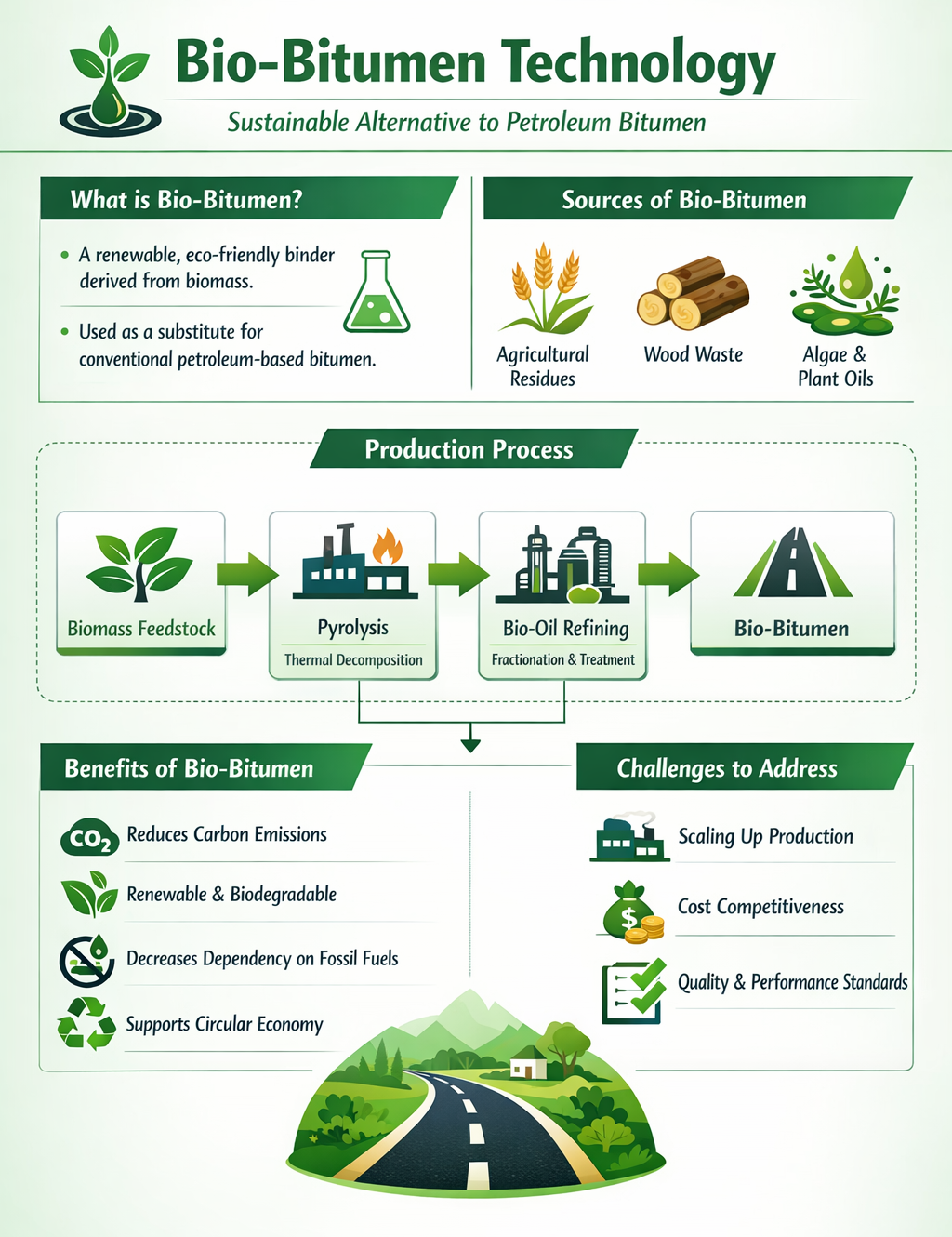
Bitumen is traditionally a by-product obtained from crude oil refining and is used as a ‘binder’ in road construction. In contrast, bio-bitumen is a sustainable alternative prepared from agricultural waste, particularly paddy stubble and other biomass. It has been jointly developed by CSIR-Indian Institute of Petroleum (CSIR-IIP) and CSIR-Central Road Research Institute (CSIR-CRRI).
Significance and Benefits of the Technology:
-
-
- Environmental Solution (Prevention of Stubble Burning): During winters in North India, burning of paddy stubble is a major cause of air pollution. Bio-bitumen technology converts stubble into a valuable resource, encouraging farmers to sell it instead of burning it.
- Economic Savings and Self-Reliance: India currently imports a significant portion of its bitumen requirements. The widespread adoption of this technology is estimated to save around ₹40,000 crore annually in foreign exchange, making the country more self-reliant in the energy and infrastructure sectors.
- Waste to Wealth: This is an ideal example of a ‘Circular Economy.’ It not only manages waste but also creates new sources of revenue in the rural economy, thereby increasing farmers’ income. It can be a game-changer particularly for states like Punjab, Haryana, and western Uttar Pradesh.
- Sustainable Infrastructure: Tests have shown that the quality and strength of bio-bitumen are comparable to petroleum-based bitumen. The Ministry of Road Transport and Highways (MoRTH) has already initiated the process of including it in road construction standards.
- Environmental Solution (Prevention of Stubble Burning): During winters in North India, burning of paddy stubble is a major cause of air pollution. Bio-bitumen technology converts stubble into a valuable resource, encouraging farmers to sell it instead of burning it.
-
Government Initiatives and Strategy:
This project is aligned with several major missions of the Government of India:
-
-
- National Bio-Energy Mission: Promoting the use of biofuels.
- SATAT Initiative: Providing sustainable alternatives for affordable transport.
- Net Zero Target 2070: India’s global commitment to reducing carbon emissions.
- National Bio-Energy Mission: Promoting the use of biofuels.
-
Challenges:
-
-
- Supply Chain: A robust logistics network is required for the collection, storage, and processing of agricultural waste.
- Commercial Viability: Adequate incentives and subsidies are needed to encourage private sector adoption of this technology.
- Standardization: Continuous monitoring is required to ensure the long-term stability of bio-bitumen under different climatic conditions.
- Supply Chain: A robust logistics network is required for the collection, storage, and processing of agricultural waste.
-
Conclusion:
The transfer of bio-bitumen technology is not just a scientific achievement but also a tool for socio-economic transformation. If implemented effectively, it can become a milestone in making India’s roads greener while balancing environmental protection and energy security. This initiative transforms the ‘stubble problem’ into an ‘economic opportunity,’ steering India towards a green, self-reliant, and sustainable development model.



