
BHAVYA Scheme: Features, Benefits & Impact on India’s Manufacturing
Context:
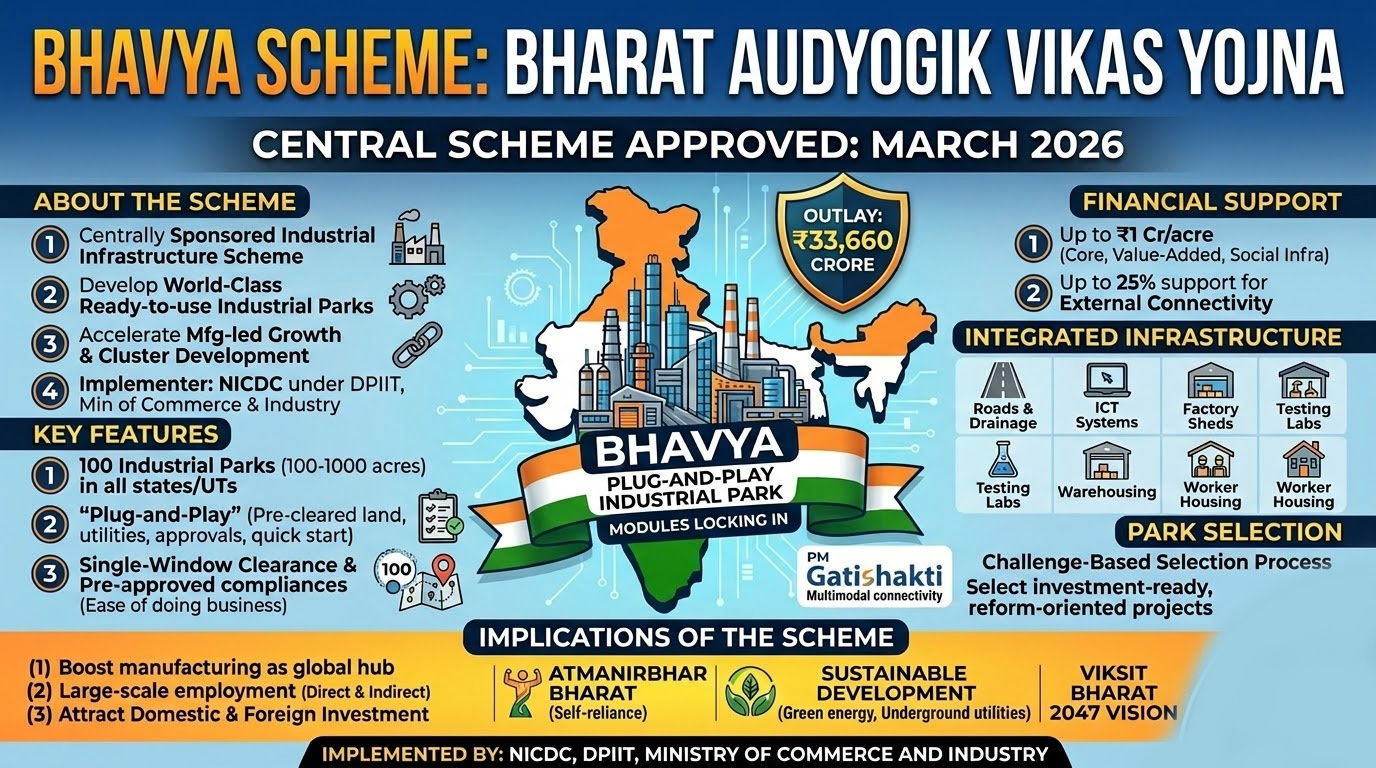
Recently, The Union Cabinet in March 2026 approved the Bharat Audyogik Vikas Yojna (BHAVYA) with an outlay of ₹33,660 crore. BHAVYA scheme aims to establish 100 plug-and-play industrial parks across India to boost manufacturing, improve investment climate, and enhance ease of doing business.
About the BHAVYA Scheme:
-
-
- Bharat Audyogik Vikas Yojna (BHAVYA) is a centrally sponsored industrial infrastructure scheme designed to develop world-class industrial parks with ready-to-use facilities. It is implemented by the National Industrial Corridor Development Corporation under the Department for Promotion of Industry and Internal Trade (DPIIT), Ministry of Commerce and Industry.
- The scheme focuses on accelerating manufacturing-led growth, promoting cluster-based development, and strengthening domestic supply chains by providing pre-approved infrastructure and reducing procedural delays.
- Bharat Audyogik Vikas Yojna (BHAVYA) is a centrally sponsored industrial infrastructure scheme designed to develop world-class industrial parks with ready-to-use facilities. It is implemented by the National Industrial Corridor Development Corporation under the Department for Promotion of Industry and Internal Trade (DPIIT), Ministry of Commerce and Industry.
-
Key Features of BHAVYA scheme:
-
-
- BHAVYA scheme emphasizes plug-and-play infrastructure where land, utilities and approvals are pre-cleared, enabling industries to start operations quickly.
- It proposes the development of 100 industrial parks ranging from 100 to 1000 acres across all states and union territories. Financial assistance includes up to ₹1 crore per acre for core, value-added, and social infrastructure, along with up to 25% support for external connectivity. The parks will have integrated infrastructure including roads, drainage, ICT systems, factory sheds, testing labs, warehousing, and worker housing.
- It also promotes ease of doing business through single-window clearance systems and pre-approved compliances. A challenge-based selection process ensures that only investment-ready and reform-oriented projects are chosen. Additionally, the scheme aligns with PM GatiShakti for multimodal connectivity and emphasizes sustainable development through green energy integration and underground utility corridors.
- BHAVYA scheme emphasizes plug-and-play infrastructure where land, utilities and approvals are pre-cleared, enabling industries to start operations quickly.
-
Implications of the scheme:
-
-
- BHAVYA is expected to significantly boost India’s manufacturing sector and strengthen its position as a global manufacturing hub. It will generate large-scale employment opportunities, both direct and indirect, and attract domestic as well as foreign investments by reducing entry barriers. The scheme promotes cluster-based industrialization, thereby improving supply chain efficiency and reducing costs.
- It also contributes to balanced regional development by spreading industrial growth across states. Furthermore, integration with national infrastructure initiatives like PM GatiShakti will enhance logistics efficiency and overall economic productivity.
-
Conclusion:
BHAVYA marks a paradigm shift in India’s industrial development strategy by moving towards ready-to-use, integrated industrial ecosystems. If implemented effectively, it can play a crucial role in accelerating economic growth, improving competitiveness, and realizing the vision of Atmanirbhar Bharat and Viksit Bharat 2047.



