
Context:
Recently, the Department for Promotion of Industry and Internal Trade (DPIIT), Ministry of Commerce & Industry, Government of India, released detailed operational guidelines for the BHAVYA Scheme (Bharat Audyogik Vikas Yojana). The scheme is a strategic initiative to develop world-class, investment-ready industrial parks across India, aimed at strengthening the manufacturing ecosystem and attracting global investment.
About BHAVYA Scheme:
-
-
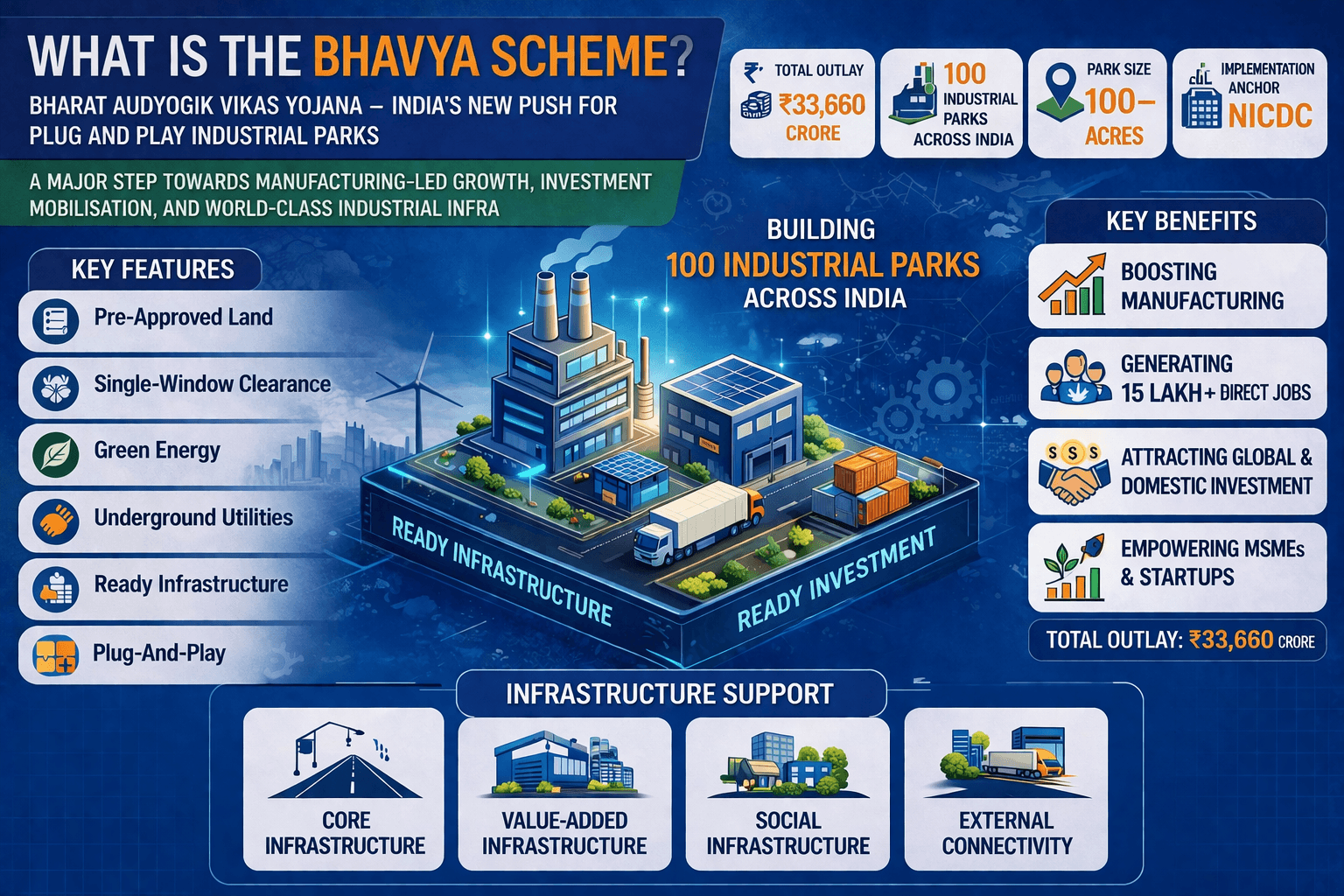
- The BHAVYA Scheme is a Central Sector Scheme designed to develop 100 modern industrial parks across India between 2026–27 and 2031–32, with a total financial outlay of approximately ₹33,660 crore.
- In the first phase, up to 50 industrial parks will be selected through a challenge-based competitive process to ensure transparency, efficiency, and high-quality infrastructure development. The scheme is aligned with national initiatives such as Make in India, PM Gati Shakti, and broader manufacturing and logistics development goals.
- The BHAVYA Scheme is a Central Sector Scheme designed to develop 100 modern industrial parks across India between 2026–27 and 2031–32, with a total financial outlay of approximately ₹33,660 crore.
-
Key Objectives of the Scheme:
The primary objective is to create investment-ready industrial ecosystems that attract domestic and global manufacturers. These parks aim to reduce logistics inefficiencies, improve ease of doing business, and enhance India’s competitiveness in global value chains. The scheme also focuses on employment generation, strengthening supply chains, and promoting balanced regional industrial development across states.
Plug-and-Play Industrial Infrastructure:
A key feature of the scheme is the development of plug-and-play industrial parks offering pre-developed land parcels, ready utilities, and pre-approved regulatory clearances. These parks are designed for immediate operational readiness. Core infrastructure includes road connectivity, underground utility systems, water and drainage management, and integrated power including renewable energy solutions.
Coverage and Land Requirements:
The scheme supports both greenfield and eligible brownfield industrial parks. Minimum land requirements include 100 acres for non-hilly states, 25 acres for hilly states, North-Eastern states, Union Territories, and smaller states, and up to 1000 acres for large-scale developments. This flexible structure ensures inclusive and regionally balanced industrial growth.
Financial Structure and Assistance:
The Central Government provides financial assistance through equity contributions linked to land value transferred to Special Purpose Vehicles (SPVs), along with milestone-based funding. Assistance may go up to ₹1 crore per acre for eligible projects. This performance-based model promotes accountability and efficient use of public funds while encouraging private and state participation.
Implementation Framework:
The scheme is implemented through SPVs registered under the Companies Act, 2013. These SPVs are responsible for planning, infrastructure development, investor facilitation, and long-term operations and maintenance of industrial parks. The National Industrial Corridor Development Corporation (NICDC) serves as the Project Management Agency (PMA) for coordination, monitoring, and execution support.
Challenge-Based Selection Process:
Industrial parks are selected through a competitive challenge-based framework. Evaluation parameters include multimodal connectivity, land suitability, infrastructure quality, industrial ecosystem strength, digital governance readiness, sustainability, and long-term economic viability. This ensures only high-potential projects are approved.
Infrastructure and Ecosystem Development:
The scheme emphasizes holistic industrial ecosystem creation, including effluent treatment plants, testing laboratories, logistics hubs, worker housing, skill development centres, and digital single-window clearance systems. These facilities ensure smooth industrial operations and improved productivity.
Private Sector Participation:
Private developers are actively encouraged to participate through structured SPV-based models. Strong governance frameworks, transparency mechanisms, and accountability standards are built in to ensure efficient execution and investor confidence.
Monitoring and Governance:
Implementation is monitored through GIS-based systems, regular progress reporting, independent audits, and oversight by a National Level Steering Committee chaired by the Secretary, DPIIT. These mechanisms ensure transparency, accountability, and timely execution.
Convergence with Other Schemes:
The scheme integrates with initiatives in logistics, renewable energy, skill development, industrial corridors, and environmental sustainability. This convergence ensures a coordinated and holistic approach to industrial development.
Significance of the Scheme:
BHAVYA is expected to significantly boost India’s manufacturing capacity, attract global investment, generate large-scale employment, improve exports, and strengthen integration into global value chains, supporting India’s growth as a major industrial hub.
Conclusion:
The BHAVYA Scheme is a forward-looking initiative aimed at building globally competitive, sustainable, and technology-driven industrial parks. With plug-and-play infrastructure, strong governance, and private sector participation, it is positioned to accelerate India’s journey toward becoming a $5 trillion economy and a global manufacturing powerhouse.



