
Context:
Recently, parliament passed Bankers’ Books Evidence Bill, 2026, which seeks to repeal and replace the Bankers’ Books Evidence Act, 1891. It aims to modernise the legal framework governing the use of banking records as evidence in courts.
Background:
The Bankers’ Books Evidence Act, 1891 was enacted when banking records were primarily maintained in physical books. With the rapid growth of digital banking, internet banking, electronic payments and cloud-based data storage, the existing framework had become outdated. The new Bill seeks to align evidentiary law with India's evolving digital financial ecosystem.
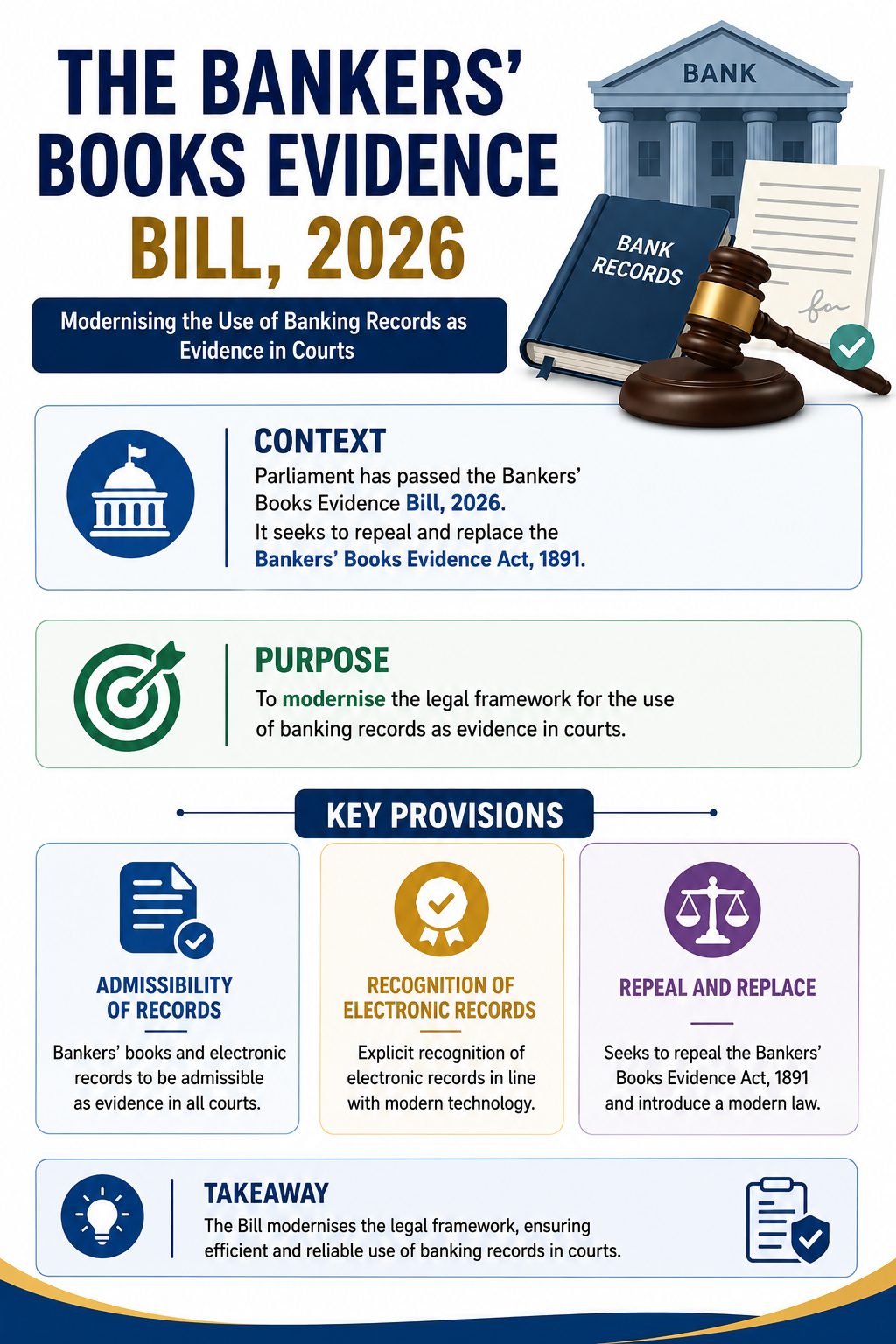
Key Provisions of new bill:
-
-
- Recognition of Digital Records: The Bill recognises electronic and digital records of bankers’ books as admissible and legally valid evidence, subject to prescribed conditions.
- Wider Definition of Bankers’ Books: The definition covers records maintained in physical, electronic, digital and virtual forms, including records stored at cloud, backup and disaster-recovery locations.
- Authentication of Records: Digital records must satisfy requirements relating to accuracy, authenticity and integrity. The Bill permits authentication through manual, electronic and digital signatures.
- Protection of Bank Officials: Bank employees are generally not required to appear in court merely to produce or prove banking records when the bank is not a party to the case. Courts can, however, require production where there is special cause, such as doubts regarding the accuracy or genuineness of records.
- Wider Financial-Sector Coverage: The Central Government may extend the framework to other financial-sector entities, subject to prescribed conditions.
- Recognition of Digital Records: The Bill recognises electronic and digital records of bankers’ books as admissible and legally valid evidence, subject to prescribed conditions.
-
Significance:
The Bill replaces a colonial-era, paper-based framework with a technology-neutral system suited to modern banking. It can:
-
-
- facilitate the use of digital evidence in courts;
- reduce unnecessary litigation-related burdens on bank officials;
- provide greater certainty regarding authentication of digital records;
- accommodate cloud-based banking infrastructure; and
- potentially create a common evidentiary framework across parts of the financial sector.
- facilitate the use of digital evidence in courts;
-
Concerns:
The increasing use of digital financial records also raises concerns regarding data privacy, cybersecurity, unauthorised access and manipulation of electronic evidence. Banks and financial institutions will need strong safeguards, audit trails and authentication mechanisms to ensure the integrity of records.
Conclusion:
The Bankers’ Books Evidence Bill, 2026 represents an important transition from a paper-based to a digital evidentiary framework. Its success will depend on balancing ease of digital evidence with privacy, cybersecurity, authenticity and accountability, thereby strengthening India's legal infrastructure for the digital economy.



