
Context:
Recently, The Bankers’ Books Evidence Act, 2026 comes into force on 1 October 2026, replacing the colonial-era Bankers’ Books Evidence Act, 1891. The new legislation modernises the legal framework governing the admissibility and proof of banking records in judicial proceedings, taking into account digital banking, electronic records and modern financial systems.
Background:
-
-
- The earlier Bankers’ Books Evidence Act, 1891 was enacted when banking records were primarily maintained in physical books and ledgers. Over time, banking has undergone significant technological transformation, with transactions increasingly taking place through core banking systems, electronic records, digital payments and computerised databases.
- The 2026 legislation seeks to align the evidentiary framework with these developments and reduce dependence on procedures designed for nineteenth-century banking practices.
- The earlier Bankers’ Books Evidence Act, 1891 was enacted when banking records were primarily maintained in physical books and ledgers. Over time, banking has undergone significant technological transformation, with transactions increasingly taking place through core banking systems, electronic records, digital payments and computerised databases.
-
What are Bankers’ Books?
-
-
- Bankers’ books broadly refer to records maintained by banks in the ordinary course of their business. These can include ledgers, account statements, transaction records and other banking records.
- Such records can be important evidence in cases involving financial disputes, fraud, recovery of loans, taxation, commercial transactions and criminal investigations.
- Bankers’ books broadly refer to records maintained by banks in the ordinary course of their business. These can include ledgers, account statements, transaction records and other banking records.
-
Key Features of the new act:
-
-
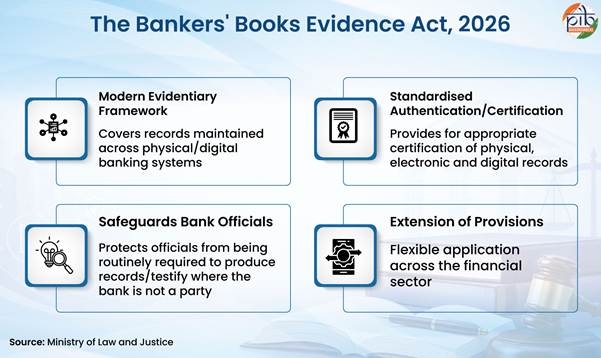
- The Bankers’ Books Evidence Act, 2026 provides a contemporary framework for recognising banking records as evidence before courts and other judicial authorities. Its framework is designed to accommodate electronic and digitally maintained banking records, reflecting the widespread use of computerised banking systems.
- By recognising modern forms of banking records, the legislation can reduce procedural difficulties involved in producing traditional physical books before courts. It also seeks to facilitate the use of authenticated banking records while maintaining safeguards concerning their evidentiary reliability.
- The Bankers’ Books Evidence Act, 2026 provides a contemporary framework for recognising banking records as evidence before courts and other judicial authorities. Its framework is designed to accommodate electronic and digitally maintained banking records, reflecting the widespread use of computerised banking systems.
-
Why was a New Law Needed?
-
-
- The 1891 legislation was framed for a banking environment dominated by physical registers and paper-based accounting. Modern banking, however, involves enormous volumes of electronically generated data.
- Digital transactions through internet banking, mobile banking, UPI, cards and automated banking systems have fundamentally changed how financial records are created and stored. A modern evidentiary law is therefore necessary to ensure that the legal system keeps pace with technological developments.
- The 1891 legislation was framed for a banking environment dominated by physical registers and paper-based accounting. Modern banking, however, involves enormous volumes of electronically generated data.
-
Significance:
-
-
- The new law can contribute to faster and more efficient judicial proceedings by facilitating the use of digital banking records. It is particularly relevant in an economy where financial transactions increasingly leave electronic trails.
- It can also support the investigation and adjudication of banking fraud, money laundering, financial disputes and cyber-enabled financial offences, subject to the requirements of the applicable laws and evidentiary procedures.
- The new law can contribute to faster and more efficient judicial proceedings by facilitating the use of digital banking records. It is particularly relevant in an economy where financial transactions increasingly leave electronic trails.
-
Challenges:
Greater reliance on digital records also creates challenges relating to authentication, data integrity, cybersecurity, privacy and preservation of electronic evidence. Courts and investigative agencies need adequate technological expertise to determine whether digital records are genuine and have not been altered.
Conclusion:
The Bankers’ Books Evidence Act, 2026 represents an important step in adapting India's evidentiary framework to the digital banking era. By replacing a law enacted in 1891 with a framework suited to electronic banking records, it seeks to bridge the gap between technological transformation in the financial sector and the requirements of the justice system.



