
Context:
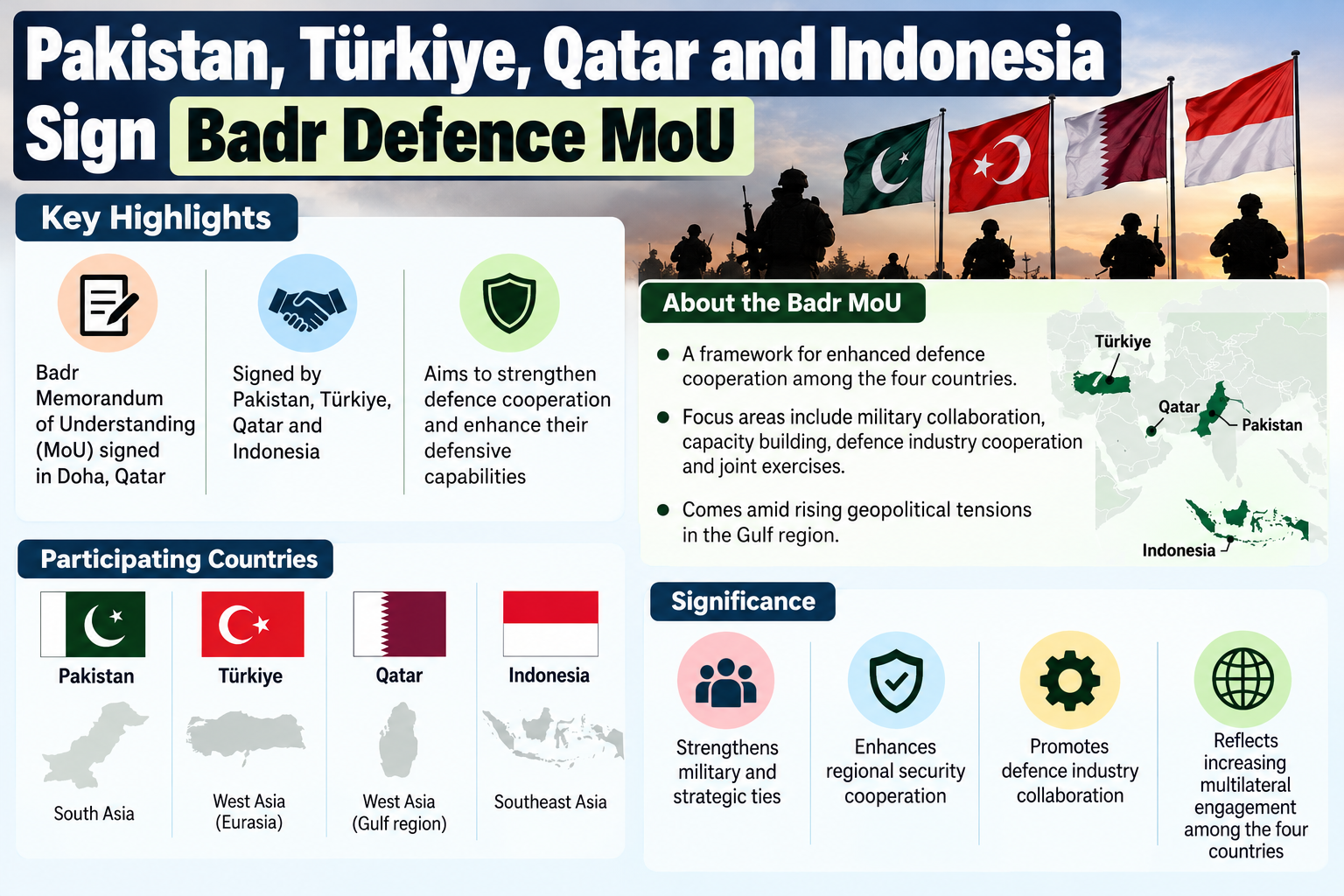
Recently, Pakistan, Türkiye, Qatar and Indonesia signed the Badr Memorandum of Understanding (MoU) in Doha, Qatar, to strengthen defence cooperation and enhance their defensive capabilities.
Background of the Badr MoU:
-
-
- The agreement comes amid escalating tensions in the Gulf region and concerns over a possible renewed confrontation between the United States and Iran. It also follows the Makkah Joint Defence Agreement, signed by Pakistan, Saudi Arabia and Türkiye in August 2026, under which an attack against one participating country would be treated as an attack against all three.
- The Badr MoU appears to focus on defence-industrial cooperation rather than establishing an automatic collective-defence obligation. Its name reportedly refers to the Battle of Badr, the first major military engagement between early Muslims and the tribes of Makkah.
- The agreement comes amid escalating tensions in the Gulf region and concerns over a possible renewed confrontation between the United States and Iran. It also follows the Makkah Joint Defence Agreement, signed by Pakistan, Saudi Arabia and Türkiye in August 2026, under which an attack against one participating country would be treated as an attack against all three.
-
Key Features of the Agreement:
-
-
- The agreement aims to promote cooperation in defence manufacturing, strengthen military capabilities, and expand technical training, research and development (R&D). It seeks to combine the four countries’ industrial and technological strengths to develop modern defence solutions.
- The agreement also has economic significance, as joint production and technology cooperation could strengthen domestic defence industries, create employment and improve the participating countries’ ability to meet the requirements of allied and friendly nations.
- The agreement aims to promote cooperation in defence manufacturing, strengthen military capabilities, and expand technical training, research and development (R&D). It seeks to combine the four countries’ industrial and technological strengths to develop modern defence solutions.
-
Strategic Significance:
The MoU reflects a broader trend towards diversified defence partnerships and greater indigenous military production. Türkiye has developed capabilities in drones, naval platforms and armoured vehicles, while Pakistan has pursued defence manufacturing through international partnerships. Qatar has invested in defence cooperation, and Indonesia seeks technology transfer and domestic industrial development.
However, the agreement should not automatically be interpreted as an anti-India alliance or a unified military bloc.
Implications for India:
For India, the agreement warrants attention because enhanced defence-industrial cooperation involving Pakistan could influence regional security dynamics. India should strengthen indigenous defence manufacturing under Aatmanirbhar Bharat, expand defence exports and deepen strategic partnerships with Gulf and Southeast Asian countries. Diplomatic engagement and careful assessment of the agreement’s actual implementation remain essential.
Challenges:
Differences in national interests, technology-sharing restrictions, financing, intellectual-property rights and export controls could hinder implementation. The agreement’s practical significance will depend on concrete projects and sustained cooperation.
Conclusion:
The Badr MoU highlights the growing importance of defence-industrial partnerships in an uncertain geopolitical environment. Its implications will depend on how effectively the four countries translate the agreement into joint production, technology development and stronger defence capabilities.



