
Context:
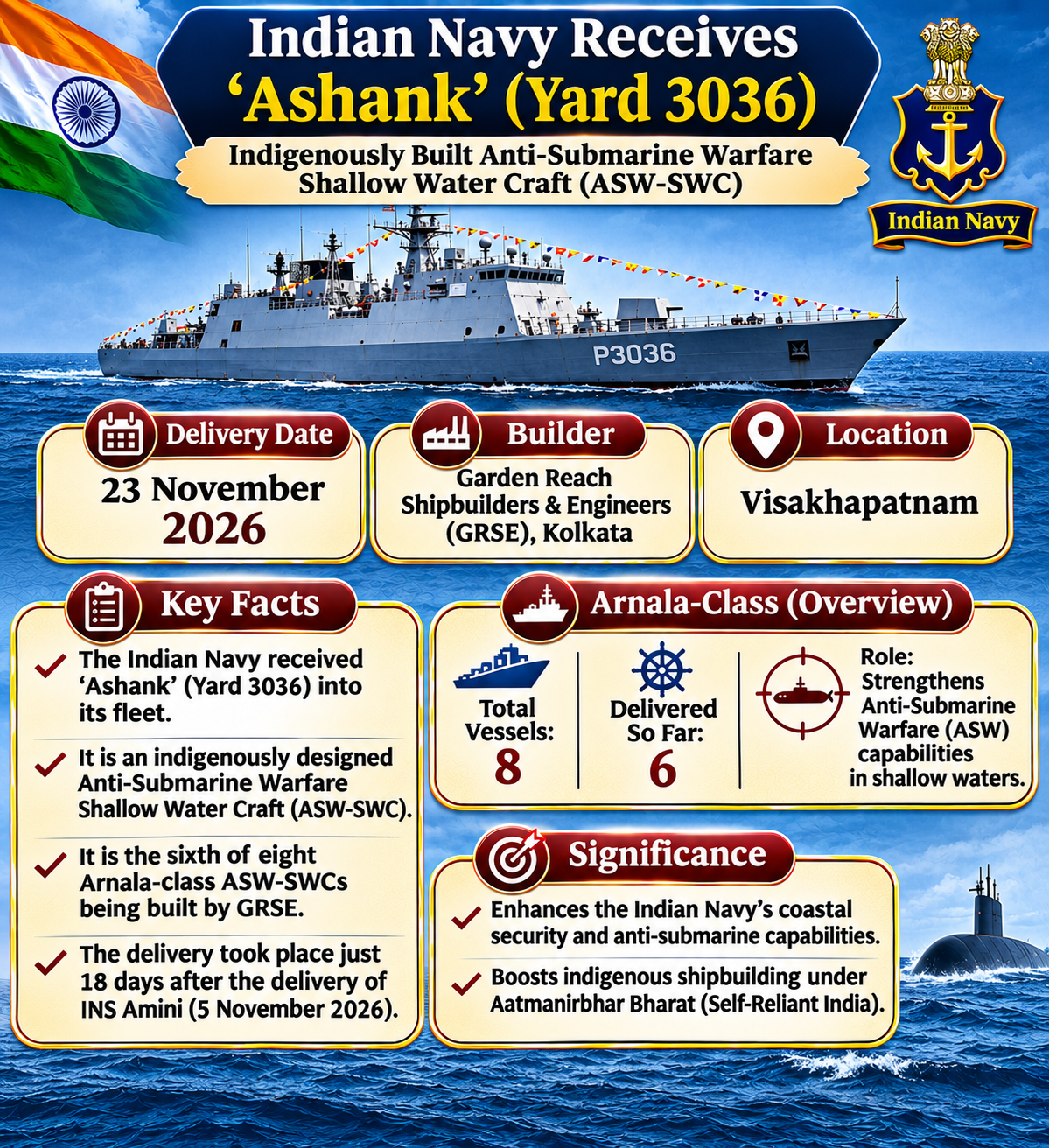
On 23 November 2026, the Indian Navy received ‘Ashank’ (Yard 3036), an indigenously designed Anti-Submarine Warfare Shallow Water Craft (ASW-SWC), from Garden Reach Shipbuilders and Engineers (GRSE), Kolkata, at Visakhapatnam. It is the sixth of eight Arnala-class ASW-SWCs being built by GRSE. The delivery took place just 18 days after the delivery of INS Amini on 5 November 2026.
What is ASW-SWC?
Anti-Submarine Warfare Shallow Water Crafts are specialised naval vessels designed to detect, track and neutralise enemy submarines operating in shallow and coastal waters. They are particularly important for protecting ports, naval bases, offshore installations and strategically important maritime routes. These vessels use SONAR (Sound Navigation and Ranging), which employs sound waves to detect underwater objects, and are equipped with lightweight torpedoes and anti-submarine rocket launchers.
Key Features of Ashank:
-
-
- Ashank is approximately 77.6 metres long, has a displacement of around 900 tonnes and carries a crew of approximately 57 personnel. It has around 88% indigenous content, according to GRSE.
- Its major features include advanced shallow-water SONAR, lightweight torpedoes, indigenous rocket launchers, a GRSE-manufactured 30 mm naval surface gun and waterjet propulsion.
- Waterjet propulsion provides high manoeuvrability in shallow and confined coastal waters. The vessel has been constructed according to the classification rules of the Indian Register of Shipping (IRS).
- Ashank is approximately 77.6 metres long, has a displacement of around 900 tonnes and carries a crew of approximately 57 personnel. It has around 88% indigenous content, according to GRSE.
-
Significance for India's Maritime Security:
-
-
- First, Ashank strengthens India's coastal defence by improving the detection and neutralisation of hostile submarines.
- Second, it enhances India's strategic capabilities in the Indian Ocean Region (IOR), particularly amid China's growing naval presence and submarine activities.
- Third, it improves Maritime Domain Awareness (MDA) and helps protect critical maritime infrastructure.
- Fourth, it supports India's vision of Aatmanirbhar Bharat by reducing dependence on imported defence equipment and promoting indigenous shipbuilding. It also strengthens the domestic defence manufacturing ecosystem and creates opportunities for MSMEs.
- First, Ashank strengthens India's coastal defence by improving the detection and neutralisation of hostile submarines.
-
ASW-SWC Programme in India:
The Indian Navy's Arnala-class programme involves the construction of eight ASW-SWCs by GRSE, Kolkata. Ashank is the sixth vessel in this series. The first vessel, INS Arnala, was commissioned in June 2025. The programme aims to replace ageing Abhay-class corvettes and strengthen India's shallow-water anti-submarine warfare capabilities.
Conclusion:
The delivery of Ashank represents an important milestone in India's naval modernisation and defence indigenisation. Indigenous platforms, combined with advanced surveillance technologies and maritime cooperation, are essential for safeguarding India's maritime interests and strengthening its position as a net security provider in the Indian Ocean Region.