
Anti-Defection Law and the Rajya Sabha Chairman’s Decision
Context:
The recent acceptance by the Rajya Sabha Chairman, C. P. Radhakrishnan, of the merger of seven MPs from Aam Aadmi Party (AAP) with the Bharatiya Janata Party (BJP) has reignited debate over the efficacy of the Tenth Schedule (Anti-Defection Law). While the move is constitutionally permissible, it raises deeper concerns about democratic ethics and institutional neutrality.
About The Tenth Schedule:
-
-
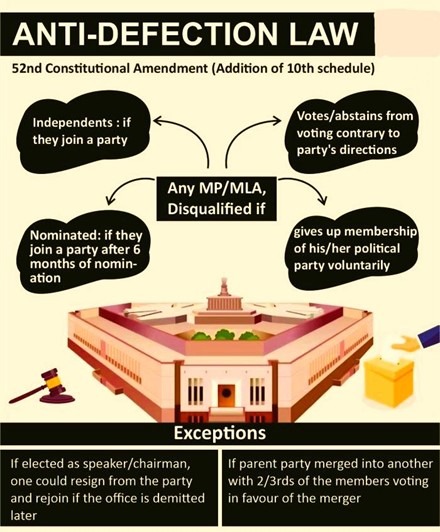
- The 10th Schedule of the Indian Constitution, commonly known as the Anti-Defection Law, was introduced by the 52nd Constitutional Amendment Act, 1985 and later strengthened by the 91st Constitutional Amendment Act, 2003. It was enacted to curb political defections by disqualifying legislators who switch parties after being elected, thereby promoting stability in governments and maintaining ethical political practices.
- Howver, Under Paragraph 4 (Merger Clause):
- If two-thirds members agree, it is treated as a valid merger
- Members are protected from disqualification
- If two-thirds members agree, it is treated as a valid merger
- The Chairman acts as the adjudicating authority in defection cases in the Rajya Sabha.
- The 10th Schedule of the Indian Constitution, commonly known as the Anti-Defection Law, was introduced by the 52nd Constitutional Amendment Act, 1985 and later strengthened by the 91st Constitutional Amendment Act, 2003. It was enacted to curb political defections by disqualifying legislators who switch parties after being elected, thereby promoting stability in governments and maintaining ethical political practices.
-
Issues and Concerns:
-
-
- Spirit vs Letter of Law: While legally valid, the decision raises questions about the spirit of the anti-defection law, which aims to prevent opportunistic political shifts. The merger clause has effectively become a loophole for collective defections.
- Institutional Neutrality:
- Possible partisanship
- Lack of detailed scrutiny into whether the merger was genuine or engineered
- This reflects a broader concern about entrusting adjudicatory powers to political office holders.
- Possible partisanship
- Impact on Parliamentary Democracy:
- Reduce deliberative quality of legislation
- Undermine the representative mandate of voters
- Reduce deliberative quality of legislation
- Absence of Procedural Safeguards:
- Transparent hearings
- Time-bound processes
- Independent oversight
- Transparent hearings
- Broader Implications:
- The anti-defection law ensures stability but may simultaneously enable large-scale political realignments that distort electoral mandates.
- It highlights the tension between:
- Legislative stability
- Democratic accountability
- Legislative stability
- The anti-defection law ensures stability but may simultaneously enable large-scale political realignments that distort electoral mandates.
- Judicial Context:
- Speaker/Chairman’s role
- But allowed judicial review
- However, in practice:
- Courts intervene only after the Chairman’s decision
- Speaker/Chairman’s role
- This makes the Chairman’s ruling crucial and often decisive
- Spirit vs Letter of Law: While legally valid, the decision raises questions about the spirit of the anti-defection law, which aims to prevent opportunistic political shifts. The merger clause has effectively become a loophole for collective defections.
-
Way Forward:
To address these concerns, several reforms may be considered:
-
-
- Revisiting the merger clause, possibly requiring fresh elections
- Establishing an independent tribunal instead of relying on the Speaker/Chairman
- Introducing time-bound decision-making
- Strengthening intra-party democracy to reduce defections
- Revisiting the merger clause, possibly requiring fresh elections
-
Conclusion:
The Rajya Sabha Chairman’s decision in the AAP–BJP merger case is constitutionally sound but normatively contentious. It exposes the limitations of the current anti-defection framework, particularly the merger exception. Reforming the Tenth Schedule is essential to ensure that it upholds not just legal correctness, but also the spirit of democratic integrity and accountability.



