
Context:
Recently, the Defence Research and Development Organisation (DRDO) successfully completed the User Evaluation Trials (UETs) of the Akash New Generation (Akash NG) missile system. This marks a critical milestone in strengthening India’s indigenous air defence capabilities and paves the way for its induction into operational service.
About the Akash NG Missile:
-
-
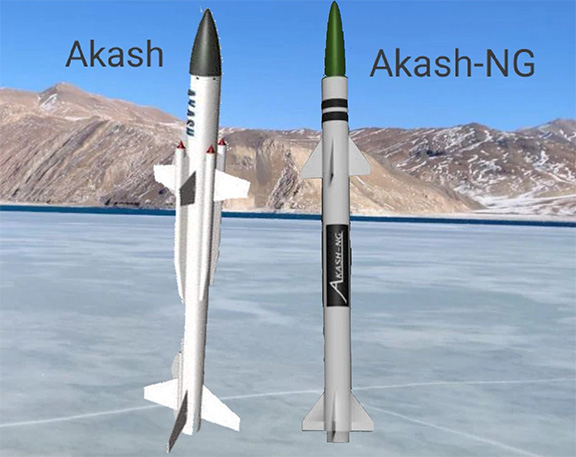
- Developed by Bharat Dynamics Limited and Bharat Electronics Limited for the Indian Air Force, Akash NG is a medium-range, mobile surface-to-air missile system designed to counter modern aerial threats and enhance operational readiness.
- Akash NG, the successor to the Akash Mark I and Akash Prime variants, was approved for development in September 2016 with a funding allocation of ₹470 crore. The missile employs a dual-pulse solid rocket motor, which is lighter and more efficient than the earlier air-breathing propulsion system.
- The system features an Active Electronically Scanned Array (AESA) multi-function radar (MFR), an electro-optical targeting system (EOTS), and an optical proximity fuze, significantly improving accuracy and resistance to electronic countermeasures.
- It can engage up to ten targets simultaneously, with interception ranges of 70–80 km and rapid firing capability, including the launch of three missiles within twenty seconds.
- Akash NG is fully transportable by road, rail, and air, and can transition from transport to ready-to-fire mode in under 20 minutes. Its Ku-band active radar seeker, indigenously supplied by Bharat Dynamics Limited in 2023 combined with advanced electronic counter-countermeasure (ECCM) features, ensures effectiveness against low radar cross-section targets in all-weather conditions. These capabilities make Akash NG a vital component of India’s layered air defence architecture.
- Developed by Bharat Dynamics Limited and Bharat Electronics Limited for the Indian Air Force, Akash NG is a medium-range, mobile surface-to-air missile system designed to counter modern aerial threats and enhance operational readiness.
-
Significance:
-
-
- Enhanced Air Defence: With extended range, rapid reaction time, and multi-target engagement capability, Akash NG significantly strengthens India’s layered air defence against aircraft, drones, and missile threats.
- Indigenous Capability: Entirely developed and produced domestically with public and private sector participation, the system exemplifies India’s growing self-reliance in advanced missile technologies.
- Strategic Deterrence: High mobility and operational flexibility enhance border security, airspace control, and deterrence against evolving regional aerial threats.
- Technological Edge: Integration of AESA radar, Ku-band seekers, and electro-optical targeting ensures precision, survivability, and readiness for future network-centric warfare environments.
- Enhanced Air Defence: With extended range, rapid reaction time, and multi-target engagement capability, Akash NG significantly strengthens India’s layered air defence against aircraft, drones, and missile threats.
-
Conclusion:
The successful completion of UETs and the impending induction of Akash NG reinforce India’s Atmanirbhar Bharat initiative by strengthening domestic defence manufacturing and reducing dependence on foreign imports. With enhanced mobility, extended engagement range, and rapid response capability, Akash NG significantly boosts India’s strategic deterrence against contemporary aerial threats such as drones, cruise missiles, and high-speed aircraft. Overall, the system reflects India’s growing technological maturity and commitment to self-reliant defence preparedness.



