
Why in News?
Recently, in a joint study, scientists from the Indian Space Research Organisation (ISRO), Manipur Centre for Natural Sciences and Manipur Academy of Higher Education have successfully recorded the early signals generated in the Sun's atmosphere before the eruption of solar flares. This study utilized data obtained from India's first solar mission, Aditya-L1.
Key Highlights of the Research:
The research utilized simultaneous Ultraviolet (UV) and X-ray observations captured by three major payloads aboard Aditya-L1:
-
-
- Pre-flare Transient Events: Scientists discovered that small, short-lived 'bright points' appear in the Sun's atmosphere a few hours before the onset of a major solar flare.
- Release of Magnetic Energy: X-ray signatures were observed alongside many of these bright points detected by SUIT, indicating that magnetic energy was undergoing contraction and release during this process.
- Magnetic Field Destabilization: These small bright points were clustered around the exact location where the major solar flare subsequently erupted. This leads to the conclusion that these recurring, small-scale energy emissions eventually destabilize the magnetic field of the active region, triggering a massive explosion (solar flare).
- Pre-flare Transient Events: Scientists discovered that small, short-lived 'bright points' appear in the Sun's atmosphere a few hours before the onset of a major solar flare.
-
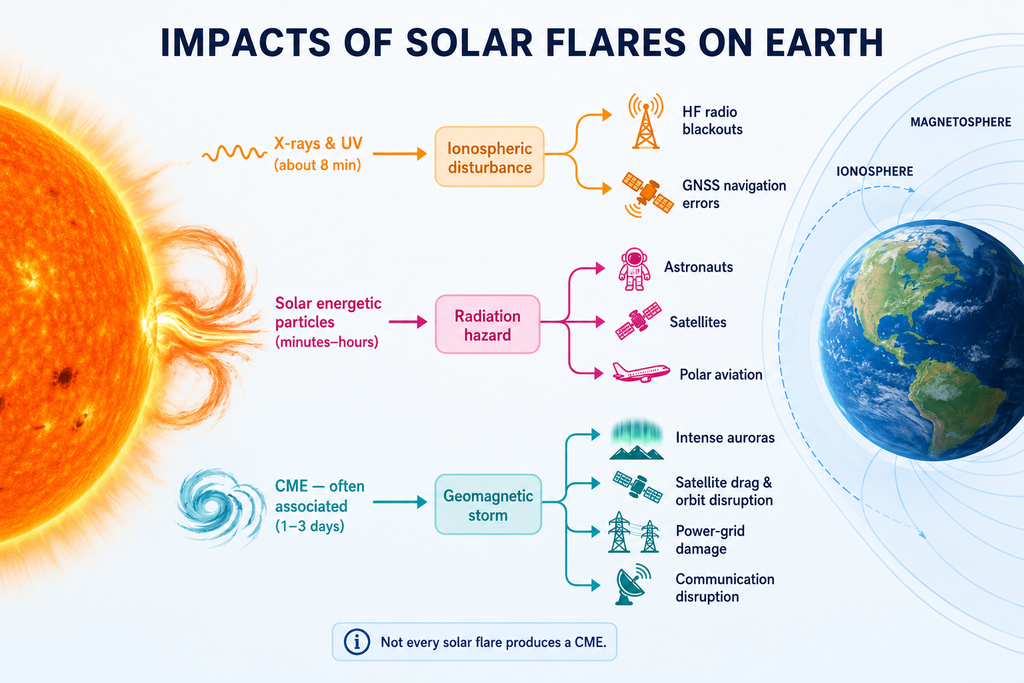
Impact on Space Weather and Global Technology:
Solar flares release highly energetic particles and radiation into space. The findings of this study are crucial for the following reasons:
-
-
- Accurate Space Weather Prediction: This study brings scientists one step closer to accurately forecasting solar flares.
- Satellite and Communication Security: Solar storms can affect Earth's ionosphere, potentially disrupting GPS, radio communications, and power grids. Timely warnings allow satellites to be switched to 'safe mode'.
- Astronaut Safety: It will become possible to protect astronauts aboard the International Space Station (ISS) and those on future crewed space missions (such as India's Gaganyaan) from lethal solar radiation.
- Accurate Space Weather Prediction: This study brings scientists one step closer to accurately forecasting solar flares.
-
Conclusion:
Detecting early signs of solar flares through the Aditya-L1 mission represents a significant achievement for the Indian Space Research Organisation (ISRO) and the global scientific community. This study not only aids in understanding the Sun's complex magnetic dynamics but also marks a major step towards making 'space weather forecasting' more reliable. In an era of rapidly growing digital dependence and a satellite-based global economy, this indigenous Indian initiative will prove to be crucial and visionary in safeguarding sensitive technical systems, communication networks, and future human space missions against solar storms.



