
Context:
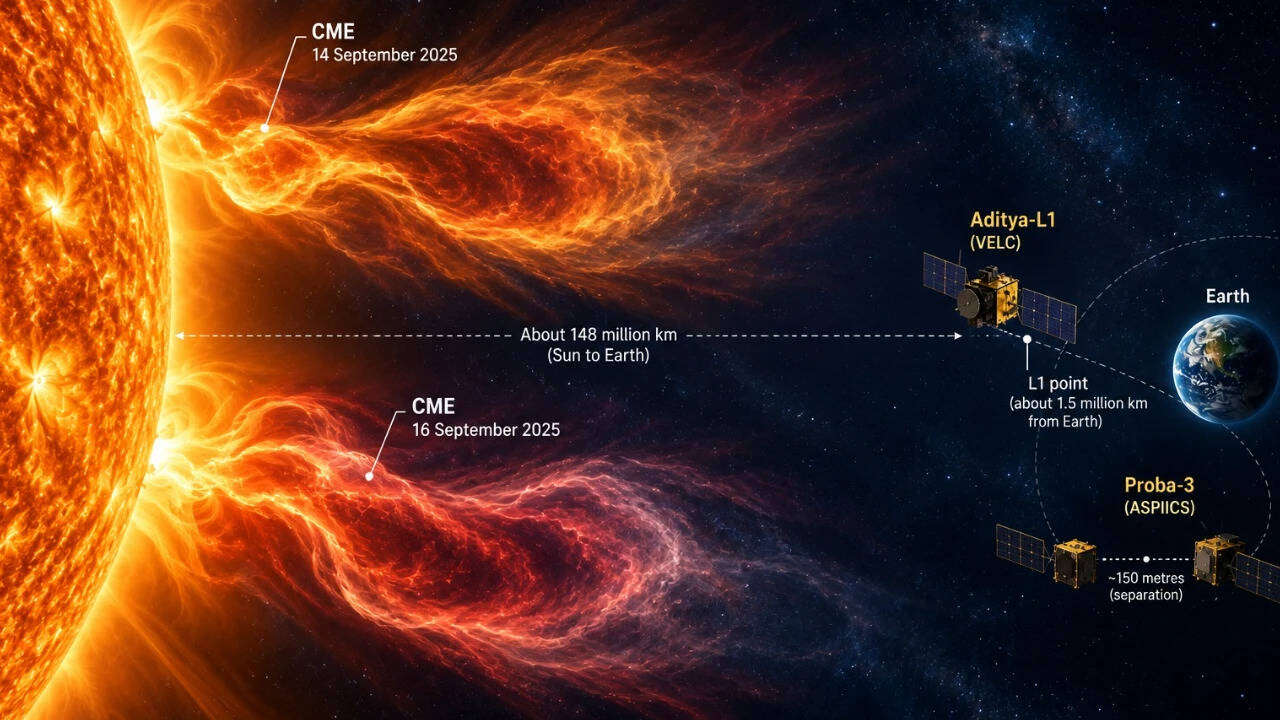
Recently, India's first dedicated solar mission, Aditya-L1, generated new Doppler velocity images of the solar corona using its Visible Emission Line Coronagraph (VELC) payload. These images provide insights into the direction in which solar plasma moves during eruptions, improving scientists' understanding of Coronal Mass Ejections (CMEs) and their potential impact on Earth.
About Aditya-L1 Mission:
Aditya-L1 was launched on 2 September 2023 by the Indian Space Research Organisation (ISRO) aboard PSLV-C57. It operates in a halo orbit around the Sun–Earth Lagrange Point 1 (L1), approximately 1.5 million kilometres from Earth. Its primary objective is to study the Sun's outer atmosphere, solar activity, solar wind and related space-weather phenomena. The spacecraft carries seven scientific payloads for remote sensing and in-situ observations. The L1 location provides a relatively uninterrupted view of the Sun, enabling continuous monitoring of solar activity.
Key Scientific Findings:
The Visible Emission Line Coronagraph (VELC) helps scientists investigate solar plasma movement through Doppler velocity imaging. These observations indicate whether plasma is moving towards or away from the observer and provide information about the propagation of solar material during eruptions. By complementing conventional images with velocity measurements, Aditya-L1 improves scientific understanding of solar dynamics. The mission also demonstrates India's growing indigenous capabilities in solar observation and scientific data processing.
About Coronal Mass Ejections:
Coronal Mass Ejections are large expulsions of plasma and magnetic fields from the Sun's outer atmosphere, known as the corona. They are associated with changes in the Sun's magnetic field and can release enormous quantities of charged particles into space. When Earth-directed CMEs interact with Earth's magnetosphere, they can trigger geomagnetic storms. Such disturbances may affect satellites, radio communications, navigation systems and electricity transmission networks.
Role of the Doppler Effect:
The Doppler effect refers to the change in the observed wavelength or frequency of a wave due to relative motion between the source and the observer. In solar observations, a blueshift generally indicates plasma moving towards the observer, while a redshift indicates movement away from the observer. Analysing these spectral shifts enables scientists to estimate plasma velocities and investigate the direction of solar eruptions, providing information that ordinary images alone cannot fully reveal.
Significance for India:
Aditya-L1 can contribute to improved space-weather assessment and preparedness. Better understanding of solar eruptions can help satellite operators anticipate potential disturbances and protect communication and navigation services. It can also improve assessments of geomagnetic storms that may affect power grids and other critical infrastructure. Furthermore, the mission strengthens India's self-reliance in space science, promotes advanced solar research and enhances the country's contribution to international scientific cooperation.
Conclusion:
Aditya-L1 represents a significant advancement in India's solar research capabilities. Its observations of plasma motion can deepen understanding of Coronal Mass Ejections and improve space-weather assessments. Continued research and effective application of mission data can help protect critical infrastructure and reinforce India's position in space science.