
Acceleration of Global Warming
Context:
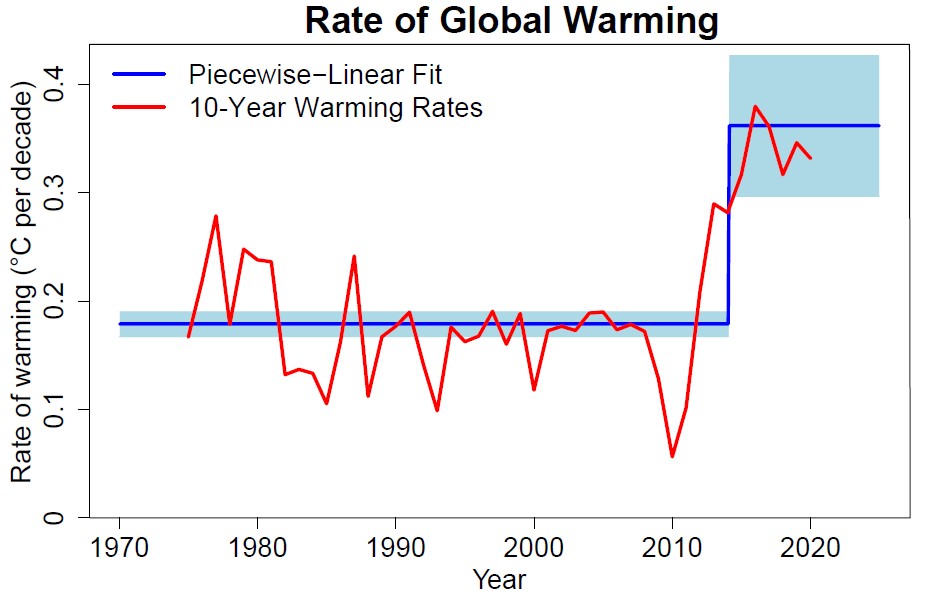
A recent study published in Geophysical Research Letters has confirmed that global warming is accelerating significantly. The new research provides the first statistically significant evidence that the pace of global warming has increased since around 2015.
Key Findings of the Study:
-
-
- Faster Rate of Temperature Rise: The study found that the rate of warming has nearly doubled in the last decade.
- 1970–2015: ~0.2°C increase per decade
- 2015–2025: ~0.35°C increase per decade
- 1970–2015: ~0.2°C increase per decade
- This represents the fastest warming trend observed since global temperature records began in 1880.
- Scientific Methodology: Scientists analysed multiple global temperature datasets and filtered out natural climate influences such as:
- El Niño events
- Volcanic eruptions
- Solar radiation fluctuations
- El Niño events
- By removing these short-term variations, researchers were able to detect the underlying long-term warming trend more clearly.
- Evidence of Acceleration: The findings indicate a statistically significant acceleration of global warming since around 2015, providing stronger evidence that the warming trend is not merely linear but increasing in intensity.
- Faster Rate of Temperature Rise: The study found that the rate of warming has nearly doubled in the last decade.
-
Drivers of Accelerating Global Warming:
-
-
- Rising Greenhouse Gas Emissions: The primary driver of climate change remains human-induced greenhouse gas emissions, particularly from:
- Burning fossil fuels (coal, oil, natural gas)
- Industrial processes
- Deforestation
- Burning fossil fuels (coal, oil, natural gas)
- These emissions trap heat in the atmosphere, increasing Earth’s average temperature.
- Declining Cooling Effects of Aerosols: Air pollution particles (aerosols) previously reflected sunlight and had a temporary cooling effect. As countries reduce pollution for health reasons, this masking effect has decreased, revealing more warming.
- Weakening Natural Carbon Sinks: Forests and oceans that absorb carbon dioxide are becoming less effective due to droughts, fires, and ecosystem stress, contributing to faster warming.
- Rising Greenhouse Gas Emissions: The primary driver of climate change remains human-induced greenhouse gas emissions, particularly from:
-
Implications for Climate Goals:
-
-
- Paris Agreement Target at Risk: If the current trend continues, the world could cross the 1.5°C global warming threshold before 2030, earlier than previously expected.
- Increasing Climate Risks: Accelerated warming increases the likelihood of:
- Extreme heatwaves
- Intense storms and floods
- Droughts and wildfires
- Rapid melting of glaciers and polar ice
- Extreme heatwaves
- These impacts threaten ecosystems, food security, and human livelihoods worldwide.
- Paris Agreement Target at Risk: If the current trend continues, the world could cross the 1.5°C global warming threshold before 2030, earlier than previously expected.
-
Conclusion:
The latest scientific evidence indicates that global warming has entered a phase of rapid acceleration, largely driven by human activities. The findings underscore the urgency of rapid emission reductions, expansion of renewable energy, and stronger international climate cooperation. Without decisive action, the accelerating warming trend could push the planet closer to irreversible climate tipping points.



