
Context:
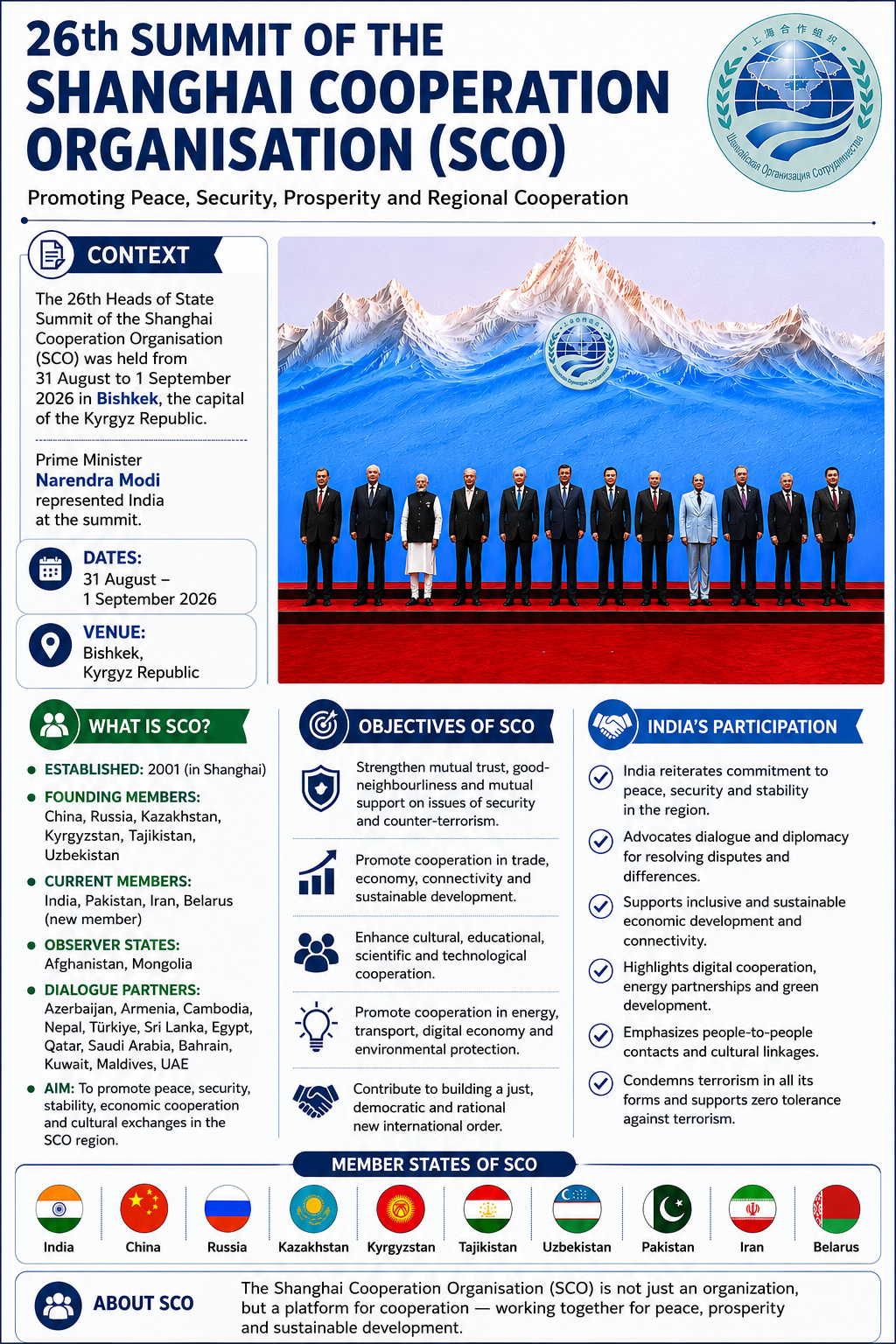
The 26th Heads of State Summit of the Shanghai Cooperation Organisation (SCO) was held from 31 August to 1 September 2026 in Bishkek, the capital of the Kyrgyz Republic. Prime Minister Narendra Modi represented India at the summit. SCO is celebrating its 25th anniversary in 2026.
Key points by India on 26th Summit:
-
-
- Cooperation Against Terrorism: India described terrorism as a serious challenge to regional peace and development and stressed the need for collective and decisive action against terrorist networks and their support systems. India also highlighted the need to end double standards on the issue of terrorism.
- Peace and Diplomacy: India emphasised giving priority to dialogue and diplomacy for resolving conflicts. This is in line with India's policy of strategic autonomy and multilateral diplomacy.
- Connectivity and Economic Cooperation: India highlighted the need to promote better connectivity, trade, digital cooperation and economic opportunities in the SCO region. At the same time, India emphasised connectivity that respects sovereignty and territorial integrity.
- Central Asia and Afghanistan: The SCO is an important platform for India to strengthen its relations with the Central Asian countries. Peace and stability in Afghanistan are also important components of the SCO's regional security concerns. India reiterated its commitment to continue developmental and humanitarian assistance to the Afghan people.
- Cooperation Against Terrorism: India described terrorism as a serious challenge to regional peace and development and stressed the need for collective and decisive action against terrorist networks and their support systems. India also highlighted the need to end double standards on the issue of terrorism.
-
New Institutional Cooperation:
-
-
- The Summit approved the establishment of the Universal Centre for Countering Challenges and Threats to the Security of SCO Member States to address terrorism, extremism, organized crime, and other transnational security challenges.
- Apart from this, measures were taken to strengthen cooperation against drug trafficking and narco-terrorism. Decisions were also taken to enhance cooperation in areas such as climate change, energy efficiency, disaster management, and artificial intelligence.
- The Summit approved the establishment of the Universal Centre for Countering Challenges and Threats to the Security of SCO Member States to address terrorism, extremism, organized crime, and other transnational security challenges.
-
What is the SCO?
-
-
- The Shanghai Cooperation Organisation (SCO) is a major political, economic and security organisation in Eurasia. It originated in 1996 as the "Shanghai Five", comprising China, Russia, Kazakhstan, Kyrgyzstan and Tajikistan. After Uzbekistan joined in 2001, it evolved into the SCO.
- India and Pakistan became full members in 2017. Iran became a full member in 2023, followed by Belarus in 2024.
- The organisation promotes the "Shanghai Spirit," which is based on principles such as mutual trust, equality, consultation, mutual benefit and respect for different civilisations.
- The Shanghai Cooperation Organisation (SCO) is a major political, economic and security organisation in Eurasia. It originated in 1996 as the "Shanghai Five", comprising China, Russia, Kazakhstan, Kyrgyzstan and Tajikistan. After Uzbekistan joined in 2001, it evolved into the SCO.
-
Counter-Terrorism Cooperation and RATS:
-
-
- Combating terrorism, separatism and extremism, referred to as the SCO's "three evil forces", is one of the key areas of cooperation within the organisation.
- The Regional Anti-Terrorist Structure (RATS) is headquartered in Tashkent. It facilitates the exchange of intelligence and coordination among member countries.
- India seeks to use this platform to promote a non-selective and comprehensive approach towards terrorism. The objective is not only to target terrorists but also to ensure action against their financiers, recruiters, propagandists and safe havens.
- Combating terrorism, separatism and extremism, referred to as the SCO's "three evil forces", is one of the key areas of cooperation within the organisation.
-
Importance of the SCO for India:
-
-
- Strengthening strategic relations with Central Asia.
- Cooperation against terrorism and extremism.
- Opportunities for energy security and economic cooperation.
- Enhancing connectivity across the Eurasian region.
- Regional cooperation on the stability of Afghanistan.
- Maintaining dialogue with major powers, including Russia and China.
- Strengthening India's Strategic Autonomy.
- Strengthening strategic relations with Central Asia.
-
Challenges:
-
-
- The SCO faces several important limitations. India-Pakistan tensions, differing approaches towards terrorism, and India-China strategic competition may create obstacles to building consensus within the organisation.
- In addition, China's growing influence and the organisation's consensus-based decision-making process may limit its effectiveness and decision-making capacity.
- The SCO faces several important limitations. India-Pakistan tensions, differing approaches towards terrorism, and India-China strategic competition may create obstacles to building consensus within the organisation.
-
Conclusion:
The SCO can become an effective pillar of Eurasian security only when its members adopt a united, non-discriminatory and comprehensive approach towards combating terrorism. For India, active engagement with the SCO is extremely important for advancing national security, connectivity with Central Asia, and strategic autonomy.



