
Context
Recently, the Royal Swedish Academy of Sciences announced on 6 October 2026 that the Nobel Prize in Physics would be awarded to Belgian-American physicist Francis Halzen. He has been honoured for his visionary leadership in the development of the IceCube Neutrino Observatory and his decisive contribution to the discovery of high-energy neutrinos of astrophysical origin. This achievement is considered significant in the development of modern astrophysics and multi-messenger astronomy.
Prof. Francis Halzen and His Contribution:
-
-
- Francis Halzen was born in Belgium in 1944. He obtained his PhD from the University of Leuven. He is currently a distinguished professor of physics at the University of Wisconsin–Madison and the Principal Investigator of the IceCube project.
- His most important idea emerged in 1988, when he proposed that the deep and highly transparent ice of Antarctica could be used as a giant neutrino detector. This idea later became the foundation of the IceCube Observatory.
- Francis Halzen was born in Belgium in 1944. He obtained his PhD from the University of Leuven. He is currently a distinguished professor of physics at the University of Wisconsin–Madison and the Principal Investigator of the IceCube project.
-
IceCube Neutrino Observatory:
-
-
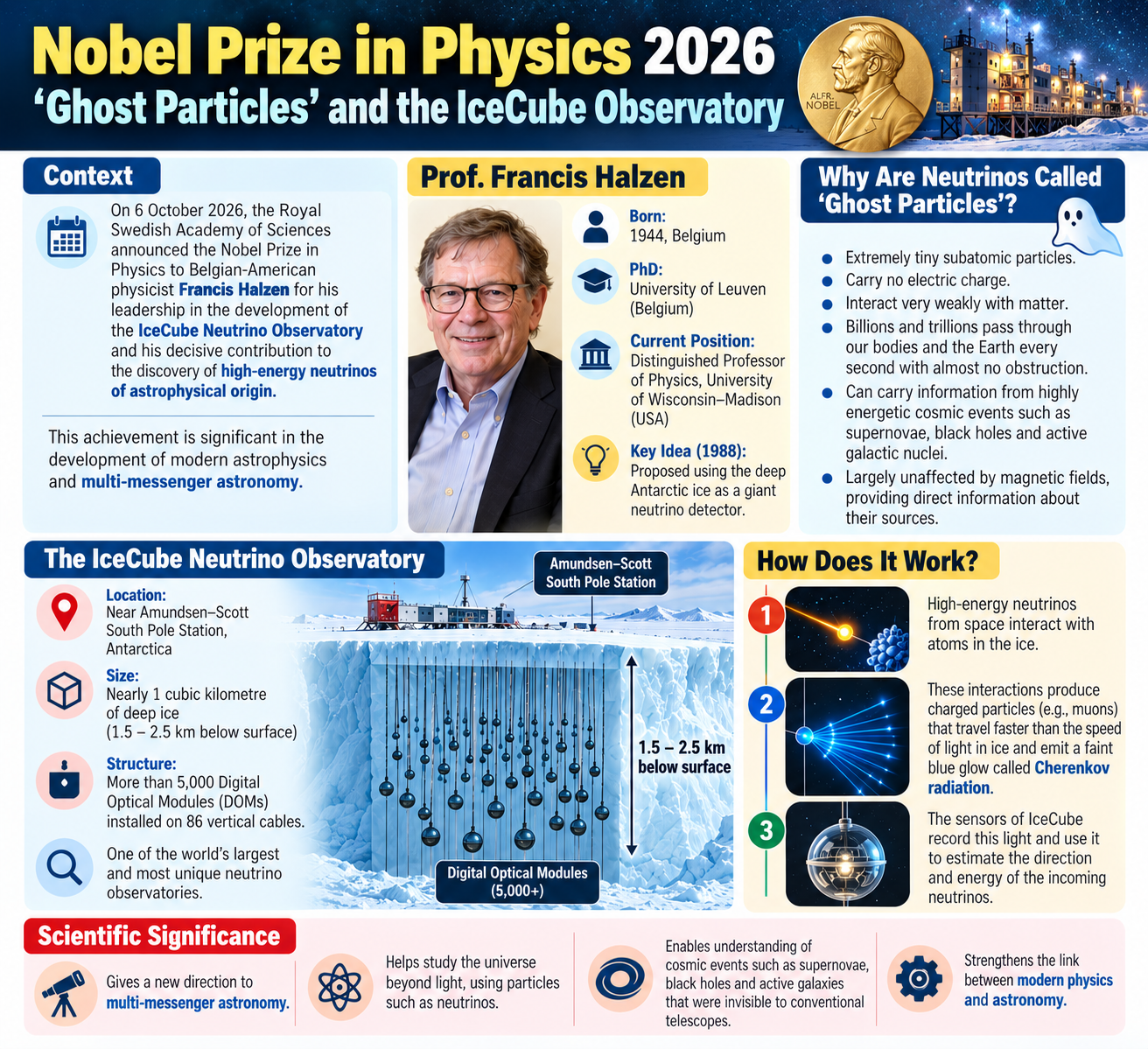
- IceCube is one of the world’s most unique and largest neutrino observatories. It is located near the Amundsen–Scott South Pole Station in Antarctica. Its detector is spread across nearly one cubic kilometre of deep Antarctic ice, approximately 1.5 to 2.5 kilometres below the surface. It consists of more than 5,000 Digital Optical Modules installed along 86 vertical cables.
- When high-energy neutrinos arriving from outer space interact with atoms in the ice, they can produce charged particles such as muons. These particles travel through the ice at speeds greater than the speed of light in ice and generate a faint blue glow known as Cherenkov radiation. The sensors of IceCube record this light and use it to estimate the direction and energy of the neutrinos.
- IceCube is one of the world’s most unique and largest neutrino observatories. It is located near the Amundsen–Scott South Pole Station in Antarctica. Its detector is spread across nearly one cubic kilometre of deep Antarctic ice, approximately 1.5 to 2.5 kilometres below the surface. It consists of more than 5,000 Digital Optical Modules installed along 86 vertical cables.
-
Why Are Neutrinos Called ‘Ghost Particles’?
-
-
- Neutrinos are extremely tiny subatomic particles. They carry no electric charge and interact only very weakly with matter. As a result, billions and trillions of neutrinos pass through our bodies and through the Earth every second with almost no obstruction. This is why they are often called ‘ghost particles’.
- Neutrinos are also highly important because they can carry information to Earth from extremely energetic cosmic events such as supernovae, black holes and active galactic nuclei. Since they are electrically neutral, they are largely unaffected by magnetic fields and can therefore provide more direct information about their sources.
- Neutrinos are extremely tiny subatomic particles. They carry no electric charge and interact only very weakly with matter. As a result, billions and trillions of neutrinos pass through our bodies and through the Earth every second with almost no obstruction. This is why they are often called ‘ghost particles’.
-
Scientific Significance:
-
-
- The achievement of Francis Halzen and the IceCube Observatory has given a new direction to multi-messenger astronomy. Scientists can now study the universe not only through light, X-rays and other forms of electromagnetic radiation, but also through particles such as neutrinos. This is helping researchers understand cosmic events that remained invisible to conventional telescopes.
- Thus, the IceCube Observatory has provided humanity with a new way of observing the universe and has further strengthened the connection between modern physics and astronomy.
- The achievement of Francis Halzen and the IceCube Observatory has given a new direction to multi-messenger astronomy. Scientists can now study the universe not only through light, X-rays and other forms of electromagnetic radiation, but also through particles such as neutrinos. This is helping researchers understand cosmic events that remained invisible to conventional telescopes.
-



