
Context:
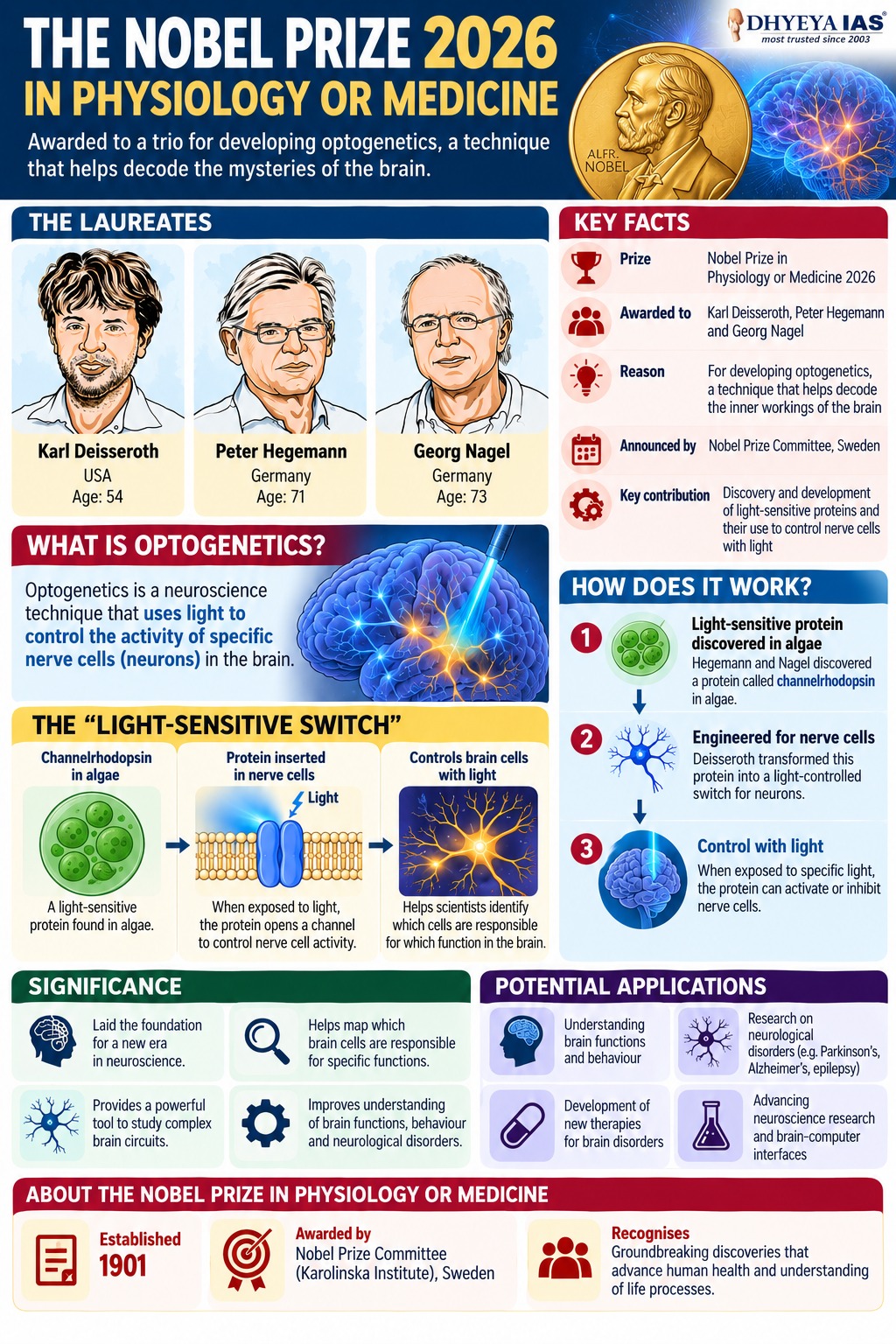
On 5 October 2026, Sweden announced the Nobel Prize in Physiology or Medicine for the year 2026. This prestigious award has been jointly given to three scientists- Karl Deisseroth (USA), Peter Hegemann (Germany), and Georg Nagel (Germany). They have been honoured for their important contributions to the development of ‘light-gated ion channels’ and optogenetics (Optogenetics), and through these, to understanding the activity of nerve cells.
What is Optogenetics?
Optogenetics is a modern technique in neuroscience in which the activity of specific nerve cells is controlled with the help of light. It uses light-sensitive proteins known as opsins.
Scientists induce the expression of these proteins in specific neurons. Then, by using a particular wavelength of light, these neurons can be activated or deactivated. This helps scientists understand how neurons present in a particular part of the brain influence behaviour, memory, emotions, and other biological processes.
Contribution of the Scientists:
Peter Hegemann and Georg Nagel made important contributions to the study of light-sensitive proteins found in microorganisms. Their research helped in understanding how the electrical activity of cells can be influenced through light.
Karl Deisseroth played an important role in applying these discoveries to the field of neuroscience. His work provided scientists with a practical method to control specific neurons in the brain with the help of light. This made it possible to study neural circuits and their relationship with behaviour more precisely.
Importance in the Field of Medicine and Science
1. Understanding Brain Function: The brain is one of the most complex organs of the human body. Optogenetics helps scientists understand how specific cells in the brain control our memories, emotions, decisions, and behaviours.
2. Treatment of Neurological Disorders: This technique has opened new avenues for the treatment of serious diseases such as Parkinson’s, Alzheimer’s, epilepsy, depression, and blindness. Through light, damaged neurons can be targeted and potentially reactivated or controlled.
3. Precision: Traditional medicines or drug treatments affect the entire brain, which can cause side effects. In contrast, optogenetics affects only those cells that are specifically targeted.
Optogenetics has strengthened the ability of neuroscience to understand “cause and effect.” Merely observing that the activity of a particular neuron is associated with a certain behaviour is not sufficient. Through optogenetics, scientists can control that neuron and examine what changes occur in behaviour when it is activated or deactivated. Thus, this technique can prove to be an important scientific tool for understanding the relationship between the brain, behaviour, and diseases.
Conclusion:
The 2026 Nobel Prize demonstrates how modern science is using a simple physical phenomenon like light to open new avenues for understanding the extremely complex biological system of the human brain. Optogenetics can play an important role in the future in improving the understanding of neurological diseases and developing potential treatments.



