
Somnath Swabhiman Parv: Faith, Identity and the Continuity of Indian Civilization
Context:
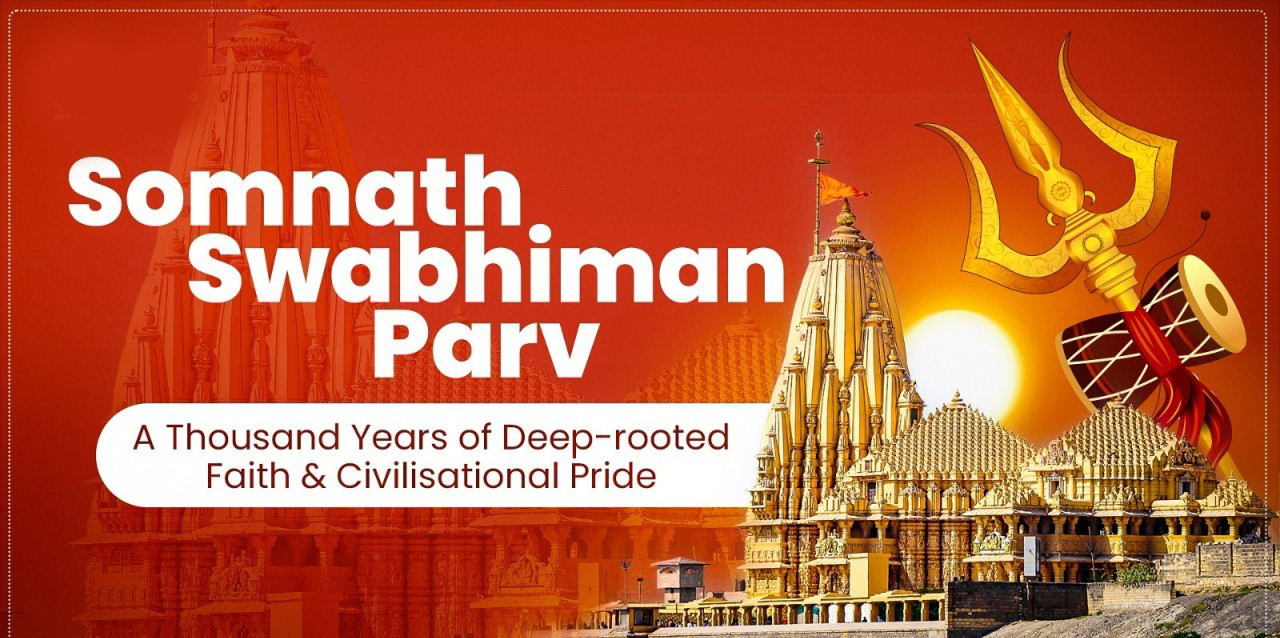
The Somnath Temple stands as a symbol of India’s spiritual continuity and indomitable national spirit. Recently, 75 years were completed since the inauguration of the reconstructed Somnath Temple in independent India. In 2026, the Government of India and the Somnath Trust are organizing the “Somnath Swabhiman Parv.”
-
-
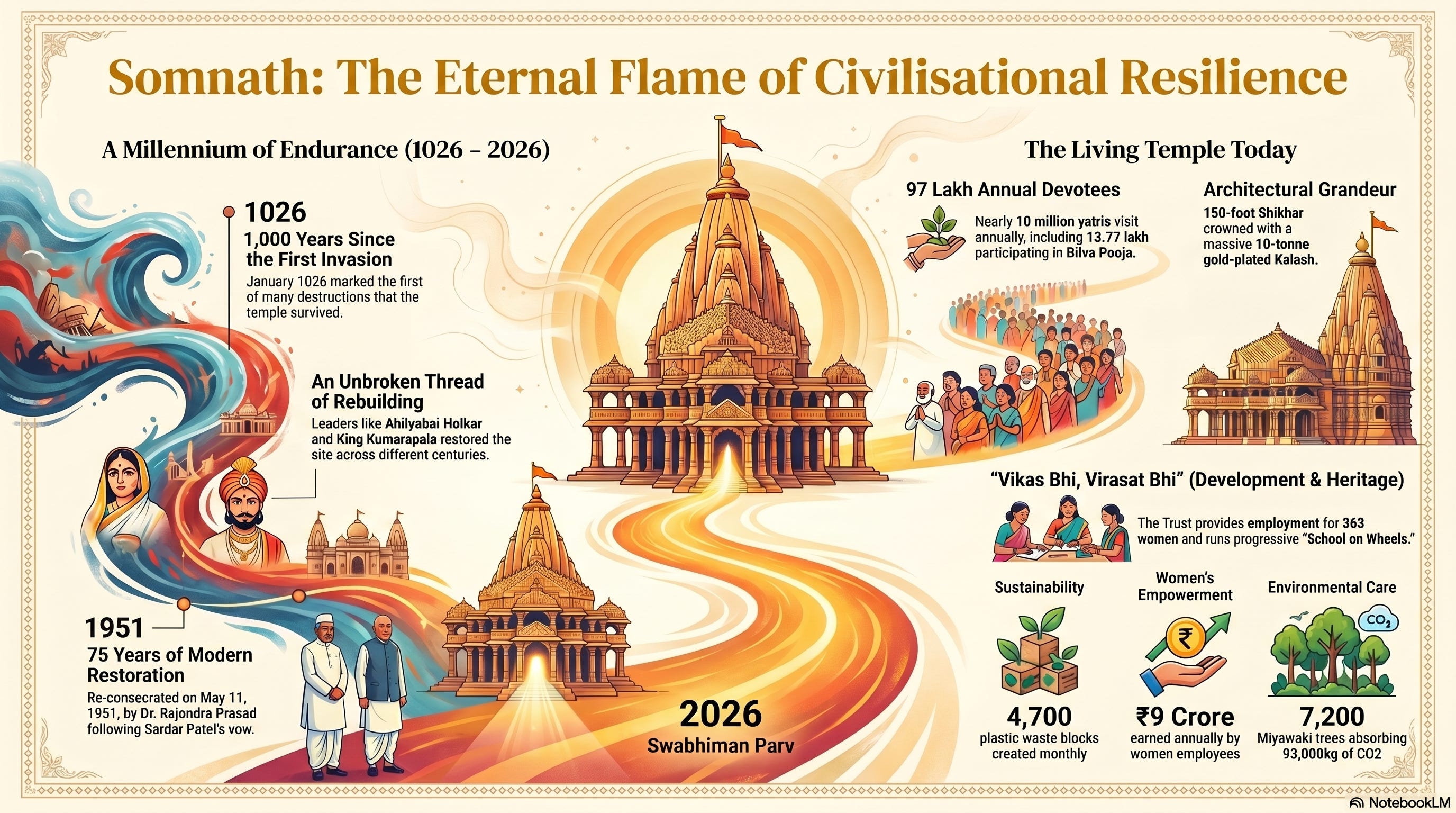
- The “Somnath Swabhiman Parv” marks two significant milestones in India’s historical journey: one thousand years since the first recorded attack on the Somnath Temple in 1026 CE and seventy-five years since the consecration of the reconstructed temple in 1951 after Independence.
- The celebration of “Somnath Swabhiman Parv” is not merely a religious event; it symbolizes the continuity of Indian civilization, cultural renaissance, and national self-confidence. At a time when India is attempting to establish itself as a “Civilizational State,” the discourse surrounding Somnath becomes even more relevant.
- The “Somnath Swabhiman Parv” marks two significant milestones in India’s historical journey: one thousand years since the first recorded attack on the Somnath Temple in 1026 CE and seventy-five years since the consecration of the reconstructed temple in 1951 after Independence.
-
Historical Background of the Somnath Temple:
-
-
- Located at Prabhas Patan in the Saurashtra region of Gujarat, the Somnath Temple is considered the first among the 12 Jyotirlingas of Lord Shiva. Since ancient times, the temple has been a major center of Indian maritime trade, religious faith, and cultural prosperity. References to the temple and the region are found in the Rigveda, Shiva Purana, Skanda Purana, and the Mahabharata.
- Rigveda: Mentions the Somnath Temple and the construction of the Jyotirlinga situated there.
- Skanda Purana: In its “Prabhas Khanda,” Somnath is described as the Adilinga (the first Jyotirlinga). It elaborately narrates the story of Chandra Deva’s penance to Lord Shiva and the construction of the temple.
- Shiva Purana: Chapter 13 mentions Someshwara Mahadeva (Somnath) as the first among the 12 Jyotirlingas.
- Mahabharata: The epic and the Bhagavata Purana refer to this place as “Prabhas Kshetra” or “Prabhas Pattana,” an important pilgrimage site. According to belief, Lord Krishna relinquished his mortal form here.
- Rigveda: Mentions the Somnath Temple and the construction of the Jyotirlinga situated there.
- Throughout history, the temple faced several invasions, but the attack by Mahmud of Ghazni in 1026 CE remains the most widely discussed. During this invasion, the temple’s wealth was looted and the structure suffered severe damage.
- However, the Somnath Temple was rebuilt every time. This is why the temple is not merely a religious symbol but also represents the cultural resilience and regenerative capacity of Indian society.
- Located at Prabhas Patan in the Saurashtra region of Gujarat, the Somnath Temple is considered the first among the 12 Jyotirlingas of Lord Shiva. Since ancient times, the temple has been a major center of Indian maritime trade, religious faith, and cultural prosperity. References to the temple and the region are found in the Rigveda, Shiva Purana, Skanda Purana, and the Mahabharata.
-
Independent India and the Reconstruction of Somnath:
-
-
- After Independence, India’s first Deputy Prime Minister and Home Minister, Sardar Vallabhbhai Patel, initiated the reconstruction of the Somnath Temple. This decision was not merely religious in nature; it was linked to national pride and cultural renaissance.
- At that time, India was struggling with the trauma of Partition, communal tensions, and a colonial mindset. In such circumstances, the reconstruction of Somnath conveyed the message that India sought to reconnect with its cultural roots. K.M. Munshi described it as the “revival of the soul of the nation.”
- In 1951, India’s first President, Rajendra Prasad, inaugurated the temple. He stated, “The reconstruction of Somnath symbolizes the resurgence of a nation that has regained its identity after centuries of subjugation.”
- After Independence, India’s first Deputy Prime Minister and Home Minister, Sardar Vallabhbhai Patel, initiated the reconstruction of the Somnath Temple. This decision was not merely religious in nature; it was linked to national pride and cultural renaissance.
-
|
Architectural Style of the Somnath Temple: The present temple has been built in the ‘Chalukyan’ or ‘Solanki’ architectural style. It belongs to the ‘Mahamuru’ type of temple architecture, known for its grandeur. The outer and inner walls of the temple are intricately carved with depictions of deities, apsaras, and animals. The present temple was designed by the renowned architect Prabhashankar Sompura. Structure of the Temple: The temple is mainly divided into three sections—the Garbhagriha (sanctum sanctorum), Sabhamandapa (assembly hall), and Nrityamandapa (dance hall/entrance section).
Baan Stambh (Arrow Pillar):
|
Somnath Swabhiman Parv and Cultural Heritage:
-
-
- The Indian Constitution views “secularism” as equal respect for all religions rather than opposition to religion. Therefore, governments in India have actively participated in the preservation of religious and cultural heritage.
- In recent years, the trend of “cultural renaissance” has gained momentum in India. Projects such as the Kashi Vishwanath Corridor, Mahakal Lok, Ram Mandir, and Somnath are being presented not merely as religious initiatives but as symbols of cultural-national identity.
- The Somnath Swabhiman Parv is also considered part of this broader cultural renaissance. Through this event, India is bringing its historical memories, religious sites, and cultural symbols back to the center of national discourse.
- India is now presenting itself not merely as a modern political nation but as a civilization with thousands of years of cultural tradition.
- The Indian Constitution views “secularism” as equal respect for all religions rather than opposition to religion. Therefore, governments in India have actively participated in the preservation of religious and cultural heritage.
-
The Concept of a Civilizational State and India:
-
-
- The significance of Somnath is not confined to religion alone. It reflects a defining characteristic of Indian civilization—the ability to rebuild even after destruction.
- Indian civilization has faced invasions, colonial rule, cultural suppression, and Partition, yet its fundamental cultural stream has continued uninterrupted. Somnath symbolizes this “civilizational continuity.”
- Today, the concept of a “Civilizational State” is gaining increasing attention in international politics. Countries such as China, Türkiye, and Russia are attempting to connect their historical-cultural identities with modern politics. India, too, is presenting itself not merely as a modern political entity but as a nation rooted in an ancient cultural tradition. Symbols such as Somnath, Kashi, Ayodhya, and Nalanda strengthen this discourse.
- The significance of Somnath is not confined to religion alone. It reflects a defining characteristic of Indian civilization—the ability to rebuild even after destruction.
-
Heritage Conservation and Economic Development:
-
-
- The significance of Somnath is not only cultural but also economic. Religious tourism is growing rapidly in India. Under schemes such as PRASAD and Swadesh Darshan, pilgrimage sites are being connected with modern infrastructure.
- Every year, the Somnath Temple attracts millions of devotees and tourists, thereby boosting local employment, the hotel industry, handicrafts, and the transport sector.
- Thus, heritage conservation is increasingly becoming an important part of the “cultural economy.” This also demonstrates that modern development and cultural preservation are not contradictory but complementary to each other.
- The significance of Somnath is not only cultural but also economic. Religious tourism is growing rapidly in India. Under schemes such as PRASAD and Swadesh Darshan, pilgrimage sites are being connected with modern infrastructure.
-
India’s Soft Power and Somnath:
-
-
- At the global level, India is attempting to strengthen its “soft power.” Along with yoga, Ayurveda, Buddhist heritage, and Indian philosophy, the importance of religious-cultural sites is also increasing.
- Places such as Somnath present the antiquity and vibrancy of Indian culture before the world. This strengthens India’s image as a civilization based on diversity, tolerance, and cultural continuity.
- Additionally, for the Indian diaspora, such sites serve as a medium of cultural connection and identity.
- At the global level, India is attempting to strengthen its “soft power.” Along with yoga, Ayurveda, Buddhist heritage, and Indian philosophy, the importance of religious-cultural sites is also increasing.
-
Major Challenges:
Although the resurgence of Somnath presents positive symbolism, certain challenges remain:
-
-
- Politicization of History – Selective interpretation of historical events may increase social polarization.
- Question of Inclusivity – Cultural renaissance must remain aligned with India’s pluralistic traditions.
- Commercialization – Excessive commercial development of pilgrimage sites may affect their spiritual identity.
- Heritage Conservation vs Modernization – A balance between modern facilities and original architecture is essential.
- Historical Authenticity – It is necessary to preserve the historical character during reconstruction and beautification.
- Politicization of History – Selective interpretation of historical events may increase social polarization.
-
Conclusion:
The thousand-year journey of Somnath and the seventy-five years of its reconstruction do not merely represent the history of a temple; they represent the history of the vitality and regenerative power of Indian civilization. At a time when India is strengthening its cultural identity and soft power on the global stage, symbols such as Somnath convey that the true strength of a nation lies not only in its economy or military capability, but also in its cultural memory and civilizational confidence.



