
Context:
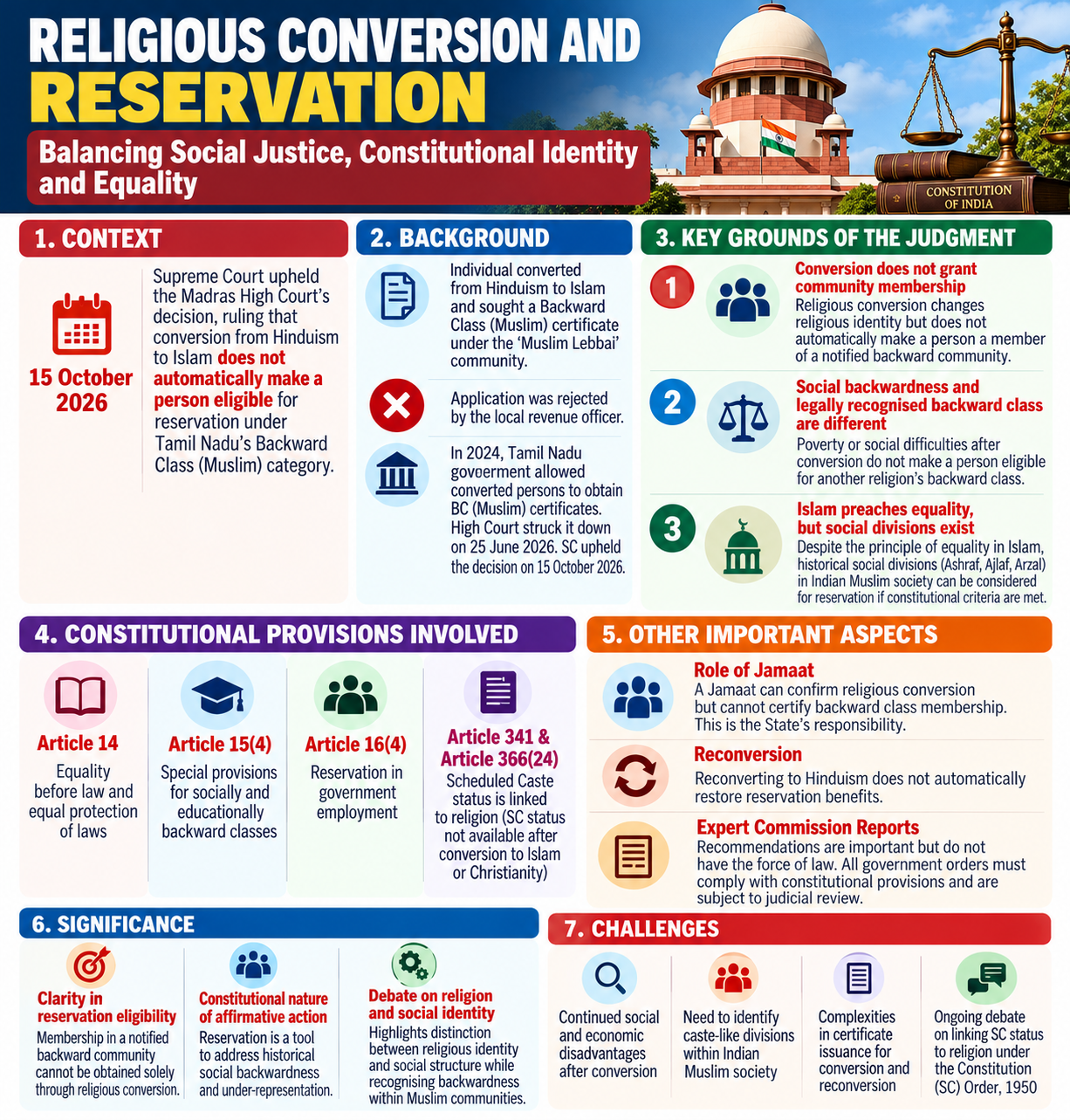
Recently, on October 15, 2026, the Supreme Court upheld the Madras High Court's decision in a case concerning reservation under the Backward Class (Muslim) category in Tamil Nadu following religious conversion. The Court clarified that merely converting from Hinduism to Islam does not automatically make a person eligible for reservation under Tamil Nadu's notified Backward Class (Muslim) category. This decision has brought the constitutional foundations of religious conversion, caste identity, social backwardness and affirmative action into the centre of public debate.
Background of the Case:
-
-
- The case concerned an individual who had converted from Hinduism to Islam. Subsequently, he applied for a certificate recognising him as a member of the 'Muslim Lebbai' community, which is included in Tamil Nadu's Backward Class (Muslim) list. However, the local revenue officer rejected his application, following which he approached the Madras High Court.
- Meanwhile, in 2024, the Tamil Nadu government issued a government order permitting individuals belonging to the Backward Class (BC), Most Backward Class (MBC), Denotified Communities (DNC) or Scheduled Castes (SC) who converted to Islam to obtain certificates under any of the state's seven notified Muslim Backward Class categories.
- These seven communities include Deccani Muslims, Dudekula, Labbai (including Rowther and Marakayar), Mapilla, Sheikh, Syed and Ansar. A 3.5% reservation is provided to these communities in Tamil Nadu under a state law enacted in 2007.
- On June 25, 2026, the Madras High Court struck down this government order. Subsequently, the state government appealed to the Supreme Court. On October 15, 2026, a Bench comprising Justice Prashant Kumar Mishra and Justice S. Chandrashekhar upheld the High Court's decision.
- The case concerned an individual who had converted from Hinduism to Islam. Subsequently, he applied for a certificate recognising him as a member of the 'Muslim Lebbai' community, which is included in Tamil Nadu's Backward Class (Muslim) list. However, the local revenue officer rejected his application, following which he approached the Madras High Court.
-
Key Grounds of the Supreme Court's Judgment:
-
-
- Religious Conversion Does Not Automatically Grant Membership of a Backward Class:
- The Court clarified that religious conversion changes an individual's religious identity but does not automatically confer membership in a particular social community. For example, a person who converts to Islam cannot be considered a member of the Muslim Lebbai community or any other notified Muslim backward community solely on the basis of religious conversion.
- According to the Court, the identity of these communities is based on their shared history, ancestry, occupation and social relationships. Therefore, inclusion in these communities requires compliance with the prescribed social and legal criteria.
- The Court clarified that religious conversion changes an individual's religious identity but does not automatically confer membership in a particular social community. For example, a person who converts to Islam cannot be considered a member of the Muslim Lebbai community or any other notified Muslim backward community solely on the basis of religious conversion.
- Social Backwardness and Legally Recognised Backward Class Are Different Concepts:
- The Court clarified the distinction between social backwardness and membership of a constitutionally recognised backward class. Even after religious conversion, an individual may continue to face poverty, illiteracy, unemployment and other social difficulties. However, these circumstances alone do not make the person a member of another religion's notified backward community.
- In other words, reservation is not an individual or transferable right. Rather, it is linked to the identity of a social group recognised under the Constitution and its backward social status.
- The Court clarified the distinction between social backwardness and membership of a constitutionally recognised backward class. Even after religious conversion, an individual may continue to face poverty, illiteracy, unemployment and other social difficulties. However, these circumstances alone do not make the person a member of another religion's notified backward community.
- The Principle of Equality in Islam and the Social Structure of Indian Muslim Society:
- The Court emphasised the principle of equality in the fundamental teachings of Islam, where religious conduct and morality are given importance rather than birth-based social hierarchy. However, it also acknowledged the historical existence of social classifications such as Ashraf, Ajlaf and Arzal within Indian Muslim society.
- The Court recognised that despite the concept of equality in religious teachings, the historical and social divisions existing in Indian society cannot be ignored. Therefore, Muslim communities can also receive reservation as Backward Classes if they fulfil the constitutional requirements.
- The Court emphasised the principle of equality in the fundamental teachings of Islam, where religious conduct and morality are given importance rather than birth-based social hierarchy. However, it also acknowledged the historical existence of social classifications such as Ashraf, Ajlaf and Arzal within Indian Muslim society.
- Religious Conversion Does Not Automatically Grant Membership of a Backward Class:
-
Constitutional Provisions and Legal Position:
To understand this judgment, it is necessary to examine some important provisions of the Indian Constitution.
-
-
- Article 14: Equality Before Law: Article 14 guarantees equality before the law and equal protection of the laws to all persons. Any reservation policy introduced by the State must be consistent with the constitutional principles of equality and reasonable classification. In this case, the Court clarified that including an individual in a notified backward class without establishing the prescribed social identity would not be consistent with the constitutional principle of equality.
- Article 15(4): Special Provisions for Socially and Educationally Backward Classes: Article 15(4) empowers the State to make special provisions for the advancement of socially and educationally backward classes, Scheduled Castes and Scheduled Tribes. Its objective is to address historical inequalities and provide equal opportunities in the field of education.
- Article 16(4): Reservation in Government Employment: Article 16(4) allows the State to provide reservation in government appointments for backward classes that are not adequately represented in state services. The Supreme Court clarified that the benefit of reservation is linked to a constitutionally recognised backward class and is not a transferable right derived from an individual's previous social identity.
- Article 341 and Article 366(24): Identification of Scheduled Castes: Under Article 341, communities notified by the President are granted Scheduled Caste status. Article 366(24) defines Scheduled Castes as those castes, races or tribes that have been notified under Article 341.
- Article 14: Equality Before Law: Article 14 guarantees equality before the law and equal protection of the laws to all persons. Any reservation policy introduced by the State must be consistent with the constitutional principles of equality and reasonable classification. In this case, the Court clarified that including an individual in a notified backward class without establishing the prescribed social identity would not be consistent with the constitutional principle of equality.
- According to Clause 3 of the Constitution (Scheduled Castes) Order, 1950, a person professing a religion other than Hinduism, Sikhism or Buddhism cannot be recognised as a member of a Scheduled Caste. Thus, under this Order, conversion to Islam or Christianity results in the loss of Scheduled Caste status.
-
Other Important Aspects of the Judgment:
-
-
- Role of Jamaat and Responsibility of the State: The Tamil Nadu government argued that the concerned Muslim religious institution (Jamaat) could certify the community identity of a person converting to Islam. The Supreme Court clarified that while a Jamaat may confirm religious conversion, its certificate alone cannot establish an individual's legal membership in a backward class. This responsibility lies with the concerned government authority.
- Position in Cases of Reconversion: The Court also clarified that if an individual reconverts to Hinduism, the person does not automatically regain reservation benefits merely on the basis of their previous caste identity. The competent authority must determine, based on the facts, whether the individual's original caste identity has genuinely been re-established.
- Recommendations of Expert Commissions: The Court observed that recommendations made by a Backward Classes Commission may be important, but expert recommendations do not automatically acquire the force of law. Every government order must comply with Articles 14, 15(4) and 16(4) of the Constitution and remains subject to judicial review.
- Role of Jamaat and Responsibility of the State: The Tamil Nadu government argued that the concerned Muslim religious institution (Jamaat) could certify the community identity of a person converting to Islam. The Supreme Court clarified that while a Jamaat may confirm religious conversion, its certificate alone cannot establish an individual's legal membership in a backward class. This responsibility lies with the concerned government authority.
-
Broader Significance of the Judgment:
This judgment highlights the importance of social identity and constitutional eligibility within India's reservation system. Its implications can be understood in the following areas:
-
-
- Clarity in Reservation Eligibility: The judgment establishes that membership in a notified backward community cannot be acquired solely through religious conversion. It increases the importance of social and legal criteria in determining reservation eligibility.
- Constitutional Nature of Affirmative Action: The Court clarified that reservation is not an individual benefit but a constitutional instrument to address historical social backwardness and inadequate representation.
- Debate on the Relationship Between Religion and Social Identity: The judgment highlights the distinction between religious identity and social structure. It also recognises that certain communities within Indian Muslim society have historically faced social and educational backwardness.
- Accountability of the State: Governments can formulate policies to promote social justice, but such policies must be based on constitutional provisions, reliable social data and established legal procedures.
- Clarity in Reservation Eligibility: The judgment establishes that membership in a notified backward community cannot be acquired solely through religious conversion. It increases the importance of social and legal criteria in determining reservation eligibility.
-
Challenges:
-
-
- Although this judgment clarifies the legal eligibility for reservation, it also raises several important questions.
- The social and economic difficulties faced by an individual do not disappear immediately after religious conversion. If a person has previously experienced caste-based discrimination, poverty and educational deprivation, their effects may continue even after conversion. Therefore, assessing social backwardness solely on the basis of religious identity may not be sufficient.
- It is necessary to identify caste-like social divisions and historical deprivation within Indian Muslim society. Social realities cannot be understood solely through the principles of religious teachings.
- The process of issuing certificates in cases involving religious conversion and reconversion may also become complicated. In the absence of clear administrative guidelines, eligible individuals may face unnecessary difficulties.
- Furthermore, the provisions of the Constitution (Scheduled Castes) Order, 1950, which link Scheduled Caste status to religion, have long been a subject of debate. Therefore, continuous constitutional deliberation on this issue is necessary in accordance with the broader objectives of social justice and equality.
- Although this judgment clarifies the legal eligibility for reservation, it also raises several important questions.
-
Way Forward:
To establish a balance between social justice and constitutional equality in this matter, the following steps can be taken:
-
-
- Scientific Social Surveys: Data related to education, employment, income and social representation across different religious communities should be collected to identify actual backwardness.
- Assessment of Deprivation Beyond Religion: Reservation policies should consider not only social and educational backwardness but also historical deprivation and the level of representation.
- Clear Administrative Guidelines: The process of issuing certificates in cases of religious conversion and reconversion should be transparent and time-bound.
- Institutional Accountability: Recommendations made by Backward Classes Commissions should be based on reliable data and constitutional criteria.
- Judicial Oversight: The mechanism of judicial review should remain effective to ensure the constitutional validity of government orders relating to reservation.
- Scientific Social Surveys: Data related to education, employment, income and social representation across different religious communities should be collected to identify actual backwardness.
-
Conclusion:
-
-
- The Supreme Court's judgment clarifies that the objective of reservation is not merely to provide individual economic assistance but to eliminate historical social inequalities and ensure equal opportunities for disadvantaged communities. At the same time, it is essential that reservation benefits are provided in accordance with established constitutional and legal criteria.
- However, the reality of an individual's social and economic backwardness cannot be ignored even after religious conversion. Therefore, India's reservation system should be based not only on religious identity but also on social realities, historical deprivation and an objective assessment of representation. Ultimately, the success of social justice lies in establishing a balance between the constitutional principle of equality and the objective of providing special opportunities to disadvantaged sections of society.
- The Supreme Court's judgment clarifies that the objective of reservation is not merely to provide individual economic assistance but to eliminate historical social inequalities and ensure equal opportunities for disadvantaged communities. At the same time, it is essential that reservation benefits are provided in accordance with established constitutional and legal criteria.
-