
Context:
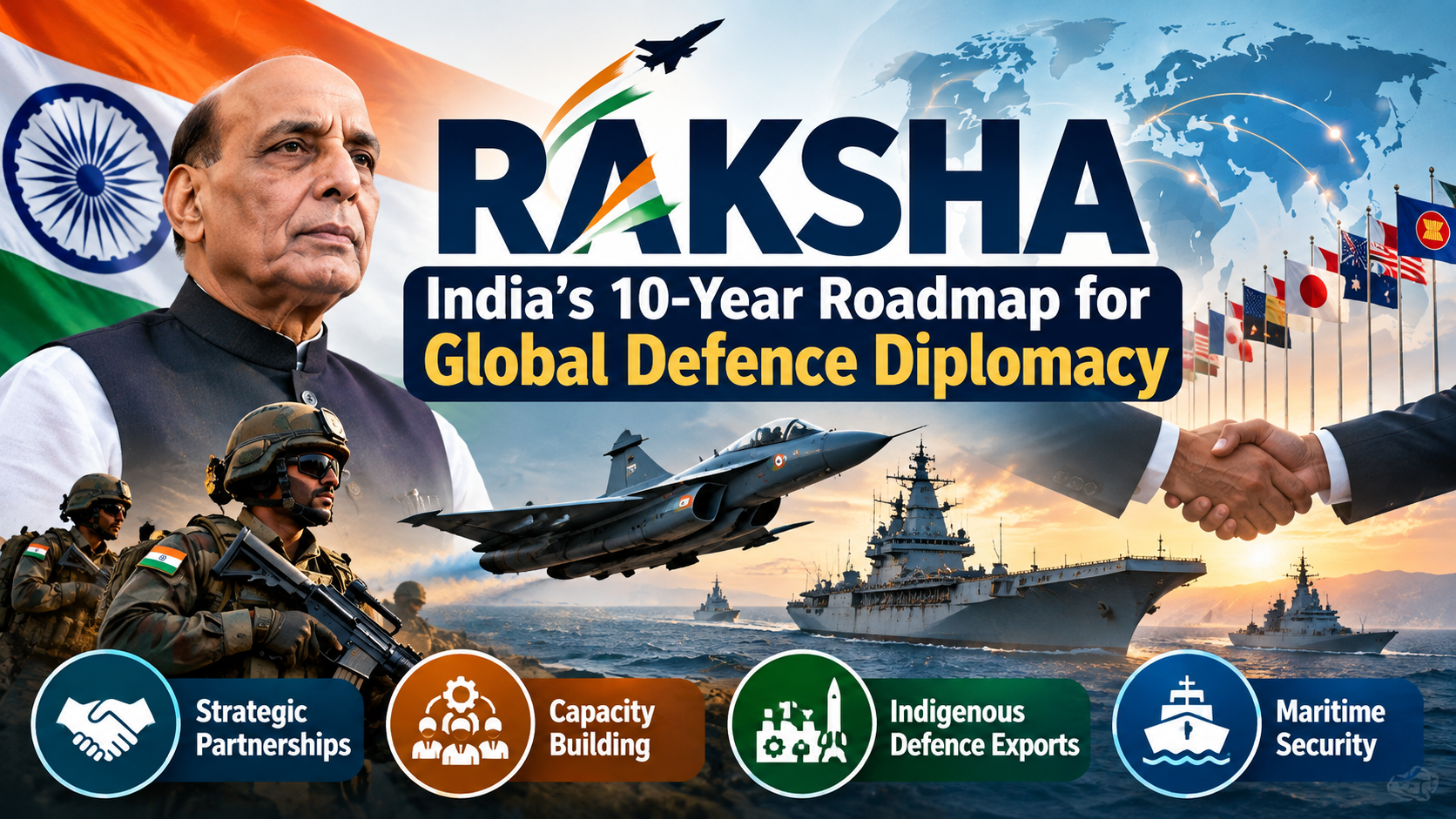
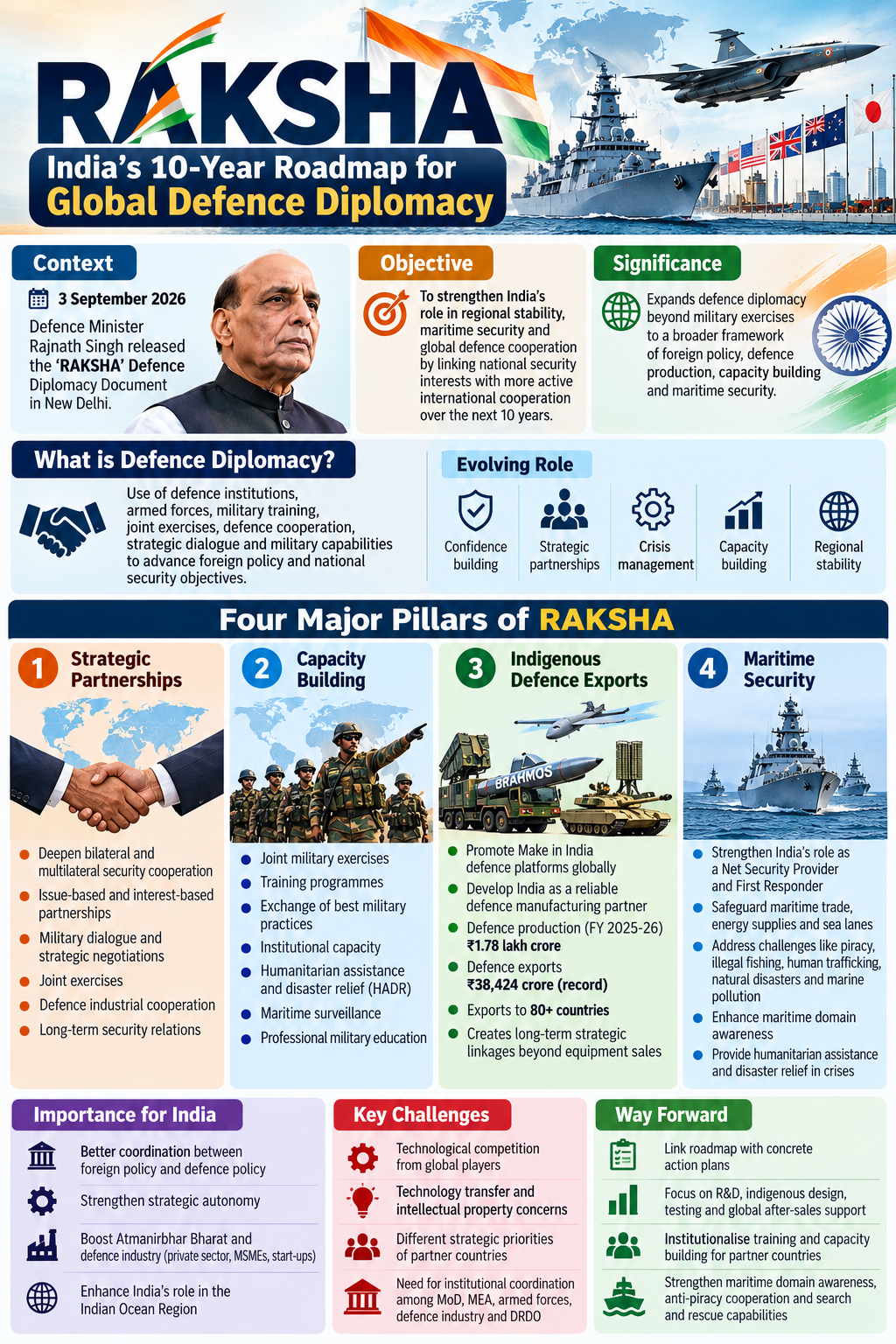
Recently, on 3 September 2026, Defence Minister Rajnath Singh released the ‘RAKSHA’ Defence Diplomacy Document in New Delhi. This document presents the strategic direction for India’s global defence partnerships, security cooperation, and defence diplomacy over the next 10 years. Its objective is to strengthen India’s role in regional stability, maritime security, and global defence cooperation by linking national security interests with more active international cooperation.
Through RAKSHA, India has attempted to expand defence diplomacy beyond military exercises and defence relations by linking it with foreign policy, defence production, capacity building, and maritime security within a broader framework.
What is Defence Diplomacy?
Defence Diplomacy refers to the use of defence institutions, armed forces, military training, joint exercises, defence cooperation, strategic dialogue, and military capabilities to advance foreign policy and national security objectives.
Traditionally, the primary objective of defence policy has been to protect the country in the event of war. However, in the changing global order, defence capabilities are also being used for confidence building, strategic partnerships, crisis management, capacity building, and regional stability.
The defence document seeks to institutionalise this broader approach. According to the Ministry of Defence, defence diplomacy is an important pillar of India’s foreign policy, and the new document presents a clear and actionable vision for the coming decade.
Four Major Pillars of RAKSHA
1. Strategic Partnerships
The first pillar of RAKSHA is to deepen bilateral and multilateral security cooperation. In the current global order, instead of depending on any single power, India is developing issue-based and interest-based partnerships with different countries.
This includes military dialogue, strategic negotiations, joint exercises, defence industrial cooperation, and building long-term security relations.
Such partnerships are important for India because the contemporary security environment has become increasingly complex and multidimensional. Along with conventional warfare, risks related to cybersecurity, space, drones, maritime security, terrorism, and critical technologies are also increasing.
In this context, defence diplomacy can provide India with opportunities to exchange experience, technology, and security information with different countries.
2. Capacity Building
The second important pillar is Capacity Building. It includes joint military exercises, training programmes, and the exchange of best military practices with friendly countries.
Capacity building should not be viewed merely as the provision of military equipment. It can also include military training, institutional capacity, humanitarian assistance and disaster relief, maritime surveillance, and professional military education.
For India, a major advantage is that this can strengthen the security capabilities of partner countries while also developing long-term institutional relationships with them.
3. Indigenous Defence Exports
The third pillar of RAKSHA is Indigenous Defence Exports. Its objective is to establish defence platforms developed under Make in India in global markets and develop India as a reliable defence manufacturing partner.
This initiative is important against the background of India’s changing defence economy. In FY 2025–26, India’s defence production reached approximately ₹1.78 lakh crore, while defence exports touched a record ₹38,424 crore. According to the Ministry of Defence, Indian defence products are being exported to more than 80 countries.
This shows that defence exports are no longer merely an economic activity; they can also become an instrument of foreign policy. Defence relations between two countries do not remain limited to the purchase of equipment. They can also lead to training, maintenance, technical assistance, logistics, and long-term institutional linkages.
Thus, RAKSHA represents an important step towards strengthening the relationship between defence production and foreign policy.
4. Maritime Security
The fourth pillar of RAKSHA is Maritime Security. It emphasises strengthening India’s role in the Indian Ocean Region as a Net Security Provider and First Responder.
India’s geographical location makes it naturally important in the Indian Ocean Region. India’s maritime trade, energy supplies, sea lines of communication, and island neighbourhood are directly linked to maritime security.
Challenges such as piracy, illegal fishing, human trafficking, natural disasters, marine pollution, and the security of important maritime routes have increased the importance of cooperation in the Indian Ocean.
Through its role as a First Responder, India can strengthen its ability to provide humanitarian assistance, disaster relief, and necessary security cooperation during crises.
Significance of RAKSHA for India
1. Better Coordination between Foreign Policy and Defence Policy
India’s foreign policy increasingly gives importance to the interrelationship between security, economy, technology, and strategic interests. By making defence diplomacy an institutional component of foreign policy, RAKSHA can provide a basis for better coordination between the two domains.
2. Strengthening Strategic Autonomy
India has long emphasised the policy of Strategic Autonomy. By developing relations with multiple countries through defence diplomacy, India can move towards reducing excessive dependence on any single source, market, or partner.
However, multi-partnership does not mean joining a military alliance. The challenge for India will be to maintain its independent decision-making capability while expanding cooperation.
3. Atmanirbhar Bharat and the Defence Industry
The growth of India’s defence production capabilities has created opportunities for the private sector, MSMEs, and start-ups. In April 2026, the Ministry of Defence stated that defence exports had reached ₹38,424 crore in FY 2025–26, with contributions from both the public and private sectors.
RAKSHA can connect this industrial capability with international markets and strategic partnerships.
4. India’s Role in the Indian Ocean Region
The Indian Ocean is extremely important for India’s security and economic interests. Through maritime cooperation, joint exercises, coastal surveillance, and Humanitarian Assistance and Disaster Relief (HADR) activities, India can strengthen security relations with regional countries.
Major Challenges
Technological Competition:
The global defence market is already strongly competitive, with countries such as the United States, Russia, France, and Israel, among others, having well-established positions. Indian products will have to compete on the basis of quality, cost, timely delivery, and after-sales services.
Technology Transfer and Intellectual Property:
While cooperating in advanced defence technologies, it will be necessary to maintain a balance between national security interests and commercial interests.
Different Strategic Priorities of Partner Countries:
India will have to balance its relations simultaneously with Western countries, Russia, West Asia, Africa, and the Indo-Pacific region.
Institutional Coordination:
Effective defence diplomacy will require continuous coordination among the Ministry of Defence, Ministry of External Affairs, armed forces, defence industry, DRDO, and other institutions.
Way Forward
For RAKSHA to be effective, high-level strategic declarations alone will not be sufficient. It must be linked with concrete action plans.
Along with defence exports, India will need to focus on defence research and development, indigenous design, testing capabilities, and global after-sales support.
At the same time, training and capacity-building programmes for partner countries can be made more institutionalised. Indian military training institutions can be used to develop long-term training programmes for foreign military officers.
In the Indian Ocean Region, India can further strengthen maritime domain awareness, humanitarian assistance and disaster relief, anti-piracy cooperation, and search-and-rescue capabilities.
Conclusion
RAKSHA is a document that provides a broad strategic direction to India’s defence diplomacy for the next decade. Its significance is not limited to military cooperation; it seeks to bring defence diplomacy, strategic partnerships, self-reliant defence production, and maritime security within a common framework.
For India, the real challenge will be to translate this roadmap from a declaratory document into tangible outcomes. If strategic partnerships are effectively linked with reliable defence production, technological innovation, capacity building, and maritime cooperation, defence diplomacy can become a more effective instrument of India’s broader foreign policy and national security strategy.
From this perspective, RAKSHA should not be understood merely as a 10-year defence plan, but rather as an effort to integrate security, diplomacy, and the defence economy into India’s emerging global role.



