
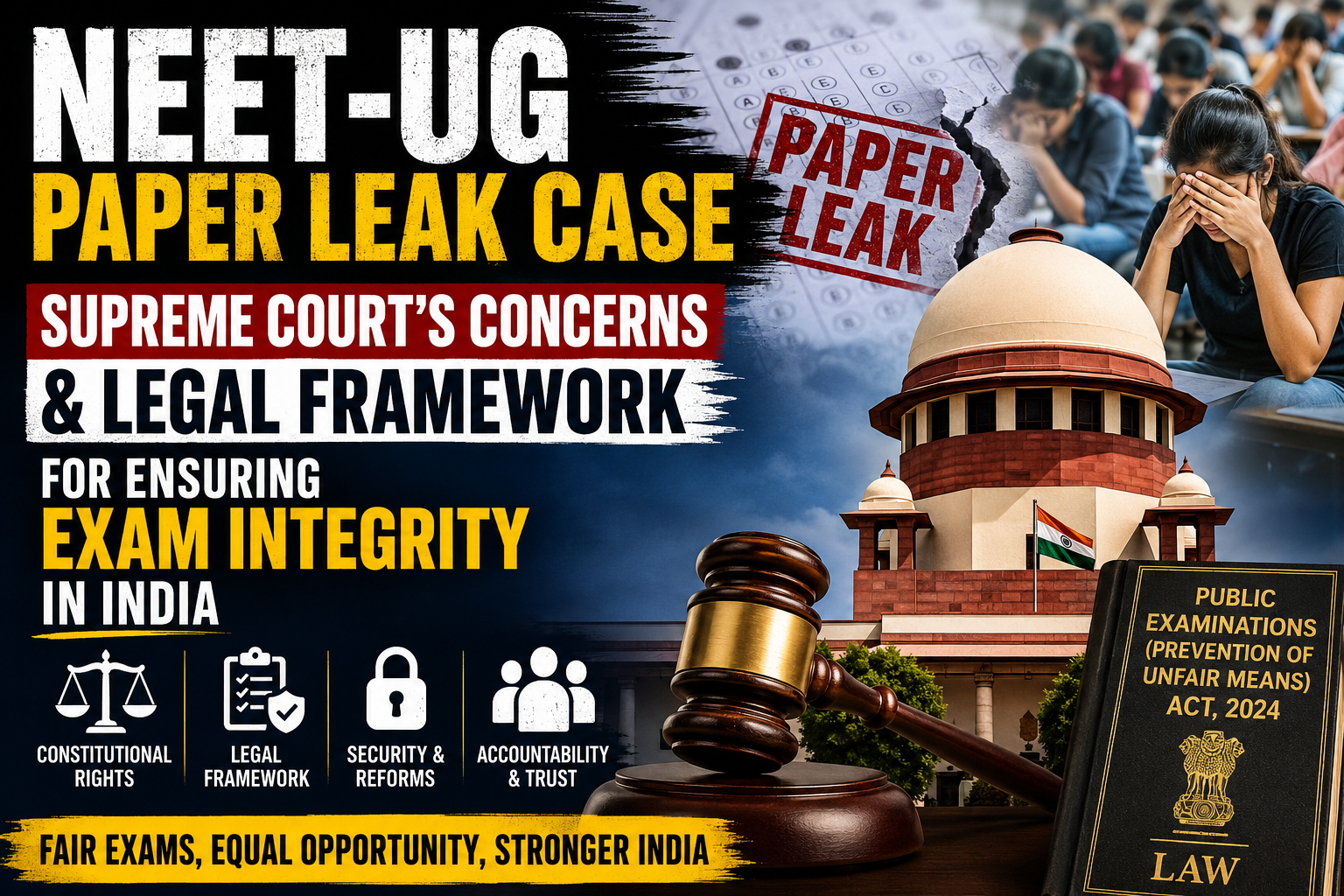
Context
India’s competitive examination system forms the foundation of the aspirations of millions of young people. Examinations conducted for admission to medical, engineering, civil services, and other higher educational institutions are not only a means of career advancement but also serve as the cornerstone of social mobility and equal opportunity. In this context, the recent NEET-UG paper leak incident has challenged not only the credibility of a single examination but also the integrity of India’s merit-based selection system, educational administration, and public institutions. The cancellation of the examination and the subsequent re-test have raised serious questions regarding the fairness and reliability of the National Testing Agency (NTA) and the country’s public examination system.
Observations of the Supreme Court
During the hearing of the NEET-UG controversy, the Supreme Court strongly criticized the repeated failures in conducting secure and fair examinations. The Court observed that such incidents have caused immense psychological and emotional distress to millions of students and their families.
The key concerns raised by the Court included:
- Severe mental and emotional harm suffered by students and their families.
- Growing crisis of trust in national-level entrance examinations.
- Absence of a clear accountability mechanism within the examination system.
- “Ad-hocism” in examination administration and weak institutional memory.
- Failure to establish individual accountability of responsible officials.
The Supreme Court emphasized that merely constituting new committees or introducing procedural changes would not solve the problem; rather, accountability and institutional reforms must be ensured.
Constitutional Dimension of Exam Integrity
Paper leaks are not merely administrative or legal issues; they directly relate to the constitutional principles of equality and justice.
Article 14
This Article guarantees equality before the law and equal protection of the laws to all individuals. When the examination process becomes unfair and some candidates gain unauthorized access to question papers, equal treatment is denied to all aspirants, resulting in a violation of Article 14.
Article 16
This Article guarantees equality of opportunity in matters of public employment. Many competitive examinations serve as the gateway to government services and public institutions. If examinations are compromised through malpractice or paper leaks, deserving candidates are deprived of fair opportunities, thereby weakening the principle of equal opportunity.
Article 21
Through its expansive interpretation, the Supreme Court has recognized dignified life, fair procedures, and equitable opportunities as part of Article 21. Paper leaks subject students to stress, uncertainty, and insecurity regarding their future, adversely affecting their right to a dignified life and fair opportunities.
Government and NTA’s Response
The National Testing Agency (NTA), in its affidavit before the Supreme Court, outlined several reforms undertaken following the paper leak incident. These measures include strengthening security protocols, improving logistics arrangements, and enhancing monitoring mechanisms.
Major steps include:
- Secure printing arrangements under the supervision of senior officials.
- Use of the Department of Posts and Central Armed Police Forces (CAPF) for transportation of question papers.
- CCTV surveillance and preservation of digital records.
- Preparation of multiple sets of question papers, including backup arrangements.
- Isolation of question paper setters and implementation of controlled access systems.
- Adoption of stricter Standard Operating Procedures (SOPs).
Present Structure of the National Testing Agency (NTA)
Following the NEET controversy, concerns have emerged not only regarding security measures but also about the institutional capacity of the NTA itself.
Major Institutional Challenges
- The NTA, established in 2017, still has a limited permanent administrative structure.
- Excessive dependence on outsourcing for examination operations.
- Frequent transfers of key officials.
- Lack of institutional memory and experience.
- Highly centralized examination management.
The Supreme Court’s reference to “ad-hocism” is closely linked to these structural weaknesses.
Legal Framework to Prevent Examination Leaks
A major legal safeguard against paper leaks and examination fraud in India is the Public Examinations (Prevention of Unfair Means) Act, 2024, which came into force on 21 June 2024. The law was enacted to curb organized examination fraud, question paper leaks, and the misuse of technology.
Key Features of the Act
(A) Scope and Applicability
- Applicable to major public examinations notified by the Central Government.
- Includes NEET, JEE, UPSC, SSC, CUET, and other significant examinations.
(B) Definition of Unfair Means
The Act defines various offences, including:
- Leakage or unauthorized disclosure of question papers.
- Tampering with OMR sheets or computer systems.
- Providing illegal assistance to candidates during examinations.
- Impersonation and fraudulent conduct of examinations.
- Cyber manipulation and hacking of examination systems.
(C) Stringent Punitive Provisions
- For individuals involved in cheating or paper leaks: imprisonment of 3 to 5 years and a fine up to ₹10 lakh.
- For organized criminal networks or “education mafias”: imprisonment of 5 to 10 years and fines exceeding ₹1 crore.
- For service providers involved in malpractice: fines up to ₹1 crore and imprisonment for senior officials.
- All offences are cognizable, non-bailable, and non-compoundable.
(D) Strong Enforcement Provisions
- Attachment and confiscation of properties of offenders.
- Provision for speedy investigation.
- Special emphasis on action against organized examination fraud syndicates.
The Act represents one of India’s most stringent legal frameworks against examination malpractice, although its effectiveness will depend on robust enforcement and timely prosecution.
State-Level Anti-Paper Leak Laws
Uttar Pradesh
Under the Uttar Pradesh Public Examinations (Prevention of Unfair Means) Act:
- Confiscation of property of offenders.
- Life imprisonment for organized criminal networks.
- Fine up to ₹1 crore.
Other States
States such as Uttarakhand and Bihar have also introduced ordinances/laws providing for fines up to ₹1 crore and life imprisonment for masterminds involved in paper leaks and OMR sheet manipulation.
Bharatiya Nyaya Sanhita (BNS) and the Information Technology Act
Bharatiya Nyaya Sanhita (BNS)
Although the Public Examinations (Prevention of Unfair Means) Act, 2024 serves as a specialized law against examination malpractice, general criminal laws are also invoked against offenders. Provisions relating to fraud, forgery, criminal conspiracy, and organized crime are commonly applied in examination-related offences.
Information Technology (IT) Act, 2000
Data Tampering and Hacking
- Section 66 of the IT Act is invoked in cases involving unauthorized access to examination servers, hacking, theft of question papers, or manipulation of answer sheets and evaluation data.
- The Act strengthens the legal framework against cyber-enabled examination fraud and supports the secure conduct of digital examinations.
Administrative Reforms
Alongside legal measures, examination authorities are modernizing their infrastructure.
Biometric Authentication
Mandatory Aadhaar/biometric verification of candidates at examination centres.
Jammers and CCTV
Installation of jammers and high-quality CCTV cameras in all examination halls.
Digital Distribution
Transition towards computer-based examinations and digital encryption systems (such as dynamic question paper systems) to reduce risks associated with physical transportation.
International Examples
Several countries have developed advanced technological and administrative mechanisms to ensure the security of large-scale examinations, offering valuable lessons for India.
China’s Gaokao examination employs military-grade security arrangements, AI-based surveillance, facial recognition technology, and strict controls on electronic devices.
South Korea’s CSAT (College Scholastic Ability Test) relies on special administrative arrangements on examination day, centralized security mechanisms, and nationally coordinated examination management to maintain credibility.
In the United States, examinations such as SAT and GRE use digital question banks, multi-layer encryption, and multiple dynamic versions of question papers, significantly reducing the risk of leaks.
These international experiences demonstrate that a combination of technological innovation, strong institutional capacity, and effective administrative coordination is the most effective means of ensuring examination security and fairness.
Structural Challenges in Examination Administration
Despite legal safeguards, systemic weaknesses continue to undermine examination security. The Supreme Court highlighted “ad-hocism” in the functioning of the NTA and expressed concern regarding the lack of institutional continuity and frequent transfers of key officials.
Major challenges include:
- Weak institutional memory due to administrative changes.
- Fragmented accountability across multiple agencies.
- Security vulnerabilities in the transportation and distribution chain of question papers.
- Increasing use of digital devices by organized cheating syndicates.
- Inadequate implementation of recommendations made by expert committees.
Way Forward:
India must adopt a multidimensional approach to examination security.
Technological Reforms
- Expansion of computer-based examinations.
- AI-based systems for detecting suspicious activities.
- Strengthening cybersecurity infrastructure.
- Blockchain-based question paper tracking systems.
Institutional Reforms
- Establishment of a National Examination Security Authority.
- Development of a permanent professional cadre within the NTA.
- Preservation of institutional memory and expertise.
- Regular independent audits of examination security.
Legal and Administrative Reforms
- Strict implementation of the Public Examinations Act, 2024.
- Speedy investigation and prompt prosecution.
- Better coordination between central and state agencies.
- Personal accountability of officials found responsible.
Student-Centric Reforms
- Psychological counselling for affected candidates.
- Clear and transparent policies regarding re-examinations.
- Strengthening grievance redressal mechanisms.
Conclusion:
The NEET-UG paper leak case is not merely an administrative failure but a serious systemic challenge to India’s merit-based education system and the principle of equal opportunity. The incident demonstrates that enacting stringent laws alone is insufficient; effective implementation, institutional strengthening, and accountability are equally important.
India’s examination system is not merely a mechanism for selection but the most significant instrument for the social and economic advancement of millions of young people. If incidents such as paper leaks continue to recur, public trust in institutions will erode, and the legitimacy of the merit-based system itself will be undermined.



