
Context:
Indian PM Modi is visiting Uzbekistan and the Kyrgyz Republic from 29 August to 1 September 2026. In the first leg of his visit, he is undertaking a state visit to Tashkent on 29–30 August at the invitation of Uzbek President Shavkat Mirziyoyev. Thereafter, he will attend the 26th Shanghai Cooperation Organisation (SCO) Summit in Bishkek from 31 August to 1 September. The summit is being held on the occasion of the 25th anniversary of the establishment of the SCO.
-
-
- The visit is significant because, for India, Central Asia is no longer merely a geographical region located between Russia and China; it has emerged as an important centre of energy, minerals, security, trade, connectivity and geopolitical competition. India views the region as part of its extended neighbourhood.
- The visit is significant because, for India, Central Asia is no longer merely a geographical region located between Russia and China; it has emerged as an important centre of energy, minerals, security, trade, connectivity and geopolitical competition. India views the region as part of its extended neighbourhood.
-
Strategic Importance of Central Asia:
-
-
- Central Asia comprises five countries Kazakhstan, Kyrgyz Republic, Tajikistan, Turkmenistan and Uzbekistan. These countries, which became independent after the dissolution of the Soviet Union, occupy a strategically important position in the balance of power across Eurasia.
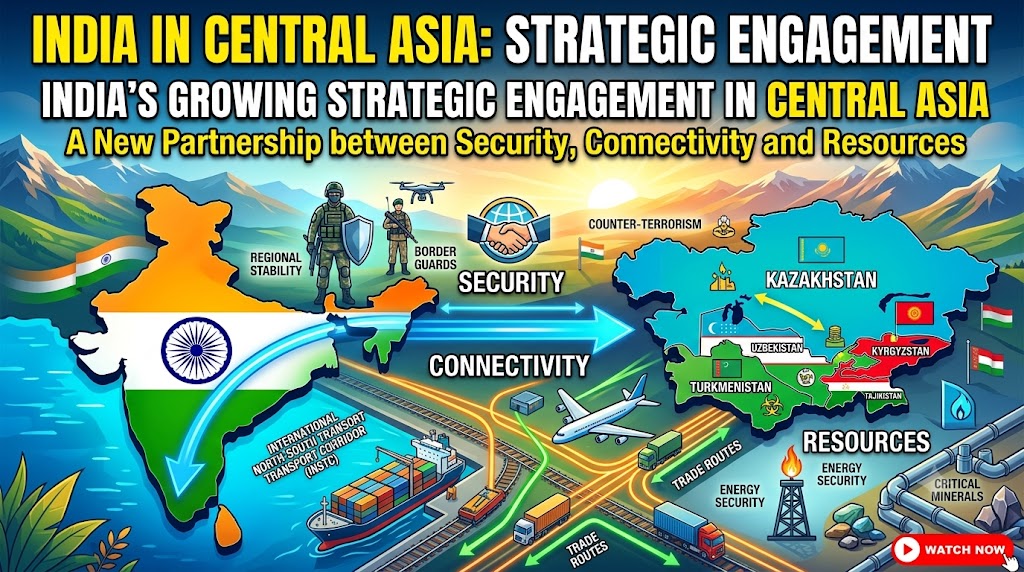
- The region is located between Russia, China, Afghanistan, Iran and the Caspian Sea. Therefore, any geopolitical development in Central Asia can have wider implications for the Asian security environment. For India, the region is important primarily at three levels strategic security, economic resources and connectivity.
- Central Asia comprises five countries Kazakhstan, Kyrgyz Republic, Tajikistan, Turkmenistan and Uzbekistan. These countries, which became independent after the dissolution of the Soviet Union, occupy a strategically important position in the balance of power across Eurasia.
-
1. Energy and Mineral Resources
-
-
- Central Asia is rich in energy and mineral resources. Kazakhstan possesses significant uranium reserves along with coal, iron ore, gold, lead and zinc. Turkmenistan is known for its vast natural gas reserves, while Uzbekistan has substantial reserves of gold, uranium and natural gas. The Kyrgyz Republic and Tajikistan possess considerable hydropower potential.
- Given India’s growing energy demand and increasing need for critical minerals, the region is of long-term importance. In particular, the availability of uranium is strategically significant for India in the context of the expansion of nuclear energy.
- Central Asia is rich in energy and mineral resources. Kazakhstan possesses significant uranium reserves along with coal, iron ore, gold, lead and zinc. Turkmenistan is known for its vast natural gas reserves, while Uzbekistan has substantial reserves of gold, uranium and natural gas. The Kyrgyz Republic and Tajikistan possess considerable hydropower potential.
-
2. Afghanistan and Regional Security
-
-
- Following the return of the Taliban to power in Afghanistan, security concerns among the Central Asian countries have increased. Terrorism, radicalisation, narcotics trafficking and the possibility of the regrouping of terrorist organisations could further destabilise the region.
- The situation in Afghanistan is also directly important for India. Security cooperation, intelligence sharing and counter-terrorism coordination with Central Asian countries form an important part of India’s broader regional security policy. The ‘Connect Central Asia’ policy, announced in 2012, had already identified military training, counter-terrorism cooperation and close coordination on Afghanistan as key areas of engagement.
- Following the return of the Taliban to power in Afghanistan, security concerns among the Central Asian countries have increased. Terrorism, radicalisation, narcotics trafficking and the possibility of the regrouping of terrorist organisations could further destabilise the region.
-
3. India’s Role amid China’s Growing Influence
-
-
- Over the past decade, China has rapidly expanded its economic and strategic presence in Central Asia. Through the Belt and Road Initiative (BRI), infrastructure investments and energy projects, China has established a strong foothold in the region.
- India seeks to pursue a policy of strategic balancing rather than direct confrontation with China. India’s growing engagement with Central Asia is not aimed merely at reducing Chinese influence; it also seeks to provide regional countries with greater strategic options so that they can preserve their strategic autonomy.
- Over the past decade, China has rapidly expanded its economic and strategic presence in Central Asia. Through the Belt and Road Initiative (BRI), infrastructure investments and energy projects, China has established a strong foothold in the region.
-
India’s ‘Connect Central Asia’ Policy
-
-
- India initiated a more active and institutionalised engagement with Central Asia through its ‘Connect Central Asia’ policy in 2012. The policy envisaged greater cooperation in the fields of politics, economy, security, education, healthcare and culture.
- The policy received a major boost in 2015, when Prime Minister Narendra Modi became the first Indian Prime Minister to visit all five Central Asian republics. Subsequently, the first India-Central Asia Summit was held in January 2022, providing a multilateral framework to the relationship.
- The fourth India-Central Asia Dialogue in 2025 also emphasised trade, investment, digital payments, banking connectivity and more effective utilisation of the International North-South Transport Corridor (INSTC).
- India initiated a more active and institutionalised engagement with Central Asia through its ‘Connect Central Asia’ policy in 2012. The policy envisaged greater cooperation in the fields of politics, economy, security, education, healthcare and culture.
-
Connectivity: India’s Biggest Challenge
-
-
- The biggest obstacle to stronger India–Central Asia relations is the lack of direct geographical connectivity. Since a land route through Pakistan is not available, India cannot conduct direct overland trade with Central Asia.
- Therefore, India attaches considerable importance to the International North-South Transport Corridor (INSTC) and Iran’s Chabahar Port. Through these routes, India is seeking to improve access to Central Asia and wider Eurasian markets.
- The 2025 India-Central Asia Dialogue emphasised the need for more effective utilisation of the INSTC and highlighted the importance of developing regional connectivity in accordance with principles of transparency, financial sustainability, sovereignty and regional priorities.
- However, the full potential of Chabahar and the INSTC continues to be constrained by infrastructural, financial, regulatory and geopolitical challenges.
- The biggest obstacle to stronger India–Central Asia relations is the lack of direct geographical connectivity. Since a land route through Pakistan is not available, India cannot conduct direct overland trade with Central Asia.
-
Why are Uzbekistan and the Kyrgyz Republic Important?
-
-
- Uzbekistan is the most populous country in Central Asia and holds a particularly important position in regional politics. India–Uzbekistan relations are expanding in areas such as defence, energy, digital connectivity, education, trade and investment. These sectors are likely to remain important during Prime Minister Modi’s current visit.
- India and Uzbekistan also share deep civilisational linkages. The Kara-Tepe Buddhist site at Termez reflects the ancient cultural connections between India and Central Asia. Similarities can also be seen in aspects of language and cuisine. Bilateral trade between India and Uzbekistan in 2025–26 was around the $1 billion mark.
- The Kyrgyz Republic, meanwhile, is important to India from the perspective of strategic access to Central Asia, mountain water resources and security cooperation. The SCO Summit in Bishkek will provide India with a broader multilateral platform to engage on regional issues.
- Uzbekistan is the most populous country in Central Asia and holds a particularly important position in regional politics. India–Uzbekistan relations are expanding in areas such as defence, energy, digital connectivity, education, trade and investment. These sectors are likely to remain important during Prime Minister Modi’s current visit.
-
Shanghai Cooperation Organisation (SCO) and India’s Regional Strategy
-
-
- India has been a full member of the SCO since 2017. The present SCO has 10 member states, including India, China, Russia, Pakistan and Iran, along with the Central Asian states. The 2026 Bishkek Summit is being held on the occasion of the organisation’s 25th anniversary.
- The SCO is important for India because it provides a platform through which India can engage with Russia, China, Central Asia and Iran within the same multilateral framework. On issues such as terrorism, extremism, regional connectivity and economic cooperation, the organisation strengthens India’s strategic presence in the region.
- India has been a full member of the SCO since 2017. The present SCO has 10 member states, including India, China, Russia, Pakistan and Iran, along with the Central Asian states. The 2026 Bishkek Summit is being held on the occasion of the organisation’s 25th anniversary.
-
Major Challenges before India:
-
-
- The biggest challenge for India’s Central Asia policy is that economic relations remain relatively weak compared to political ties. Geographical distance, high transportation costs and limited land connectivity due to Pakistan continue to restrict trade.
- In addition, China’s economic strength and Russia’s historical influence in Central Asia create a competitive strategic environment for India. In the aftermath of the Russia–Ukraine conflict, regional countries are also being compelled to rebalance their strategic autonomy and security equations.
- Regional instability, the situation in Afghanistan, radicalisation and potential disputes over water resources also remain long-term risks.
- The biggest challenge for India’s Central Asia policy is that economic relations remain relatively weak compared to political ties. Geographical distance, high transportation costs and limited land connectivity due to Pakistan continue to restrict trade.
-
Way Forward:
-
-
- India must move beyond limiting its engagement with Central Asia to high-level political visits and transform it into a practical and mutually beneficial economic partnership. Enhancing the operational capacity of the INSTC and Chabahar Port, strengthening digital payments and banking connectivity, and increasing investment in pharmaceuticals, information technology, agriculture, energy and education would be important steps in this direction. The 2025 India-Central Asia Dialogue also highlighted the need to expand trade potential in these sectors.
- At the same time, India should strengthen people-to-people ties through healthcare, education, skill development, digital public infrastructure and cultural diplomacy. On the security front, counter-terrorism cooperation and coordination on Afghanistan-related issues should be further institutionalised.
- India must move beyond limiting its engagement with Central Asia to high-level political visits and transform it into a practical and mutually beneficial economic partnership. Enhancing the operational capacity of the INSTC and Chabahar Port, strengthening digital payments and banking connectivity, and increasing investment in pharmaceuticals, information technology, agriculture, energy and education would be important steps in this direction. The 2025 India-Central Asia Dialogue also highlighted the need to expand trade potential in these sectors.
-
Conclusion:
-
-
- Central Asia is not merely a region of strategic resources for India; it is increasingly becoming an important pillar of India’s Eurasian strategy. Prime Minister Modi’s visit to Uzbekistan and the Kyrgyz Republic reflects continuity in this broader strategic approach.
- India’s response to China’s growing influence in the region should not be limited to strategic competition. Instead, it should focus on reliable partnerships, improved connectivity, economic integration, security cooperation and civilisational linkages. Ultimately, India’s success in Central Asia will depend on how effectively it can transform strong political relations into tangible economic and strategic outcomes.
- Central Asia is not merely a region of strategic resources for India; it is increasingly becoming an important pillar of India’s Eurasian strategy. Prime Minister Modi’s visit to Uzbekistan and the Kyrgyz Republic reflects continuity in this broader strategic approach.
-



