
Context:
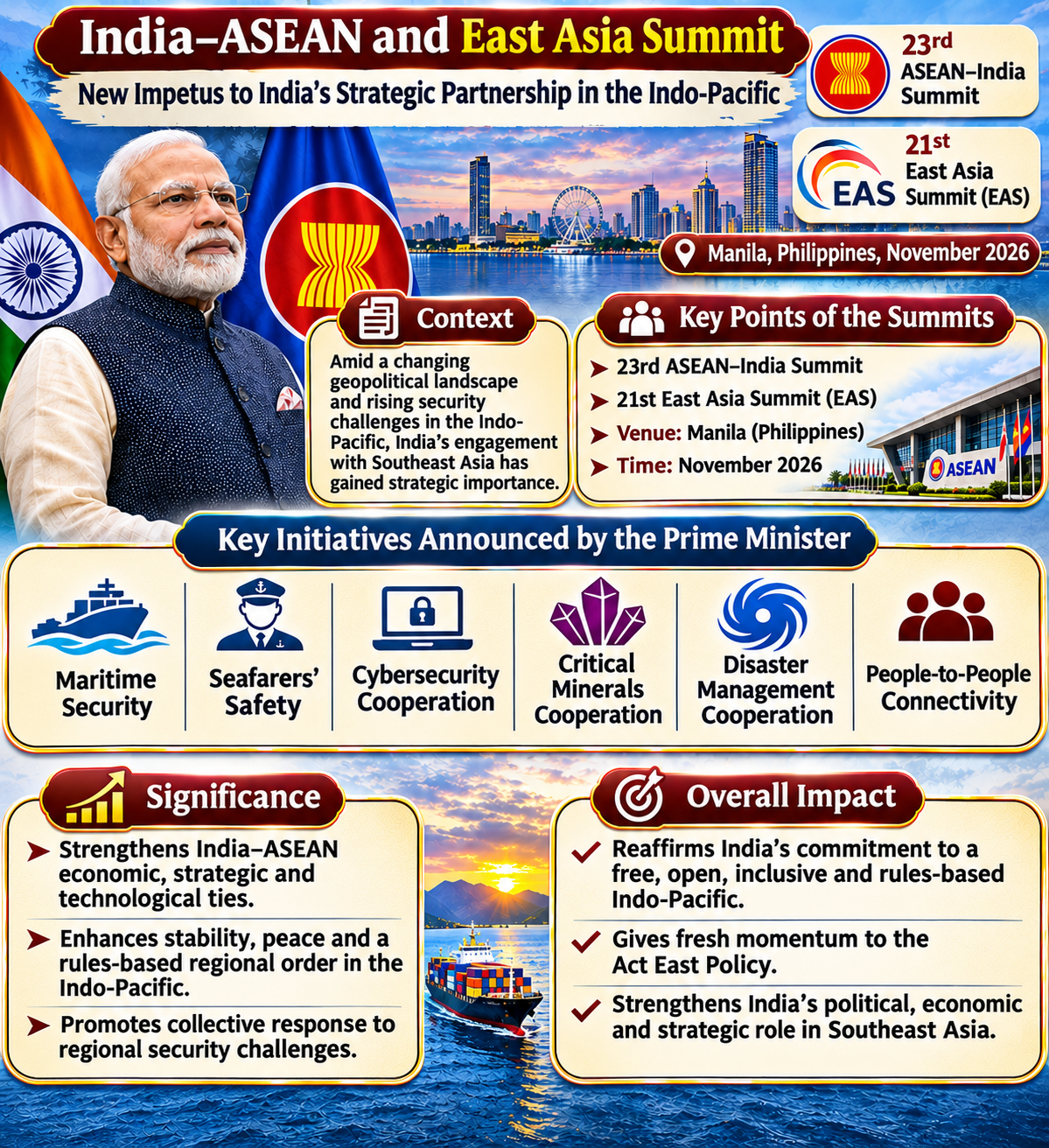
India's engagement with Southeast Asia has gained strategic importance amid changing geopolitical dynamics, intensifying great-power competition and emerging security challenges in the Indo-Pacific. Recently, the 23rd ASEAN-India Summit and 21st East Asia Summit (EAS), held in Manila in November 2026, provided an important platform for strengthening India's strategic, economic, maritime and technological engagement with the region. During these summits, the Indian Prime Minister announced several initiatives focusing on maritime security, seafarers' safety, cybersecurity, critical minerals, disaster management and people-to-people connectivity. These developments reaffirm India's commitment to a free, open, inclusive and rules-based Indo-Pacific and strengthen its Act East Policy.
About ASEAN and the East Asia Summit:
-
-
- The Association of Southeast Asian Nations (ASEAN) was established on 8 August 1967 through the Bangkok Declaration to promote regional peace, stability and economic development. It currently comprises 11 countries, including Brunei, Cambodia, Indonesia, Laos, Malaysia, Myanmar, the Philippines, Singapore, Thailand, Vietnam and Timor-Leste.
- The East Asia Summit, established in 2005, is a leaders-led forum for strategic dialogue and cooperation on regional and global issues. It comprises 19 members, including 11 ASEAN countries and eight partners: India, China, Japan, South Korea, Australia, New Zealand, the United States and Russia. India has been a founding participant in the EAS since its inception.
- The Association of Southeast Asian Nations (ASEAN) was established on 8 August 1967 through the Bangkok Declaration to promote regional peace, stability and economic development. It currently comprises 11 countries, including Brunei, Cambodia, Indonesia, Laos, Malaysia, Myanmar, the Philippines, Singapore, Thailand, Vietnam and Timor-Leste.
-
Evolution and Significance of India-ASEAN Relations:
-
-
- India's relationship with Southeast Asia is rooted in centuries-old civilisational, cultural and maritime connections. Institutional engagement began in 1992 when India became an ASEAN Sectoral Dialogue Partner, followed by Full Dialogue Partnership in 1995.
- The relationship was elevated to a Strategic Partnership in 2012 and a Comprehensive Strategic Partnership in 2022. ASEAN occupies a central position in India's Act East Policy because of its geostrategic location, economic importance and role in Indo-Pacific security.
- It provides India with opportunities to expand trade, investment, connectivity and technological cooperation while strengthening its strategic autonomy and regional influence.
- India's relationship with Southeast Asia is rooted in centuries-old civilisational, cultural and maritime connections. Institutional engagement began in 1992 when India became an ASEAN Sectoral Dialogue Partner, followed by Full Dialogue Partnership in 1995.
-
Major Outcomes of the 2026 ASEAN-India and East Asia Summits:
-
-
- Strengthening Maritime Security and Seafarers' Safety:
- Maritime security emerged as a major priority amid growing geopolitical conflicts and threats to international shipping routes. Attacks on commercial vessels carrying Indian nationals in the Strait of Hormuz and the Black Sea have highlighted the vulnerability of seafarers and maritime trade. India launched an initiative among EAS members to strengthen joint training and emergency response mechanisms for seafarers.
- It also proposed a long-term ASEAN-India Maritime Cooperation Plan covering maritime connectivity, scientific research, disaster management, Coast Guard cooperation, Maritime Domain Awareness (MDA) and seafarers' safety. These initiatives aim to protect strategic sea lanes, ensure freedom of navigation and strengthen collective maritime responses.
- Maritime security emerged as a major priority amid growing geopolitical conflicts and threats to international shipping routes. Attacks on commercial vessels carrying Indian nationals in the Strait of Hormuz and the Black Sea have highlighted the vulnerability of seafarers and maritime trade. India launched an initiative among EAS members to strengthen joint training and emergency response mechanisms for seafarers.
- Addressing Emerging Security Challenges:
- Geopolitical conflicts are disrupting global supplies of food, fuel and fertilisers, while maritime insecurity, terrorism, cyber fraud and transnational organised crime are threatening regional stability.
- India emphasised dialogue, mutual respect and cooperation as essential foundations of international relations and reiterated its support for peaceful resolution of conflicts, including those in Ukraine and West Asia. This reflects India's preference for cooperative security and peaceful dispute resolution.
- Geopolitical conflicts are disrupting global supplies of food, fuel and fertilisers, while maritime insecurity, terrorism, cyber fraud and transnational organised crime are threatening regional stability.
- Digital Security and Cybercrime Cooperation:
- Recognising the growing threats in the digital domain, India proposed hosting an EAS Cybercrime Conference at the National Forensic Sciences University to strengthen regional cooperation and capacity building. Other initiatives include joint cyber forensics training, knowledge-sharing among ASEAN countries and cooperation against online scams and cyber-enabled criminal activities.
- The EAS leaders also adopted a joint statement on combating online scams. India further advocated human-centric and responsible Artificial Intelligence (AI), along with digital watermarking to counter deepfakes and misinformation. These initiatives aim to strengthen regional digital trust and cyber resilience.
- Recognising the growing threats in the digital domain, India proposed hosting an EAS Cybercrime Conference at the National Forensic Sciences University to strengthen regional cooperation and capacity building. Other initiatives include joint cyber forensics training, knowledge-sharing among ASEAN countries and cooperation against online scams and cyber-enabled criminal activities.
- Expanding Economic and Strategic Cooperation:
- India reiterated that ASEAN unity and centrality remain at the heart of its Act East Policy. The ASEAN Community Vision 2045 and India's Viksit Bharat 2047 offer opportunities to align regional development priorities.
- India proposed free e-visas for ASEAN tourists, technical cooperation in nuclear energy, collaboration in critical mineral supply chains, a joint space hackathon, youth summits, start-up exchanges and enhanced scholarships for ASEAN students at Nalanda University. These initiatives can diversify economic engagement and strengthen regional interdependence.
- India reiterated that ASEAN unity and centrality remain at the heart of its Act East Policy. The ASEAN Community Vision 2045 and India's Viksit Bharat 2047 offer opportunities to align regional development priorities.
- Cultural and Educational Connectivity:
- India highlighted its shared civilisational heritage with Southeast Asia through initiatives such as the National Maritime Heritage Complex at Lothal, which will showcase India's maritime history and historical connections with the region.
- An East Asia Summit University Heads Conclave at Nalanda was also proposed to promote academic cooperation and research. Since 2014, India has undertaken nearly 250 Quick Impact Projects (QIPs) and provided more than 10,000 skill-development scholarships, strengthening its developmental and people-to-people engagement.
- India highlighted its shared civilisational heritage with Southeast Asia through initiatives such as the National Maritime Heritage Complex at Lothal, which will showcase India's maritime history and historical connections with the region.
- Strengthening Maritime Security and Seafarers' Safety:
-
Strategic Significance for India:
-
-
- The summits are significant for advancing India's Act East Policy and strengthening its position in the Indo-Pacific. Maritime cooperation will help protect India's trade routes and enhance regional security, while economic engagement can diversify supply chains and improve access to critical minerals and emerging technologies.
- Stronger connectivity with Southeast Asia can also promote economic development in India's northeastern states. Furthermore, ASEAN-led platforms provide India with opportunities to strengthen strategic autonomy, engage with major powers and promote an inclusive regional order without becoming part of exclusive geopolitical blocs.
- The summits are significant for advancing India's Act East Policy and strengthening its position in the Indo-Pacific. Maritime cooperation will help protect India's trade routes and enhance regional security, while economic engagement can diversify supply chains and improve access to critical minerals and emerging technologies.
-
Challenges in India-ASEAN Relations:
-
-
- Despite considerable progress, India-ASEAN relations face several challenges. India's trade deficit with ASEAN, non-tariff barriers and market access concerns continue to constrain economic integration. Delays in connectivity projects, including the India-Myanmar-Thailand Trilateral Highway and Kaladan Multimodal Transit Transport Project, have limited regional connectivity.
- Geopolitical competition between major powers and tensions in the South China Sea create additional strategic complexities. Maritime insecurity, cybercrime, terrorism, climate change and differences among ASEAN members also require stronger institutional coordination. Moreover, the implementation gap between summit-level announcements and actual outcomes remains a major concern.
- Despite considerable progress, India-ASEAN relations face several challenges. India's trade deficit with ASEAN, non-tariff barriers and market access concerns continue to constrain economic integration. Delays in connectivity projects, including the India-Myanmar-Thailand Trilateral Highway and Kaladan Multimodal Transit Transport Project, have limited regional connectivity.
-
Way Forward:
-
-
- India needs to adopt a comprehensive approach to translate diplomatic commitments into tangible outcomes. Maritime cooperation should be strengthened through joint exercises, Coast Guard collaboration, information-sharing and Maritime Domain Awareness while upholding the principles of UNCLOS and freedom of navigation.
- Economic integration should be enhanced through trade diversification, improved market access and effective implementation of connectivity projects. Cooperation in critical minerals, renewable energy, nuclear technology and digital infrastructure should be prioritised. Common frameworks for cybercrime investigation, responsible AI and digital security should be developed. Educational exchanges, tourism, cultural diplomacy and disaster management cooperation should be expanded to strengthen mutual trust and regional resilience.
- India needs to adopt a comprehensive approach to translate diplomatic commitments into tangible outcomes. Maritime cooperation should be strengthened through joint exercises, Coast Guard collaboration, information-sharing and Maritime Domain Awareness while upholding the principles of UNCLOS and freedom of navigation.
-
Conclusion:
The 23rd ASEAN-India Summit and 21st East Asia Summit reflect India's growing ambition to emerge as a reliable regional partner and an important pillar of Indo-Pacific stability. ASEAN is not merely an economic partner but a central pillar of India's regional strategy and Act East Policy. However, the success of these initiatives will depend on effective implementation, stronger institutional mechanisms and sustained cooperation. By combining maritime security, economic integration, technological collaboration and cultural diplomacy, India can contribute to a peaceful, inclusive and rules-based Indo-Pacific while advancing its vision of Viksit Bharat 2047.