
Context:
Recently, the renowned global arms and security research institution, the Stockholm International Peace Research Institute (SIPRI), published its annual Yearbook 2026. The report comes at a time when the world is witnessing unprecedented geopolitical tensions, the erosion of multilateral treaties, and the weakening of the Rules-based International Order.
-
-
- The findings of the report not only highlight the rapid modernization of global nuclear arsenals but also indicate a major and historic paradigm shift in South Asia, particularly in India’s nuclear strategy.
- The findings of the report not only highlight the rapid modernization of global nuclear arsenals but also indicate a major and historic paradigm shift in South Asia, particularly in India’s nuclear strategy.
-
Key Findings of the Global Nuclear Landscape:
According to SIPRI 2026, all nine nuclear-armed states (the United States, Russia, the United Kingdom, France, China, India, Pakistan, North Korea, and Israel) are increasingly prioritizing military deterrence over diplomatic negotiations:
-
-
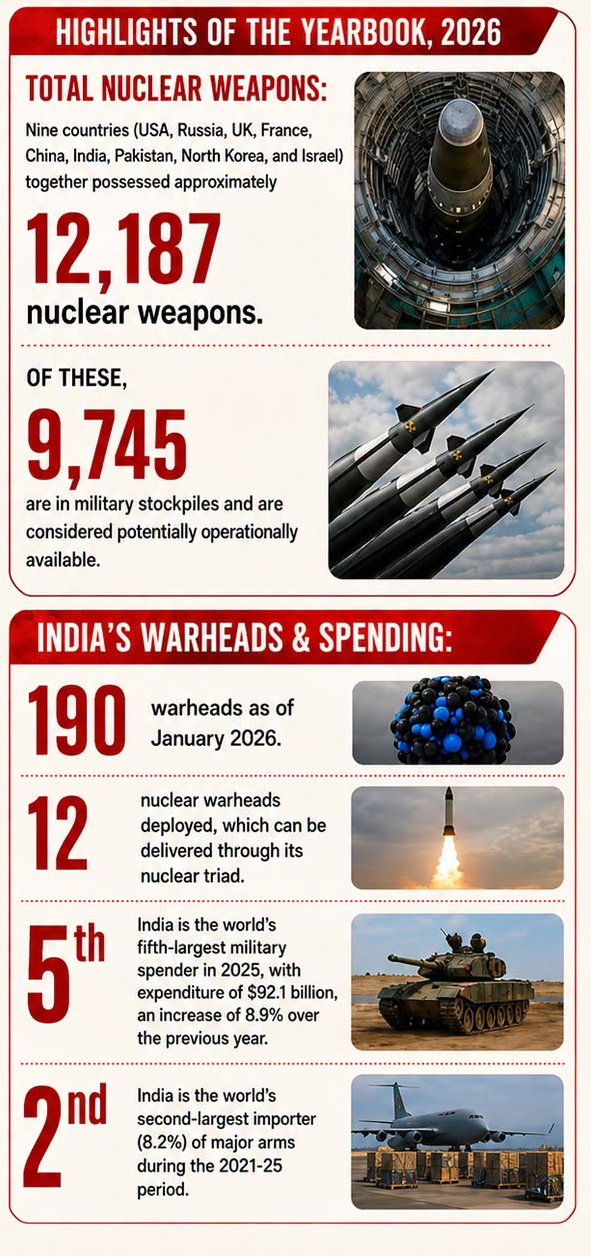
- Size of the Arsenal: The total number of nuclear weapons worldwide has reached approximately 12,187.
- High Operational Alert (Ready-to-Fire): Around 4,012 warheads are deployed on missiles and aircraft, of which approximately 2,100–2,200 warheads remain on “high operational alert,” meaning they can be launched within minutes.
- Record Military Expenditure: Global military spending has reached an all-time high of US$ 2.9 trillion.
- Size of the Arsenal: The total number of nuclear weapons worldwide has reached approximately 12,187.
-
India and South Asia: A Strategic Paradigm Shift
This year’s report confirms a significant and more assertive transformation in India’s traditional security outlook:
-
-
- Increasing Number of Warheads: India’s total nuclear warheads increased from 180 in 2025 to 190 at the beginning of 2026. This growth remains consistent with India’s policy of “Credible Minimum Deterrence.”
- Peacetime Deployment: The most significant claim in the report is that India has, for the first time, actively deployed 12 nuclear warheads during peacetime. Traditionally, India maintained a separation between the nuclear cores of its missiles and their launch systems. This “ready-to-fire” deployment reflects India’s enhanced quick-response capability.
- China-Centric Defense Strategy (Shift from Pakistan to China): India’s primary strategic focus is now increasingly centered on addressing China’s military challenge. India is currently emphasizing the development of systems such as the Agni-V intercontinental ballistic missile (ICBM) and canisterized missile platforms to ensure that the entire Chinese mainland falls within India’s deterrence range.
- Increasing Number of Warheads: India’s total nuclear warheads increased from 180 in 2025 to 190 at the beginning of 2026. This growth remains consistent with India’s policy of “Credible Minimum Deterrence.”
-
The Trilateral Nuclear Equation : India, China & Pakistan-
|
Country |
Nuclear Warheads (SIPRI 2026) |
Key Strategic Developments |
|
China |
Rapidly Expanding |
Increased deployed warheads to 34; placing missiles in silos under a “Launch-on-Warning” posture. |
|
India |
190 |
Deployed 12 warheads during peacetime for the first time; focusing on long-range strike capabilities and strengthening the Nuclear Triad. |
|
Pakistan |
Stable but Advancing |
Continuing qualitative improvements; focusing on MIRV technology to penetrate India’s Ballistic Missile Defense (BMD) system. |
The growing strategic and technological cooperation between China and Pakistan presents India with the real challenge of a potential “two-front war.”
Strategic and Security Implications for India:
-
-
- Reconsideration of the ‘No First Use’ (NFU) Policy: India’s nuclear doctrine has long been anchored in the principle of “No First Use.” However, given the aggressive nuclear modernization efforts of China and Pakistan, strategic experts are increasingly debating whether India should introduce greater flexibility into its NFU policy.
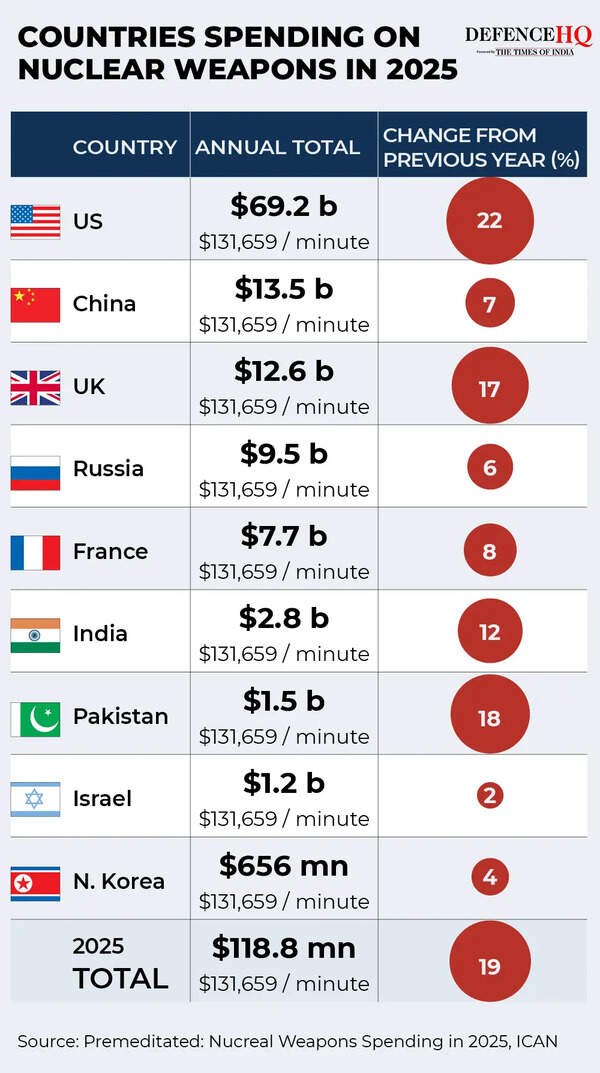
- Strategic Autonomy versus Imports: With a military budget of US$ 92.1 billion, India is the world’s fifth-largest defense spender. However, a concerning reality is that India remains the world’s second-largest arms importer. Dependence on foreign suppliers for advanced military hardware could undermine strategic autonomy during times of crisis.
- Integration of Advanced Technologies: In response to China’s advances in hypersonic missiles, space-based assets, cyber warfare, and the militarization of Artificial Intelligence (AI), India must continue to upgrade its technological capabilities.
- Reconsideration of the ‘No First Use’ (NFU) Policy: India’s nuclear doctrine has long been anchored in the principle of “No First Use.” However, given the aggressive nuclear modernization efforts of China and Pakistan, strategic experts are increasingly debating whether India should introduce greater flexibility into its NFU policy.
-
Way Forward:
-
-
- Self-Reliance in Defense Manufacturing (DefTech Autonomy): India must move beyond merely importing weapons and aggressively promote indigenous defense innovation. Industrial initiatives such as the Bharat Industrial Development Scheme (BHAVYA) should be leveraged to support defense startups and advanced military technologies.
- Strengthening the Nuclear Triad: India must further enhance its submarine-based nuclear capability (SSBNs, such as INS Arighat), as sea-based deterrents are the most difficult to neutralize and provide a credible second-strike capability.
- Multilateral Diplomacy and Risk Reduction: Alongside military preparedness, India should continue advocating for nuclear risk reduction and crisis-management communication mechanisms at global forums while keeping diplomatic channels open with Beijing and Islamabad to prevent misunderstandings and miscalculations.
- Self-Reliance in Defense Manufacturing (DefTech Autonomy): India must move beyond merely importing weapons and aggressively promote indigenous defense innovation. Industrial initiatives such as the Bharat Industrial Development Scheme (BHAVYA) should be leveraged to support defense startups and advanced military technologies.
-
Conclusion:
The SIPRI Yearbook 2026 serves as a wake-up call for India. In this evolving security environment, India’s peacetime deployment of nuclear warheads and its emphasis on China-focused long-range strike capabilities reflect strategic maturity and a realistic approach to national security. To safeguard its sovereignty, India must strengthen its indigenous defense capabilities while adhering to the principle that “Strength Respects Strength.”



