
Context:
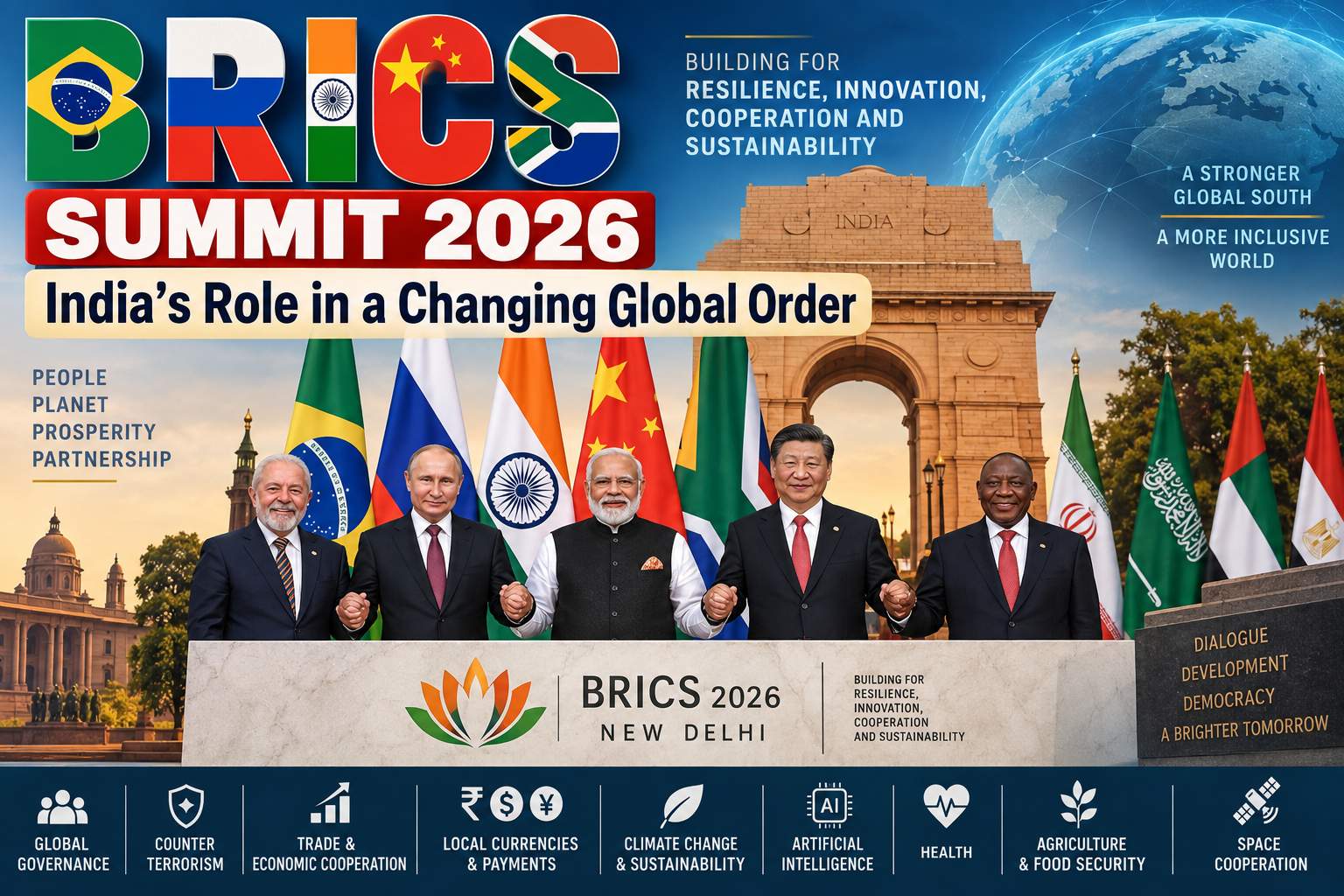
Recently, the 18th BRICS Summit was held in New Delhi on 12–13 September 2026. In 2026, India held the BRICS Chairship. The main theme of India’s Chairship was “Building for Resilience, Innovation, Cooperation and Sustainability.”
The most important outcome of the summit was the New Delhi Declaration, which contains around 140 points. The declaration outlined the direction of cooperation among member countries on various issues such as global governance, terrorism, trade, climate change, health, artificial intelligence, trade in local currencies, and development.
Key Achievements of the 2026 Summit:
1. New Delhi Declaration
The major outcome of the summit was the New Delhi Declaration. The nearly 140-point declaration highlighted the shared concerns and cooperation priorities of member countries on various global issues. Its major areas include:
- Reform of global governance
- Multilateralism
- Combating terrorism
- International trade
- Payments in local currencies
- Climate change
- Artificial intelligence
- Health
- Agriculture
- Space cooperation
- Sustainable development
The declaration is particularly significant because the political and strategic priorities of BRICS member countries differ on several issues. Despite this, reaching an agreement on a common declaration reflects the diplomatic capacity of the group.
2. Common Stand Against Terrorism
One of the important achievements of the summit for India was the explicit mention and condemnation of the Pahalgam terrorist attack. India has long maintained that terrorism is a serious threat to international peace and security.
3. Balanced Approach to the West Asia Issue
Following the expansion of BRICS, several important West Asian countries have become members. Countries such as Iran, the United Arab Emirates and Saudi Arabia have different regional priorities. Therefore, reaching consensus on disputes in West Asia is challenging.
At the 2026 summit, emphasis was placed on language that would maintain an environment of cooperation despite differences among member countries.
4. Unilateral Tariffs and Trade Protectionism
The declaration expressed concern over unilateral trade restrictions and excessive tariffs. BRICS countries emphasized the need for an international trading system that is open, transparent, fair, non-discriminatory, and rules-based.
This issue is particularly important for India because India is seeking to increase its participation in global value chains. A stable and predictable global trading system is important for Indian industries, exporters, Micro, Small and Medium Enterprises, and the services sector.
5. Trade and Payments in Local Currencies
Discussions were also held on strengthening trade in local currencies and cross-border payment systems among BRICS countries. The objective is not to immediately create a common currency, but to make the payment system more diversified and efficient. Its potential benefits include reducing the cost of cross-border payments, speeding up payments, reducing financial risks, promoting the use of local currencies, and diversifying the international payment system.
However, it would not be appropriate to view this as a process aimed at completely replacing the dollar. There are significant differences among the economies, exchange rates, and monetary policies of different countries. Therefore, current efforts are mainly focused on local-currency-based payments and diversification of the payment system.
6. Reform of the United Nations Security Council
BRICS countries reiterated the need for reforms in the United Nations and other global institutions. Particular emphasis was placed on providing greater representation to developing countries in global decision-making institutions. India has long been demanding reforms in the United Nations Security Council and permanent membership.
7. Climate Change and Carbon Border Measures
Climate change was also among the major issues discussed at the summit. India and many other developing countries face the challenge of addressing climate change while maintaining economic growth. In this context, measures such as the Carbon Border Adjustment Mechanism are important. Such measures can impose additional costs on imported goods based on their carbon emissions. Developing countries are concerned that this could affect the competitiveness of their industries. This issue is important for India because Indian exporters may have to face such arrangements in European markets in the future. Therefore, India emphasizes climate justice and equal opportunities along with climate action.
8. Agriculture and Food Security
Under India’s Chairship, cooperation in the agricultural sector was also given importance. BRICS countries initiated efforts to enhance cooperation in areas such as digital agriculture, climate-resilient agriculture, agrobiodiversity, agricultural inputs, genetic resources, agricultural research, and the use of new technologies in agriculture. Initiatives such as the BRICS agricultural network can increase the possibility of sharing agricultural knowledge and technology among member countries. This is important in the context of both food security and climate change.
9. Artificial Intelligence and Digital Cooperation
Artificial intelligence has become a major subject of global policymaking in 2026. India has extensive experience in the field of digital public infrastructure. India’s experience in Aadhaar, UPI, and digital public services can be useful for other developing countries. Therefore, BRICS provides India with an opportunity to share its digital capabilities with countries of the Global South.
10. Cooperation in the Health Sector
BRICS countries also emphasized strengthening cooperation in the health sector. Initiatives in the field of mental health cooperation are particularly significant. NIMHANS, Bengaluru, has been associated with a coordinating role in BRICS mental health cooperation initiatives. This creates opportunities for India to expand its health diplomacy.
11. Space Cooperation
Space cooperation among BRICS countries was also taken forward. The BRICS Remote Sensing Satellite Constellation aims to enhance cooperation among Earth-observation satellites of member countries.
This can assist in areas such as disaster management, agricultural monitoring, climate change studies, natural resource monitoring, and environmental protection. It also provides important opportunities for India’s space diplomacy.
Importance of BRICS for India:
1. Role in the Global South
BRICS provides India with an opportunity to raise the concerns of developing countries on the international platform.
2. Strategic Autonomy
India is active in BRICS as well as in other multilateral and regional forums. This helps India maintain an independent foreign policy.
3. Dialogue with China
India and China have differences over border and strategic issues. Despite this, BRICS provides both countries with a platform for regular multilateral dialogue.
During the 2026 summit, there was also bilateral engagement between the leadership of India and China, highlighting the potential of BRICS as a platform for broader diplomatic dialogue.
4. Economic Opportunities
The large BRICS markets can provide new opportunities for Indian sectors such as pharmaceuticals, information technology, agriculture, manufacturing, start-ups, and services.
5. Reform of Global Institutions
BRICS provides India with a platform to advance its demand for reforms in the United Nations, the World Trade Organization, and international financial institutions.
Major Challenges before BRICS:
· The political and strategic interests of member countries are not identical.
· The border dispute and strategic competition between India and China may affect BRICS cooperation.
· The ongoing tensions between Russia and Western countries affect global trade and the international financial system.
· Countries such as Iran, Saudi Arabia, and the United Arab Emirates have different regional interests.
· The increase in the number of member countries has enhanced the economic and political influence of BRICS, but reaching consensus has also become more difficult.
· A major challenge for BRICS is how to convert declarations into actual projects and institutional cooperation.
Conclusion:
The BRICS Summit 2026 is an important example of the ongoing changes in the global balance of power and the growing role of the Global South. The New Delhi Declaration presented a broad framework for cooperation in areas such as terrorism, trade, climate change, artificial intelligence, health, agriculture, space, and global governance. For India, the significance of BRICS is not limited to economic issues. It provides India with an opportunity to strengthen the voice of the Global South, advance the demand for reforms in multilateral institutions, maintain strategic autonomy, and sustain dialogue with different centres of power. However, the real effectiveness of BRICS will depend on how quickly member countries can convert common declarations into concrete institutional arrangements and actual projects despite their political differences. Thus, rather than viewing BRICS as an alliance against any particular power, it is more appropriate to understand it as a platform for cooperation in building a multipolar and more representative global order.



