
Context:
Recently, the Supreme Court of India, while hearing an important case, permitted a minor rape survivor to terminate her 30-week pregnancy. In this case, the Court not only adopted a humanitarian approach but also made significant observations regarding the limitations and practical challenges of India’s abortion laws. The Court urged the Central Government to consider making the legal gestational limit for abortion more flexible in cases involving rape survivors, particularly minors.
This judgment comes at a time when India is witnessing an extensive debate on women’s reproductive rights, bodily autonomy, mental health, and the constitutional responsibilities of the State. The matter is not merely a legal dispute; rather, it raises broader questions related to women’s rights, child protection, medical ethics, and social sensitivity.
Background of the Case:
The case concerned a 15-year-old rape survivor whose pregnancy had advanced to nearly 30 weeks. A medical institution had objected to the termination on the grounds of medical risk. However, the Court held that forcing a minor into motherhood against her will would amount to a violation of her fundamental rights.
The Court clarified that:
- The physical and mental condition of the minor must be given priority.
- Pregnancy resulting from rape cannot be viewed merely as a “medical condition.”
- The wishes of the survivor and her guardians must be respected in decisions related to termination of pregnancy.
This judgment further strengthens the constitutional dimensions of reproductive rights in India.
Abortion Laws in India:
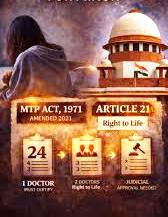
The principal legislation governing abortion in India is the Medical Termination of Pregnancy (MTP) Act, 1971, which was amended in 2021.
Key Features of the Medical Termination of Pregnancy (MTP) Act, 1971
1. Gestational Limit for Abortion
- Abortion is generally permitted up to 20 weeks of pregnancy.
- For certain categories of women, including rape survivors, minors, and differently-abled women, the limit has been extended to 24 weeks.
2. Medical Opinion
- Up to 20 weeks: opinion of one registered medical practitioner is required.
- Between 20 and 24 weeks: opinions of two registered medical practitioners are required.
3. Role of Medical Boards
For pregnancies exceeding 24 weeks, approval from courts and medical boards is often required in several cases.
4. Right to Confidentiality
The Act contains provisions to protect the identity and privacy of the woman.
Major Limitations in the Law:
Although the 2021 amendment introduced progressive reforms, several limitations continue to persist.
1. Time-Limit Based Approach
The law still primarily relies on rigid gestational limits, whereas each case may involve unique circumstances.
2. Excessive Dependence on Courts
After 24 weeks, survivors are often compelled to approach courts, making the process time-consuming and emotionally exhausting.
3. Lack of Rural Health Infrastructure
Rural areas continue to suffer from a shortage of trained doctors and safe abortion services.
4. Inconsistency in Medical Boards
The functioning and sensitivity of medical boards vary considerably across states.
Constitutional Perspective:
The Constitution of India safeguards women’s dignity, liberty, and equality. The issue of abortion is directly linked to the following fundamental rights:
Article 21: Right to Life and Personal Liberty
The Supreme Court of India has repeatedly held that the “right to life” means not merely survival, but the right to live with dignity. This includes:
- Bodily autonomy,
- Reproductive choice,
- Mental health,
- Right to privacy.
Important Judicial Decisions
Suchita Srivastava v. Chandigarh Administration (2009)
The Court held that a woman has the right to either accept or refuse motherhood.
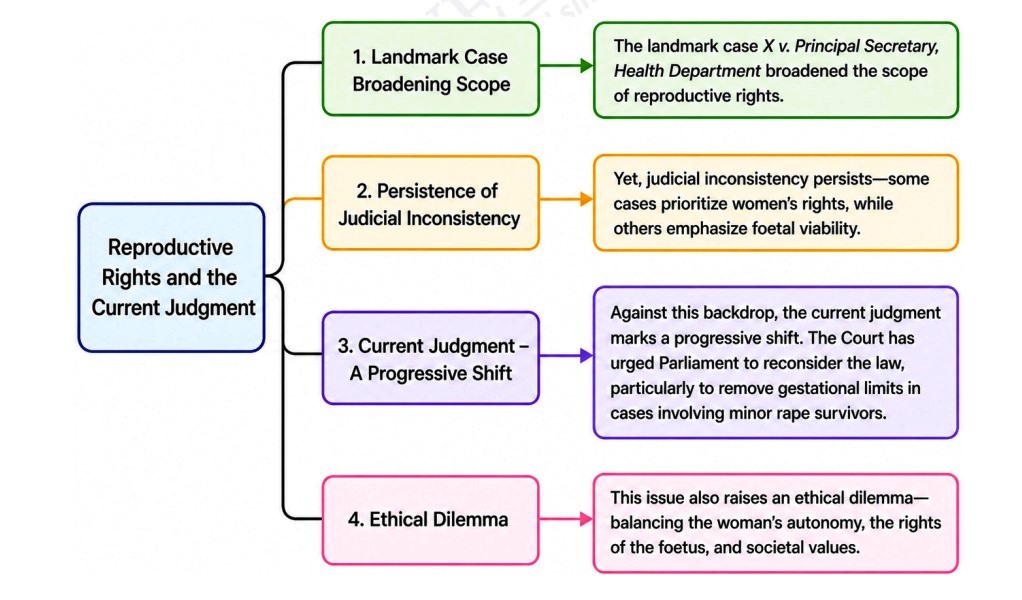
X v. Principal Secretary, Health and Family Welfare Department, Government of Delhi (2022)
The Court recognized that unmarried women are equally entitled to safe abortion rights.
Major Challenges Faced by Rape Survivors:
1. Delayed Detection of Pregnancy
Due to social stigma, lack of awareness, and rural limitations, many girls discover their pregnancy late and cross the legal gestational limit.
2. Social Stigma
Victims of sexual violence in India often face social exclusion, psychological trauma, and family pressure.
3. Fear Among Medical Institutions
Many hospitals avoid conducting abortions because of legal complexities and potential medical risks.
4. Judicial Delays
The time consumed in approaching courts and obtaining medical board recommendations often allows the pregnancy to advance further.
5. Neglect of Mental Health
Legal discourse frequently focuses more on fetal viability, while the psychological trauma of the survivor receives inadequate attention.
Judicial Activism:
In recent years, courts in India have increasingly adopted a humane and rights-based approach.
The judiciary has recognized that:
- Pregnancy resulting from rape severely affects the survivor’s mental health.
- Forcing a minor into motherhood may amount to “secondary victimisation.”
- The objective of the law should be to protect women, not subject them to further suffering.
Thus, the judiciary has strengthened the concept of Reproductive Justice in the Indian context.
International Perspective:
United Kingdom
Abortion is permitted up to 24 weeks under broad circumstances.
Canada
There is no federal criminal restriction on abortion.
France
France recently granted constitutional protection to abortion rights.
Latin American Countries
Countries such as Argentina and Mexico have introduced liberal reforms in recent years.
Compared to India, many countries place greater emphasis on women’s choice and mental health.
Way Forward:
1. Making the Law More Flexible
The rigid gestational limits in cases involving rape survivors and minors should be reconsidered.
2. Fast-Track Medical Boards
Specialized medical boards capable of providing rapid decisions should be established in every district.
3. Simplifying Judicial Procedures
Fast-track legal mechanisms should be developed for such sensitive cases.
4. Expanding Safe Abortion Services
Rural and remote regions must be provided with trained healthcare professionals and modern medical facilities.
5. Psychological Counselling
Survivors should receive mental health support alongside legal assistance.
6. Awareness Campaigns
Women and adolescent girls must be educated about their reproductive rights.
Conclusion:
The recent judgment reflects the sensitive and rights-oriented approach of the Indian judiciary. It clearly establishes that a minor rape survivor cannot be forced into motherhood against her will.
Today, there is a need to ensure that India’s abortion laws are not confined merely to medical or procedural considerations, but are interpreted within the broader framework of women’s dignity, mental health, and constitutional liberty.
If India truly seeks to evolve into a society based on gender justice and human dignity, reproductive rights must be recognized not merely as a welfare measure, but as a fundamental right. That alone will define a sensitive, just, and modern democracy.



