Brain-booster
/
24 Apr 2022
Brain Booster for UPSC & State PCS Examination (Topic: India-Australia Trade Agreement)
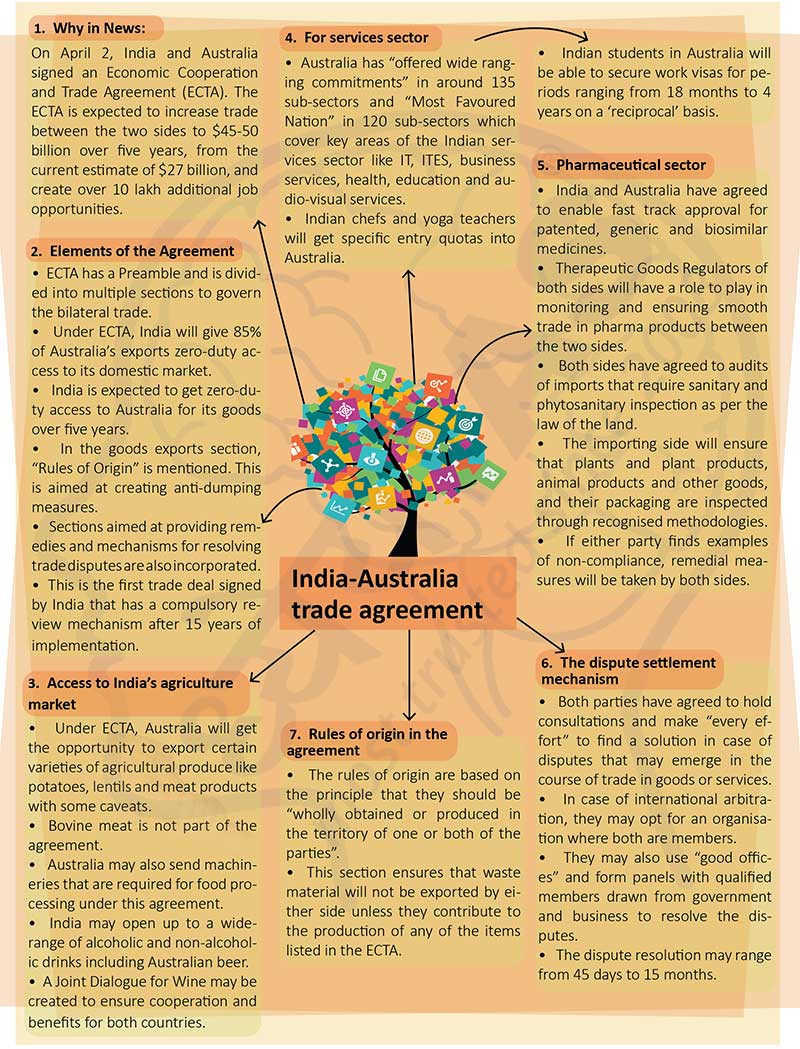
Why in News?
- On April 2, India and Australia signed an Economic Cooperation and Trade
Agreement (ECTA). The ECTA is expected to increase trade between the two
sides to $45-50 billion over five years, from the current estimate of $27
billion, and create over 10 lakh additional job opportunities.
Elements of the Agreement
- ECTA has a Preamble and is divided into multiple sections to govern the
bilateral trade.
- Under ECTA, India will give 85% of Australia’s exports zero-duty access
to its domestic market.
- India is expected to get zero-duty access to Australia for its goods
over five years.
- In the goods exports section, “Rules of Origin” is mentioned. This is
aimed at creating anti-dumping measures.
- Sections aimed at providing remedies and mechanisms for resolving trade
disputes are also incorporated.
- This is the first trade deal signed by India that has a compulsory
review mechanism after 15 years of implementation.
Access to India’s agriculture market
- Under ECTA, Australia will get the opportunity to export certain
varieties of agricultural produce like potatoes, lentils and meat products
with some caveats.
- Bovine meat is not part of the agreement.
- Australia may also send machineries that are required for food
processing under this agreement.
- India may open up to a widerange of alcoholic and non-alcoholic drinks
including Australian beer.
- A Joint Dialogue for Wine may be created to ensure cooperation and
benefits for both countries.
For services sector
- Australia has “offered wide ranging commitments” in around 135
sub-sectors and “Most Favoured Nation” in 120 sub-sectors which cover key
areas of the Indian services sector like IT, ITES, business services,
health, education and audio-visual services.
- Indian chefs and yoga teachers will get specific entry quotas into
Australia.
- Indian students in Australia will be able to secure work visas for
periods ranging from 18 months to 4 years on a ‘reciprocal’ basis.
Pharmaceutical sector
- India and Australia have agreed to enable fast track approval for
patented, generic and biosimilar medicines.
- Therapeutic Goods Regulators of both sides will have a role to play in
monitoring and ensuring smooth trade in pharma products between the two
sides.
- Both sides have agreed to audits of imports that require sanitary and
phytosanitary inspection as per the law of the land.
- The importing side will ensure that plants and plant products, animal
products and other goods, and their packaging are inspected through
recognised methodologies.
- If either party finds examples of non-compliance, remedial measures will
be taken by both sides.
The dispute settlement mechanism
- Both parties have agreed to hold consultations and make “every effort”
to find a solution in case of disputes that may emerge in the course of
trade in goods or services.
- In case of international arbitration, they may opt for an organisation
where both are members.
- They may also use “good offices” and form panels with qualified members
drawn from government and business to resolve the disputes.
- The dispute resolution may range from 45 days to 15 months.
Rules of origin in the agreement
- The rules of origin are based on the principle that they should be
“wholly obtained or produced in the territory of one or both of the
parties”.
- This section ensures that waste material will not be exported by either
side unless they contribute to the production of any of the items listed in
the ECTA.




