
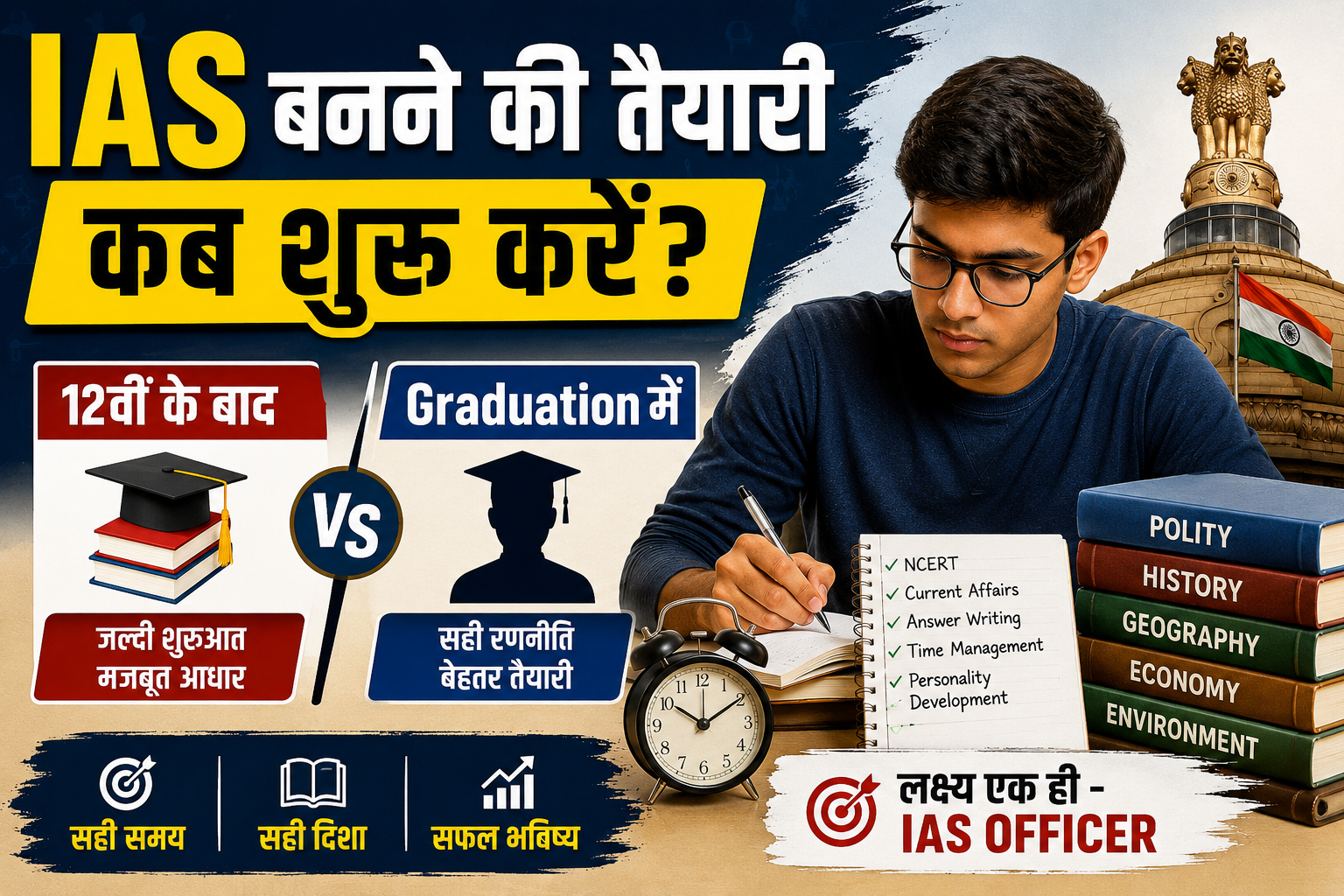
The Union Public Service Commission (UPSC) Civil Services Examination is one of the most prestigious competitive examinations in India. Every year, nearly one million candidates apply for the examination, while only a few hundred secure the final selection. This is why many students often wonder:
When is the right time to start preparing for IAS?
Should you begin immediately after Class 12? Or is it better to start after completing graduation? Do students who begin their preparation in the first year of college actually have an advantage?
The answer is not simply "Start early." The real answer is starting at the right time, with the right strategy and in the right direction.
If your goal is to become an IAS officer, the ideal time to begin your preparation is the first year of graduation, immediately after completing Class 12. During this period, you can gradually build a strong foundation through NCERT textbooks, newspaper reading, General Studies, answer-writing practice, and personality development. This approach significantly reduces the pressure during the actual examination.
What Is the Minimum Eligibility to Become an IAS Officer?
To appear for the UPSC Civil Services Examination, a candidate must possess a Bachelor's Degree (Graduation) from a recognized university.
This means:
- You cannot appear for the UPSC examination immediately after Class 12.
- Graduation is mandatory to take the examination.
- However, preparation can begin even before graduation.
This is why many successful candidates build their foundation during their college years.
Should You Start UPSC Preparation After Class 12?
Yes. The period immediately after Class 12 is ideal for building a strong foundation.
At this stage, students should focus on:
- Studying NCERT textbooks
- Developing the habit of reading newspapers
- Understanding the Indian Constitution, History, and Geography
- Improving writing skills
- Learning effective time management
- Working on communication skills and personality development
A strong foundation during this stage proves extremely beneficial for both the Mains Examination and the Personality Test (Interview).
Why Graduation Is Considered the Best Time for UPSC Preparation?
The three years of graduation are widely regarded as the golden period for UPSC preparation.
1. You Have Sufficient Time
Even studying for 2–4 hours daily alongside college can produce excellent results over time.
2. You Can Understand Core Subjects Thoroughly
Subjects such as History, Polity, Economy, Geography, and Environment can be studied without the pressure of the examination.
3. You Develop the Habit of Following Current Affairs
Reading newspapers and reliable current affairs sources regularly gradually strengthens your general awareness.
4. You Can Begin Answer Writing Practice
The UPSC Mains Examination evaluates not only your knowledge but also your analytical writing ability.
Roadmap for First-Year College Students-
First Year
- Study NCERT textbooks (Classes 6–12)
- Learn the fundamentals of the Indian Constitution
- Study Indian and World Geography
- Read newspapers daily
- Improve vocabulary and writing skills
Second Year
- Study standard reference books
- Prepare systematic current affairs notes
- Begin answer-writing practice
- Start thinking about your optional subject
Third Year
- Integrate Prelims and Mains preparation
- Take regular mock tests
- Follow a structured revision strategy
- Practice time-bound answer writing
By the time graduation is completed, a student can be well prepared for the first attempt at the UPSC Civil Services Examination.
What If You Started Preparing Late?
The reality is that success in UPSC depends more on the quality of preparation than the duration of preparation.
Many candidates have cleared the examination even after beginning their preparation in the final year of graduation or while working full-time.
Therefore, if you have started preparing recently, there is no reason to feel discouraged.
What truly matters is:
- A clear strategy
- The right study material
- Regular revision
- Consistent answer-writing practice
Advantages of Starting Early:
Strong Foundation
NCERT textbooks and fundamental concepts become deeply rooted.
Less Mental Pressure
You do not have to study the entire syllabus for the first time just before the examination.
Better Time Management
College studies and UPSC preparation can be managed simultaneously.
Personality Development
Communication skills, confidence, and analytical thinking—essential qualities for the interview—develop gradually over time.
How to Prepare for UPSC Along with College
- Attend college classes regularly.
- Study for UPSC for 2–3 hours every day.
- Read a newspaper daily.
- Revise on weekends.
- Practice answer writing once every week.
- Conduct a self-assessment every month.
This strategy is sustainable and easier to maintain over the long term.
Common Mistakes to Avoid
- Focusing only on Current Affairs
- Ignoring NCERT textbooks
- Collecting too many books
- Spending excessive time on social media
- Studying without a proper plan
- Skipping revision
- Postponing answer-writing practice
Expert Advice
If you are in college, your objective should not be limited to clearing the UPSC examination. You should also strive to become an informed, analytical, and responsible citizen.
Developing the habit of understanding news, analyzing public policies, and improving your writing skills will benefit you not only in the UPSC examination but also in other competitive examinations and your professional career.
Frequently Asked Questions (FAQs)
1. Can I appear for the UPSC examination immediately after Class 12?
No. A Bachelor's degree is mandatory to appear for the UPSC Civil Services Examination. However, you can certainly begin your preparation immediately after Class 12.
2. What is the best time to start preparing for IAS?
For most students, the first year of graduation is considered the ideal time to begin UPSC preparation.
3. Is it possible to prepare for UPSC while pursuing graduation?
Yes. Studying consistently for 2–4 hours a day alongside college is sufficient to build a strong foundation.
4. Can I succeed if I start preparing in the final year of graduation?
Yes. Success is absolutely possible with the right strategy, limited but high-quality study material, regular revision, and continuous answer-writing practice.
5. Can coaching alone help me become an IAS officer?
Coaching can provide proper guidance and streamline your preparation, but success ultimately depends on self-study, discipline, consistency, and regular practice.



