Daily-current-affairs
/
16 Nov 2020
The Regional Comprehensive Economic Partnership (RCEP) : Daily Current Affairs
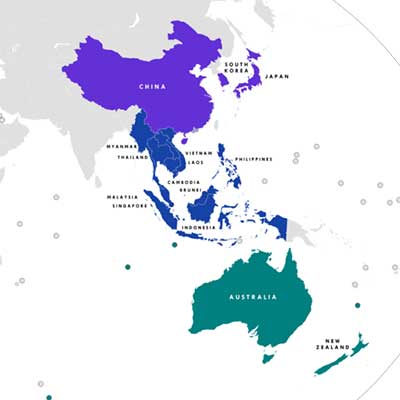
The Regional Comprehensive Economic Partnership (RCEP)
Why in NEWS ?
- RCEP has now been signed and brought into existence without India.
About
- The Regional Comprehensive Economic Partnership (RCEP) was signed into existence
on 15 th November 2020, by 15 countries led by China, Japan, South Korea, Australia,
New Zealand and the 10-state ASEAN grouping, creating one of the world’s largest
trading blocs.
- Noticeable by its absence was India, which after seven years of protracted
negotiations decided last November to exit the grouping
- India had justified its decision as protecting its economy from burgeoning trade
deficits with a majority of the 15 RCEP members and had cited the grouping’s refusal
to accede to its requests on safeguards as a deal breaker.
- Those reasons were on the face of it justifiable at the time and were welcomed by
industry, trade and farmers’ groups.
- However, 12 months down the road, India’s opting out appears far more debatable
in terms of its economic rationale.
- With global trade and the economy foundering on the shoals of the COVID-19
pandemic, especially as new infections in Europe and the U.S. prompt fresh
restrictions there, the pre-eminence of the east Asian and Pacific countries including
China, South Korea, Vietnam, Australia and New Zealand serving as a bulwark in
containing the pandemic and re-energising economic activity can hardly be
understated.
- Add to this the heightened tariff uncertainty generated by the deadlocked Brexit
negotiations between Britain and the E.U., and it becomes evident that India may
have missed a vital opportunity but India has its own grave concerns.
RCEP
- During the 19th ASEAN meeting in November 2011, RCEP was introduced and in
November 2012, RCEP negotiations were launched at the ASEAN Summit in
Cambodia.
- It is a free trade agreement (FTA) between
i. 10 members of The Association of Southeast Asian Nations (ASEAN).
ii. Additional members of ASEAN +3 = China, Japan, South Korea
iii. Members with which ASEAN countries have FTA = Australia, New Zealand
- India was also a member of ASEAN's FTA partner but opted out in November 2019.
- The group is expected to represent at least 30% of the global GDP and will emerge as
the largest free trade agreement in the world.
- It includes more than 3 billion people, has a combined GDP of about $17 trillion, and
accounts for about 40% of world trade.
- Its goal is to Boost economic growth and equitable economic development, advance
economic cooperation and broaden and deepen integration in the region through
the RCEP.
- It aims to cover the trade in goods and services, investment, economic and technical
cooperation, intellectual property and dispute resolution.
Reasons why India opted out from RCEP?
- India’s seems RCEP as an agreement leveraging China.
- India was of the view that its industries won't be able to compete with China as
cheaper Chinese goods will flood Indian markets.
- Also, Indian agriculture was at risk because it would not be able to compete on a
global scale.
- Additionally, between 2014-19, Modi government raised import duties on several
products.
- And India opted out in November 2019.
- China is the major concern for India amongst other RCEP members. This is because
China uses its non-tariff barriers so that it may export more products to different
countries.
- For instance, If India increases import duty on goods from China, it stops direct
export to India and sends it good to India via the countries in South-east Asia. Also,
China doesn't import many goods from India. This raises India's concern over joining
the RCEP.
- However Interestingly, among the ASEAN signatories are several relatively far
smaller economies including Vietnam and the Philippines, which not only continue to
have their share of disputes with Beijing but also suffer significant trade imbalances
with Asia’s largest economy. That these and other larger nations in the grouping
have chosen to bury their geopolitical differences with China in order to prioritise
what they collectively see as a mutually beneficial trading compact that would
benefit their economies over the longer term is the clearest testament to economic
realism trumping nationalist politics.
Opportunities
- The RCEP member nations look India as a potential country which can contribute not
only in terms of its huge market but its participation in regional affairs as a whole.
- If India joins RCEP now, it will be at a prime position and will get a chance to frame
the rules and investment standards of the RCEP.
- Also, India is at an advantageous position in the services sector-- IT, education, etc.
and RCEP will create greater opportunities for the companies of India to access new
markets.
- In a statement made public after the initialising ceremony among the member-
countries on the sidelines of the 37th ASEAN Summit held virtually, the newly
formed organisation has laid down the path for restarting discussion that had failed
to admit India earlier and said “new” developments would be taken into
consideration when India re-applied.
- Given that the RCEP members now account for about 30% of the global GDP and a
third of the world’s population, the signatory states were emphatic that the timing
of the accord presents a unique opportunity to support their economic recovery,
inclusive development and job creation even as it helps strengthen regional supply
chains.
- The summary of the final agreement shows that the pact does cover and attempt to
address issues that India had flagged including rules of origin, trade in services,
movement of persons and, crucially, remedies and safeguards
- Acknowledging India’s economic heft and value as a market, the RCEP members
have not only left the door open should New Delhi reconsider its stance but have
also waived a key 18-month cooling period for interested applicants.
- It would be in India’s interest to dispassionately review its position and embrace
openness rather than protectionism.




