Daily-current-affairs
/
21 Oct 2020
Minimum Support Price (MSP) for Vegetables & Fruits : Daily Current Affairs
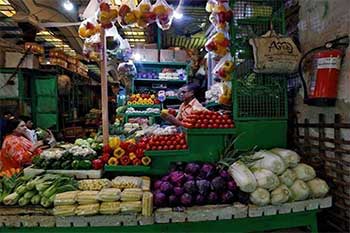
Minimum Support Price (MSP) for Vegetables & Fruits
Why in NEWS ?
- The Kerala government on 21st October 2020, decided to fix a minimum support price (MSP)
for vegetables and fruits as part of its decision to support farmers and boost the agricultural
sector.
About
- The scheme for the 16 crops will come into effect from November 1.
- The state Agriculture Department will implement the scheme with the support of
local self-governing bodies and the Cooperative Department.
- The move will encourage farmers to cultivate the vegetables which have been
included in the scheme and would help increase vegetable production in Kerala.
- MSP will be determined based on the cost of production and productivity. A
government source said that this will ensure price stability and good returns for
farmers as well as help protect farmers from market price fluctuations.
- In the first phase, 1600 –odd primary agricultural credit co-operative societies will
collect the listed products from farmers through the state-run HORTICORP,
Vegetable and Fruit Promotion Council Kerala (VFPCK) and other wholesale
markets.
- Local self-governing bodies will provide the gap in funds for the cooperative
societies, if required. The amount would be credited to the accounts of the farmers
enrolled in the scheme.
- Crops, which will come under MSP include tapioca, banana, pineapple, cucumber,
tomatoes, cabbage, carrots, potatoes, beans, beetroot and garlic. The government
hopes that this will lead to a significant increase in vegetable production in the state.
What is MSP ?
- Minimum Support Price (MSP) is the minimum price set by the government for
certain agricultural products, at which farmers can expect to sell their produce for
the season and at which the products would directly be bought from the farmers if
the open market prices are less than the cost incurred.
- It is a form of government intervention to insure the farmers against a steep decline
in the prices of their goods and to help them prevent losses.
- The government of India sets the MSP twice a year for 24 commodities. This is done
by the government to protect the farmers against a fall in prices in a year of bumper
production. When the market price falls below the declared MSP, the government
would purchase the entire quantity from the farmers at MSP.
- The Cabinet Committee of Economic Affairs announces MSP for various crops at the
beginning of each sowing season based on the recommendations of the Commission
for Agricultural Costs and Prices (CACP).
- The CACP takes into account demand and supply, the cost of production and price
trends in the market among other things when fixing MSPs.
- Factors taken into consideration for fixing MSP include:
- Demand and supply;
- Cost of production;
- Trends in the market price, both domestic and international;
- Inter-crop price parity; Input-output price parity
- Terms of trade between agriculture and non-agriculture;
- A minimum of 50% as the margin over cost of production; and
- Effect on issue prices and implications for subsidy
- . The entire structure of the economy of a particular commodity or group of commodities
- Effect on industrial cost structure
- Parity between prices paid and prices received by the farmers
FAIR AND REMUNERATIVE PRICE (FRP)
- Fair and remunerative price (FRP) is the minimum price at which rate sugarcane is to
be purchased by sugar mills from farmers.
- Price of sugarcane is fixed by the centre/State, while the price of sugar is market
determined.
- The FRP is fixed by Union government on the basis of recommendations of
Commission for Agricultural Costs and Prices (CACP).
- The ‘FRP’ of sugarcane is determined under Sugarcane (Control) Order, 1966.
- Recommended FRP is determined by taking into account various factors like cost of
production, demand-supply situation, domestic & international prices, inter-crop
price parity etc.
- FRP assures margins to farmers, irrespective of whether sugar mills generate a profit
or not.
- It is uniformly applicable all over the country.
- Besides FRP, some states such as Punjab, Haryana, Uttarakhand, UP and TN
announce a State Advised Price, which is generally higher than the FRP.
Price Stabilization Fund (PSF)
- The PSF was set up in 2014-15 under the Department of Agriculture, Cooperation &
Famers Welfare (DAC&FW) to help regulate the price volatility of important agri-
horticultural commodities like onion, potatoes and pulses were also added
subsequently.
- The scheme provides for maintaining a strategic buffer of commodities for
subsequent calibrated release to moderate price volatility and discourage hoarding
and unscrupulous speculation.
- For building such stock, the scheme promotes direct purchase from farmers/farmers’
association at farm gate/Mandi and made available at a more reasonable price to
the consumers.
- Apart from domestic procurement from farmers/wholesale mandis, import may also
be undertaken with support from the Fund.
- Losses incurred, if any, in the operations will be shared between the Centre and the
States.
- PSF provides for advancing interest-free loans to State Governments/ UTs and
Central agencies to support their working capital and other expenses they might
incur on procurement and distribution interventions for such commodities.
- The Fund will be managed by Prize Stabilization Fund Management Committee (PSFMC)
which will approve all proposals from state government and
central agencies and it will be maintained in a Central Corpus Fund account to be
opened by Small Farmers Agri-Business Consortium (SFAC), which will act as Fund
Manager, a society promoted by the Ministry of Agriculture for linking agriculture to
private businesses and investments and technology.
- It is a Central Sector Scheme so the States will have to set up a revolving fund to
which Centre and State will contribute equally (50:50) while the Ratio will be 75:25
in North East states.




